Institutional mechanism(s) and policy directions for effective - - PowerPoint PPT Presentation

institutional mechanism s and policy directions for
SMART_READER_LITE
LIVE PREVIEW

Institutional mechanism(s) and policy directions for effective - - PowerPoint PPT Presentation

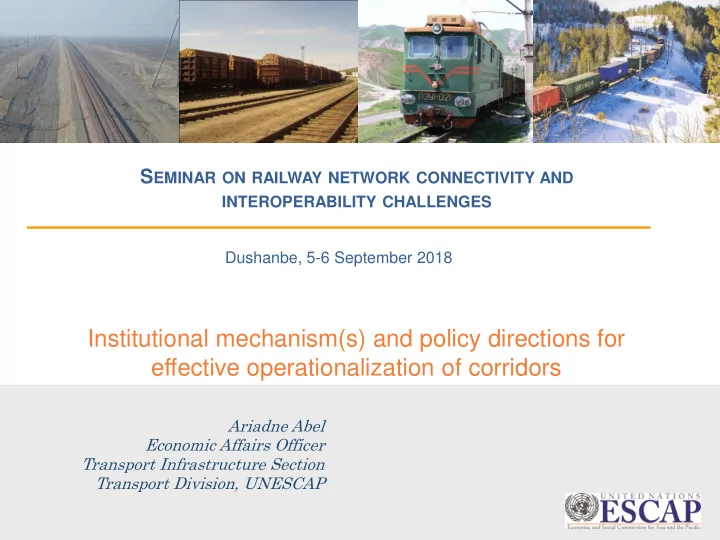
S EMINAR ON RAILWAY NETWORK CONNECTIVITY AND INTEROPERABILITY CHALLENGES Dushanbe, 5-6 September 2018 Institutional mechanism(s) and policy directions for effective operationalization of corridors Ariadne Abel Economic Affairs Officer


slide-1
SLIDE 1

Institutional mechanism(s) and policy directions for effective operationalization of corridors

SEMINAR ON RAILWAY NETWORK CONNECTIVITY AND

INTEROPERABILITY CHALLENGES Dushanbe, 5-6 September 2018 Ariadne Abel Economic Affairs Officer Transport Infrastructure Section Transport Division, UNESCAP

slide-2
SLIDE 2
  • Conceptualized by UNESCAP, the network was initiated in the

1960s, with the objective of providing a continuous 14,080 km rail link between Singapore and Turkey, with possible further connections to Europe;

  • Integration of four corridors studied under the Asian Land Transport

Infrastructure Development (ALTID) project by UNESCAP in 1992;

  • The TAR network now comprises 118,000 km of railway lines

serving 28 member countries;

  • The network was formalized in the Intergovernmental Agreement on

the Trans-Asian Railway Network, which entered into force on 11 June 2009. UNESCAP acts as secretariat for the Agreement. The Trans-Asian Railway Network

slide-3
SLIDE 3

Map of the Trans-Asian Railway Network 11,500 km, or 9.8% of the 118,000-km network, are

  • missing. The total investment required to put in place

these missing cross-border rail links is estimated by ESCAP at US$ 75.5 billion.

slide-4
SLIDE 4
  • It is a Treaty aimed at promoting and developing international rail

transport in Asia and with neighboring regions;

  • Although the Network spans across 28 countries, the Agreement

currently counts 19 State-Parties;

  • The main obligations of the parties to the Agreement are:
  • To adopt the Trans-Asian Railway network as a coordinated plan for

the development of railway lines of international importance, which they intend to undertake within the framework of their national programmes (article 2)

  • To bring the Trans-Asian Railway routes into conformity with a set of

guiding principles related to technical characteristics (article 3). The Intergovernmental Agreement on the Trans-Asian Railway Network

slide-5
SLIDE 5
  • Established under Article 6 of the Agreement to:
  • consider the implementation of the Agreement and to consider any

amendments proposed;

  • Open to all ESCAP member-States with a view to discuss issues

and to exchange information relating to the future development, upgrading and operational efficiency of rail transport in the region.

  • The 5th meeting of the Working Group on the Trans-Asian Railway

took place on 13-14 June 2017 in Busan, Republic of Korea, which recommended, among others, that Parties direct further attention to greater integration of rail operation and maritime shipping through the provision of adequate rail infrastructure in ports. The Working Group on the Trans-Asian Railway

slide-6
SLIDE 6

Parties to the Intergovernmental Agreement on the Trans-Asian Railway Network

slide-7
SLIDE 7

Trans-Asian Railway Routes in Central Asia

slide-8
SLIDE 8

Potential Rail-links

  • China to Tajikistan through Kyrgyzstan;
  • Linkages to the Islamic Republic of Iran either in the form of
  • perationalization of the existing rail networks of Turkmenistan and

Uzbekistan, or completion

  • f

the proposed rail infrastructure in Afghanistan (railway development master plan of the Government of Afghanistan)

slide-9
SLIDE 9

Facilitation of operational rail connectivity ESCAP Regional Cooperation Framework for Facilitation of International Railway Transport

  • Identifies four fundamental issues for facilitation of international

railway transport, indicates target and process 1. Standards for railway infrastructure, facilities and equipment 2. Break of gauge 3. Different legal regimes for railway transport contracts 4. Coordination of regulatory controls and inspections at border- interchange stations

  • Provides eleven areas for cooperation among member countries

to further railway transport in the region such as (i) subregional and bilateral agreements (ii) standardization of cross-border railway operations (iii) use of advance cargo information systems

slide-10
SLIDE 10
  • Optimal use of existing infrastructure – Financial resource requirements

can be minimized if the corridors are selected in such a way that they can build on existing infrastructure

  • Environment friendliness – Possibilities for bulking of cargo, options for

electrification of rail lines and usage of renewable energy etc. are some of the desirable environmental friendly characteristics of efficient economic corridors

  • Impact on competitiveness – potential contributions of selected corridors in

terms of reducing trade costs and thereby enhancing competitiveness of traded sectors/products is crucial

  • Multi-modal transport linkages – The overall efficiency of a corridor also

depends on connectivity across different modes of transport, which would allow the users to take advantage of multimodal transport options.

  • Extended inclusive corridors – The main corridors must have well-

established links with local transport networks

  • Connectivity to major markets beyond the subregion – It is important that

intra-regional connectivity also leads to better integration of the subregional economies with external markets.

Possible criteria for operationalization of rail corridors

slide-11
SLIDE 11
  • Capitalize on the benefits of the uniform ESCAP Framework:
  • Accession to the Intergovernmental Agreement on the Trans-Asian

Railway;

  • Regular participation in the Working Group on the Trans-Asian

Railway;

  • Designation of new routes and operationalization of existing ones

based on the principles and frameworks developed in the ESCAP platform;

  • Systematic approach to corridor development;
  • Development
  • f

multilateral frameworks and agreements

  • n

corridor management. Way forward

slide-12
SLIDE 12

Ban Ki Moon, Secretary-General of the United Nations

Thank you

http://www.unescap.org/our-work/transport Info.: escap-ttd@un.org