
SLIDE 1
INSIGHT into LIVING the CHRISTIAN LIFE from the APOSTLE JOHN #1 - - PowerPoint PPT Presentation
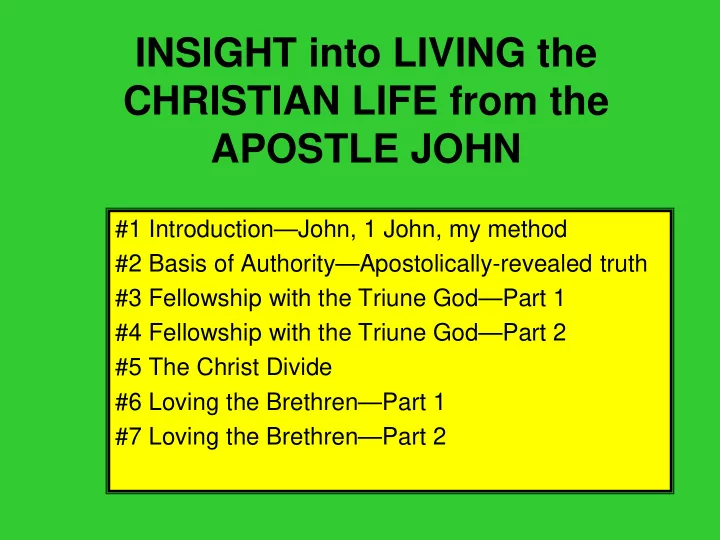
INSIGHT into LIVING the CHRISTIAN LIFE from the APOSTLE JOHN #1 IntroductionJohn, 1 John, my method #2 Basis of AuthorityApostolically-revealed truth #3 Fellowship with the Triune GodPart 1 #4 Fellowship with the Triune GodPart 2
Characteristic Matthew Mark Luke John Repent 16 Believe 34 (~11 per gospel) 98 Kingdom of God 47+ 3 Contrast Present/Future Darkness/Light Jesus’ birth Yes No Jesus’ baptism Yes Yes Jesus at Mt. of Transfiguration Yes No Jesus Olivet Discourse Yes No Eternal Life 9 (future attainment) 16 (present offer) “Ego eimi” I AM 12 (~4 per gospel) all ‘normal speech’ 24 (21 are titular) Style Only Mt 11:25-30 appears like John-type discourse John 3 may be the key: John picked up Jesus’ oral style that he used on critical occasions
“Deliberative orator” structure John’s structure Preface – introduction to the deliberation 1:1-4 Prologue—call to sharing eternal life with God through the apostles 1:5-2:11 Preamble—daily interacting with the Triune God Thesis – central proposal of the speaker 2:12-27 Purpose—to exhort believers to maintain the fellowship of eternal life while in a hostile environment Supporting material – a sequence of headings that group various arguments to support the thesis 2:28-5:17 Arguments—how to attain ultimate confidence and avoid shame before God through sharing eternal life with fellow believers “under fire” Epilogue – a review of the argument and closing motivation for audience 5:18-21 Review—three foundational truths that underlie successful experience of eternal life
“Deliberative orator” structure John’s structure Preface – introduction to the deliberation 1:1-4 Prologue—call to sharing eternal life with God through the apostles 1:5-2:11 Preamble—daily interacting with the Triune God Thesis – central proposal of the speaker 2:12-27 Purpose—to exhort believers to maintain the fellowship of eternal life while in a hostile environment Supporting material – a sequence of headings that group various arguments to support the thesis 2:28-5:17 Arguments—how to attain ultimate confidence and avoid shame before God through sharing eternal life with fellow believers “under fire” Epilogue – a review of the argument and closing motivation for audience 5:18-21 Review—three foundational truths that underlie successful experience of eternal life
arche
aletheia 1:6 something we live out 1:8 what we say fits reality 2:4 what we say fits reality 2:21 comprehended as consistency between word & reality 3:18 real life action 4:6 Opposite to “planes” (planet = wandering) 5:6 Holy Spirit is the ultimate Truth, not just “true” [think here of creation agent]
Correspondence criterion: man’s ideas can correspond with factual reality outside his head because both are part of a unified creation KNOWS partially as a creature Consistency criterion: man’s thoughts can be
God’s plan is
World of Mathematics, ed. James R. Newman, 3:2021
The Mysterious Universe, p. 149.
The “courtroom style” of John
“He who believes in Him is not condemned; but he who does not believe is condemned already, because he has not believed in the name of the only begotten Son of God.” John 3:18 “He who believes in the Son has everlasting life; and he who does not believe the Son shall not see life, but the wrath of God abides on him.” John 3:36
1 John 5:6-8
Deut 17:1-10; 19:15-21 John 8:17-18
“Deliberative orator” structure John’s structure Preface – introduction to the deliberation 1:1-4 Prologue—call to sharing eternal life with God through the apostles 1:5-2:11 Preamble—daily interacting with the Triune God Thesis – central proposal of the speaker 2:12-27 Purpose—to exhort believers to maintain the fellowship of eternal life while in a hostile environment Supporting material – a sequence of headings that group various arguments to support the thesis 2:28-5:17 Arguments—how to attain ultimate confidence and avoid shame before God through sharing eternal life with fellow believers “under fire” Epilogue – a review of the argument and closing motivation for audience 5:18-21 Review—three foundational truths that underlie successful experience of eternal life
1:2 2X eternal life visible to eyes and ears 2:19 doctrine departure of antichrist teachers from apostolic circle publicly visible 2:28 physical appearance of Christ at the Rapture 3:2 physical appearance of believers in present history compared to the coming resurrection appearance 3:5 1st advent of Christ publicly visible necessary to take away sin 3:8 1st advent of Christ publicly visible necessary to destroy Satan’s accomplishments 4:9 love of the Father shown in accomplishments of 1st advent
“manifested” (phaneroo)
F S us
What is it that is shared within the Trinity AND with us?
Our relationship with the Father Text Contrasting element Individual detail 1:5 Light (+) perfection of God 1:6 Darkness (-) talk vs. walk 1:7 Light (+) walk with cleansing for fellowship 1:8 Sin (-) talk vs. real state-of-affairs 1:9 Cleansing from sin (+) candid talk and cleansing 1:10 Sin (-) talk vs. real state-of-affairs 2:1-2 Resolution of Sin before the God of Light (+) Throne room activity
Our relationship with the Son Text Contrasting element Individual detail 2:3 Knowing him by keeping his commandments (+) Jesus’ specific teachings with divine authority (NT) recognized 2:4 Darkness (-) talk vs. walk 2:5a Love of God fully effective in the keeper of the Word (+) maturity attained through real
2:5b-6 Claim of “abiding” (-) talk vs. real state-of-affairs 2:7 Old commandment unchanging apostolic doctrine 2:8 New commandment a change in dispensation
2 4 6 8 10 12 14 16 1:1-1:4 1:5-2:11 2:12-27 2:18-5:17 5:18-21
a believer
false teacher false teacher false teacher spirit of antichrist unchanging apostolic doctrine
“Deliberative orator” structure John’s structure Preface – introduction to the deliberation 1:1-4 Prologue—call to sharing eternal life with God through the apostles 1:5-2:11 Preamble—daily interacting with the Triune God Thesis – central proposal of the speaker 2:12-27 Purpose—to exhort believers to maintain the fellowship of eternal life while in a hostile environment Supporting material – a sequence of headings that group various arguments to support the thesis 2:28-5:17 Arguments—how to attain ultimate confidence and avoid shame before God through sharing eternal life with fellow believers “under fire” Epilogue – a review of the argument and closing motivation for audience 5:18-21 Review—three foundational truths that underlie successful experience of eternal life
“Deliberative orator” structure John’s structure Preface – introduction to the deliberation 1:1-4 Prologue—call to sharing eternal life with God through the apostles 1:5-2:11 Preamble—daily interacting with the Triune God Thesis – central proposal of the speaker 2:12-27 Purpose—to exhort believers to maintain the fellowship of eternal life while in a hostile environment Supporting material – a sequence of headings that group various arguments to support the thesis 2:28-5:17 Arguments—how to attain ultimate confidence and avoid shame before God through sharing eternal life with fellow believers “under fire” Epilogue – a review of the argument and closing motivation for audience 5:18-21 Review—three foundational truths that underlie successful experience of eternal life
Correspondence criterion: man’s ideas can correspond with factual reality outside his head because both are part of a unified creation KNOWS partially as a creature Consistency criterion: man’s thoughts can be
God’s plan is
Restoration to fellowship Idolatry & eventual serious discipline Conviction of sin through conscience, the Word, other believers
Our relationship with the Father Text Contrasting element Individual detail 1:5 Light (+) perfection of God 1:6 Darkness (-) talk vs. walk 1:7 Light (+) walk with cleansing for fellowship 1:8 Sin (-) talk vs. real state-of-affairs 1:9 Cleansing from sin (+) candid talk and cleansing 1:10 Sin (-) talk vs. real state-of-affairs 2:1-2 Resolution of Sin before the God of Light (+) Throne room activity
standard for the whole relationship (the point-of-contact with God)
absolute holiness of the Father and originates in the Father- Son relationship; must walk “as He is in the light”
eternal life are located only in the Son—not in us, in nature,
involving cosmic intrigue (angelic conflict) so we must follow revealed protocols and rely upon our Advocates not upon our imagination, feelings, social consensus
affect what goes on in heaven!!
Our relationship with the Son Text Contrasting element Individual detail 2:3 Knowing him by keeping his commandments (+) Jesus’ specific teachings with divine authority (NT) recognized 2:4 Darkness (-) talk vs. walk 2:5a Love of God fully effective in the keeper of the Word (+) maturity attained through real
2:5b-6 Claim of “abiding” (-) talk vs. real state-of-affairs 2:7 Old commandment unchanging apostolic doctrine 2:8 New commandment a change in dispensation
INCLUSIO know = in = abide
“Deliberative orator” structure John’s structure Preface – introduction to the deliberation 1:1-4 Prologue—call to sharing eternal life with God through the apostles 1:5-2:11 Preamble—daily interacting with the Triune God Thesis – central proposal of the speaker 2:12-27 Purpose—to exhort believers to maintain the fellowship of eternal life while in a hostile environment Supporting material – a sequence of headings that group various arguments to support the thesis 2:28-5:17 Arguments—how to attain ultimate confidence and avoid shame before God through sharing eternal life with fellow believers “under fire” Epilogue – a review of the argument and closing motivation for audience 5:18-21 Review—three foundational truths that underlie successful experience of eternal life
Emphasis on Inner spiritual dynamics behind the
standard for the whole relationship (the point-of-contact with God)
eternal life are located only in the Son—not in us, in nature,
teachings through the apostles is our point of contact
(1) sense the holy integrity of the Father through the witness of
(2) submit to the teachings of Jesus as those of the Father, then the Father AND the Son respond by deepening their relationship with us
Classical dispensational view: CHURCH AGE Israel (Law) Tribulation & Millennium
Final, worldwide decision: “what is your response to Jesus Christ?”