SLIDE 1
1
Insertion Sort
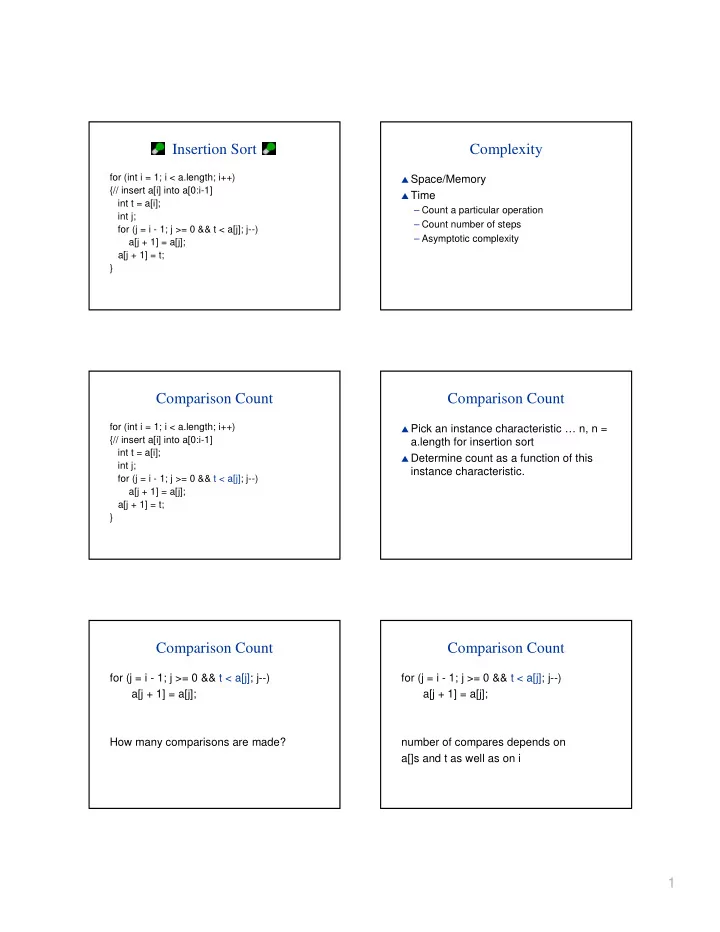
for (int i = 1; i < a.length; i++) {// insert a[i] into a[0:i-1] int t = a[i]; int j; for (j = i - 1; j >= 0 && t < a[j]; j--) a[j + 1] = a[j]; a[j + 1] = t; }
Complexity
▲ Space/Memory ▲ Time
– Count a particular operation – Count number of steps – Asymptotic complexity
Comparison Count
for (int i = 1; i < a.length; i++) {// insert a[i] into a[0:i-1] int t = a[i]; int j; for (j = i - 1; j >= 0 && t < a[j]; j--) a[j + 1] = a[j]; a[j + 1] = t; }
Comparison Count
▲ Pick an instance characteristic … n, n =
a.length for insertion sort
▲ Determine count as a function of this
instance characteristic.
Comparison Count
for (j = i - 1; j >= 0 && t < a[j]; j--) a[j + 1] = a[j]; How many comparisons are made?
Comparison Count
for (j = i - 1; j >= 0 && t < a[j]; j--) a[j + 1] = a[j]; number of compares depends on a[]s and t as well as on i
SLIDE 2
2
Comparison Count
Worst-case count = maximum count Best-case count = minimum count Average count
Worst-Case Comparison Count
for (j = i - 1; j >= 0 && t < a[j]; j--) a[j + 1] = a[j]; a = [1, 2, 3, 4] and t = 0 => 4 compares a = [1,2,3,…,i] and t = 0 => i compares
Worst-Case Comparison Count
for (int i = 1; i < n; i++) for (j = i - 1; j >= 0 && t < a[j]; j--) a[j + 1] = a[j]; total compares = 1 + 2 + 3 + … + (n-1) = (n-1)n/2
Step Count
A step is an amount of computing that does not depend on the instance characteristic n 10 adds, 100 subtracts, 1000 multiplies can all be counted as a single step n adds cannot be counted as 1 step
Step Count
for (int i = 1; i < a.length; i++) {// insert a[i] into a[0:i-1] int t = a[i]; int j; for (j = i - 1; j >= 0 && t < a[j]; j--) a[j + 1] = a[j]; a[j + 1] = t; } for (int i = 1; i < a.length; i++) 1 {// insert a[i] into a[0:i-1] int t = a[i]; 1 int j; for (j = i - 1; j >= 0 && t < a[j]; j--) 1 a[j + 1] = a[j]; 1 a[j + 1] = t; 1 } s/e
Step Count
s/e isn’t always 0 or 1 x = MyMath.sum(a, n); where n is the instance characteristic has a s/e count of n
SLIDE 3 3
Step Count
for (int i = 1; i < a.length; i++) {// insert a[i] into a[0:i-1] int t = a[i]; int j; for (j = i - 1; j >= 0 && t < a[j]; j--) a[j + 1] = a[j]; a[j + 1] = t; } for (int i = 1; i < a.length; i++) 1 {// insert a[i] into a[0:i-1] int t = a[i]; 1 int j; for (j = i - 1; j >= 0 && t < a[j]; j--) 1 a[j + 1] = a[j]; 1 a[j + 1] = t; 1 } s/e steps
i i+ 1
Step Count
for (int i = 1; i < a.length; i++) { 2i + 3} step count for for (int i = 1; i < a.length; i++) is n step count for body of for loop is 2(1+2+3+…+n-1) + 3(n-1) = (n-1)n + 3(n-1) = (n-1)(n+3)
Asymptotic Complexity of Insertion Sort
▲ O(n2) ▲ What does this mean?
Complexity of Insertion Sort
▲ Time or number of operations does not
exceed c.n2 on any input of size n (n suitably large).
▲ Actually, the worst-case time is
Theta(n2) and the best-case is Theta(n)
▲ So, the worst-case time is expected to
quadruple each time n is doubled
Complexity of Insertion Sort
▲ Is O(n2) too much time? ▲ Is the algorithm practical?
Practical Complexities
109 instructions/second n n nlogn n2 n3
1000 1mic 10mic 1milli 1sec 10000 10mic 130mic 100milli 17min 106 1milli 20milli 17min 32years
SLIDE 4 4
Impractical Complexities
109 instructions/second n n4 n10 2n
1000 17min 3.2 x 10¹³ years 3.2 x 10283 years 10000 116 days ??? ??? 106 3 x 10⁷ years ?????? ??????
Faster Computer Vs Better Algorithm
Algorithmic improvement more useful than hardware improvement. E.g. 2n to n3