Insertion Sort Insertion Sort next card? What assumptions do we - - PowerPoint PPT Presentation

insertion sort insertion sort
SMART_READER_LITE
LIVE PREVIEW

Insertion Sort Insertion Sort next card? What assumptions do we - - PowerPoint PPT Presentation

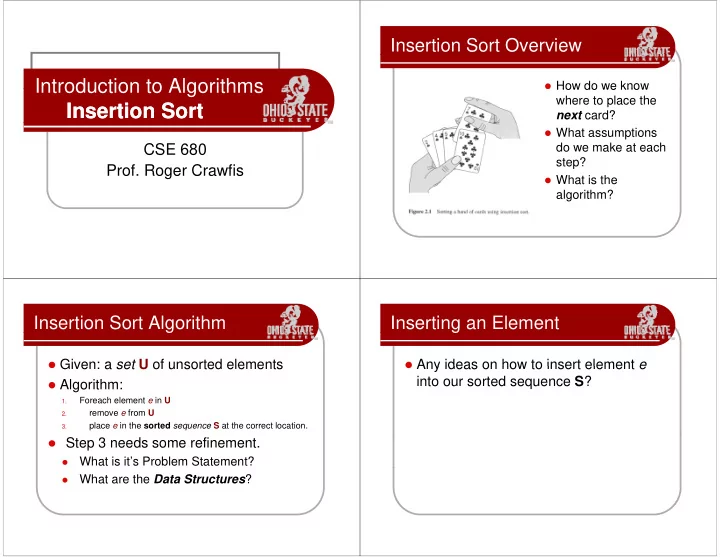
Insertion Sort Overview Introduction to Algorithms Introduction to Algorithms How do we know How do we know where to place the Insertion Sort Insertion Sort next card? What assumptions do we make at each CSE 680 step? Prof.


slide-1
SLIDE 1

Introduction to Algorithms Introduction to Algorithms

Insertion Sort Insertion Sort

CSE 680

  • Prof. Roger Crawfis

Insertion Sort Overview

How do we know How do we know

where to place the next card?

What assumptions

do we make at each step?

What is the

l i h ? algorithm?

Insertion Sort Algorithm g

Given: a set U of unsorted elements Given: a set U of unsorted elements Algorithm:

1

Foreach element e in U

1.

Foreach element e in U

2.

remove e from U

3.

place e in the sorted sequence S at the correct location.

Step 3 needs some refinement.

  • What is it’s Problem Statement?
  • What are the Data Structures?

Inserting an Element g

Any ideas on how to insert element e Any ideas on how to insert element e

into our sorted sequence S?

slide-2
SLIDE 2

Insertion Sort Algorithm g

Your book’s pseudo-code:

Why go

Your book s pseudo code:

Why go backwards?

What are the differences?

Insertion Sort Example p

The following slides are from David The following slides are from David

Luebke when he taught the course at the University of Virginia: y g

http://www.cs.virginia.edu/~luebke/cs332/

Thanks David! Unfortunately, he flipped the indices i

and j from the book.

An Example: Insertion Sort p

InsertionSort(A, n) { for i = 2 to n { key = A[i] j = i - 1; j ; while (j > 0) and (A[j] > key) { A[j+1] = A[j] j = j 1 j = j - 1 } A[j+1] = key } }

David Luebke 7 9/29/2009

An Example: Insertion Sort p

30 10 40 20

i = ∅ j = ∅ key = ∅ A[j] = ∅ A[j+1] = ∅

InsertionSort(A, n) { f i 2 t { 1 2 3 4

A[j] = ∅ A[j+1] = ∅

for i = 2 to n { key = A[i] j = i - 1; while (j > 0) and (A[j] > key) { while (j > 0) and (A[j] > key) { A[j+1] = A[j] j = j - 1 } A[j+1] = key } }

David Luebke 8 9/29/2009

}

slide-3
SLIDE 3

An Example: Insertion Sort p

30 10 40 20

i = 2 j = 1 key = 10 A[j] = 30 A[j+1] = 10

InsertionSort(A, n) { f i 2 t { 1 2 3 4

A[j] = 30 A[j+1] = 10

for i = 2 to n { key = A[i] j = i - 1; while (j > 0) and (A[j] > key) { while (j > 0) and (A[j] > key) { A[j+1] = A[j] j = j - 1 } A[j+1] = key } }

David Luebke 9 9/29/2009

}

An Example: Insertion Sort p

30 30 40 20

i = 2 j = 1 key = 10 A[j] = 30 A[j+1] = 30

InsertionSort(A, n) { f i 2 t { 1 2 3 4

A[j] = 30 A[j+1] = 30

for i = 2 to n { key = A[i] j = i - 1; while (j > 0) and (A[j] > key) { while (j > 0) and (A[j] > key) { A[j+1] = A[j] j = j - 1 } A[j+1] = key } }

David Luebke 10 9/29/2009

}

An Example: Insertion Sort p

30 30 40 20

i = 2 j = 1 key = 10 A[j] = 30 A[j+1] = 30

InsertionSort(A, n) { f i 2 t { 1 2 3 4

A[j] = 30 A[j+1] = 30

for i = 2 to n { key = A[i] j = i - 1; while (j > 0) and (A[j] > key) { while (j > 0) and (A[j] > key) { A[j+1] = A[j] j = j - 1 } A[j+1] = key } }

David Luebke 11 9/29/2009

}

An Example: Insertion Sort p

30 30 40 20

i = 2 j = 0 key = 10 A[j] = ∅ A[j+1] = 30

InsertionSort(A, n) { f i 2 t { 1 2 3 4

A[j] = ∅ A[j+1] = 30

for i = 2 to n { key = A[i] j = i - 1; while (j > 0) and (A[j] > key) { while (j > 0) and (A[j] > key) { A[j+1] = A[j] j = j - 1 } A[j+1] = key } }

David Luebke 12 9/29/2009

}

slide-4
SLIDE 4

An Example: Insertion Sort p

30 30 40 20

i = 2 j = 0 key = 10 A[j] = ∅ A[j+1] = 30

InsertionSort(A, n) { f i 2 t { 1 2 3 4

A[j] = ∅ A[j+1] = 30

for i = 2 to n { key = A[i] j = i - 1; while (j > 0) and (A[j] > key) { while (j > 0) and (A[j] > key) { A[j+1] = A[j] j = j - 1 } A[j+1] = key } }

David Luebke 13 9/29/2009

}

An Example: Insertion Sort p

10 30 40 20

i = 2 j = 0 key = 10 A[j] = ∅ A[j+1] = 10

InsertionSort(A, n) { f i 2 t { 1 2 3 4

A[j] = ∅ A[j+1] = 10

for i = 2 to n { key = A[i] j = i - 1; while (j > 0) and (A[j] > key) { while (j > 0) and (A[j] > key) { A[j+1] = A[j] j = j - 1 } A[j+1] = key } }

David Luebke 14 9/29/2009

}

An Example: Insertion Sort p

10 30 40 20

i = 3 j = 0 key = 10 A[j] = ∅ A[j+1] = 10

InsertionSort(A, n) { f i 2 t { 1 2 3 4

A[j] = ∅ A[j+1] = 10

for i = 2 to n { key = A[i] j = i - 1; while (j > 0) and (A[j] > key) { while (j > 0) and (A[j] > key) { A[j+1] = A[j] j = j - 1 } A[j+1] = key } }

David Luebke 15 9/29/2009

}

An Example: Insertion Sort p

10 30 40 20

i = 3 j = 0 key = 40 A[j] = ∅ A[j+1] = 10

InsertionSort(A, n) { f i 2 t { 1 2 3 4

A[j] = ∅ A[j+1] = 10

for i = 2 to n { key = A[i] j = i - 1; while (j > 0) and (A[j] > key) { while (j > 0) and (A[j] > key) { A[j+1] = A[j] j = j - 1 } A[j+1] = key } }

David Luebke 16 9/29/2009

}

slide-5
SLIDE 5

An Example: Insertion Sort p

10 30 40 20

i = 3 j = 0 key = 40 A[j] = ∅ A[j+1] = 10

InsertionSort(A, n) { f i 2 t { 1 2 3 4

A[j] = ∅ A[j+1] = 10

for i = 2 to n { key = A[i] j = i - 1; while (j > 0) and (A[j] > key) { while (j > 0) and (A[j] > key) { A[j+1] = A[j] j = j - 1 } A[j+1] = key } }

David Luebke 17 9/29/2009

}

An Example: Insertion Sort p

10 30 40 20

i = 3 j = 2 key = 40 A[j] = 30 A[j+1] = 40

InsertionSort(A, n) { f i 2 t { 1 2 3 4

A[j] = 30 A[j+1] = 40

for i = 2 to n { key = A[i] j = i - 1; while (j > 0) and (A[j] > key) { while (j > 0) and (A[j] > key) { A[j+1] = A[j] j = j - 1 } A[j+1] = key } }

David Luebke 18 9/29/2009

}

An Example: Insertion Sort p

10 30 40 20

i = 3 j = 2 key = 40 A[j] = 30 A[j+1] = 40

InsertionSort(A, n) { f i 2 t { 1 2 3 4

A[j] = 30 A[j+1] = 40

for i = 2 to n { key = A[i] j = i - 1; while (j > 0) and (A[j] > key) { while (j > 0) and (A[j] > key) { A[j+1] = A[j] j = j - 1 } A[j+1] = key } }

David Luebke 19 9/29/2009

}

An Example: Insertion Sort p

10 30 40 20

i = 3 j = 2 key = 40 A[j] = 30 A[j+1] = 40

InsertionSort(A, n) { f i 2 t { 1 2 3 4

A[j] = 30 A[j+1] = 40

for i = 2 to n { key = A[i] j = i - 1; while (j > 0) and (A[j] > key) { while (j > 0) and (A[j] > key) { A[j+1] = A[j] j = j - 1 } A[j+1] = key } }

David Luebke 20 9/29/2009

}

slide-6
SLIDE 6

An Example: Insertion Sort p

10 30 40 20

i = 4 j = 2 key = 40 A[j] = 30 A[j+1] = 40

InsertionSort(A, n) { f i 2 t { 1 2 3 4

A[j] = 30 A[j+1] = 40

for i = 2 to n { key = A[i] j = i - 1; while (j > 0) and (A[j] > key) { while (j > 0) and (A[j] > key) { A[j+1] = A[j] j = j - 1 } A[j+1] = key } }

David Luebke 21 9/29/2009

}

An Example: Insertion Sort p

10 30 40 20

i = 4 j = 2 key = 20 A[j] = 30 A[j+1] = 40

InsertionSort(A, n) { f i 2 t { 1 2 3 4

A[j] = 30 A[j+1] = 40

for i = 2 to n { key = A[i] j = i - 1; while (j > 0) and (A[j] > key) { while (j > 0) and (A[j] > key) { A[j+1] = A[j] j = j - 1 } A[j+1] = key } }

David Luebke 22 9/29/2009

}

An Example: Insertion Sort p

10 30 40 20

i = 4 j = 2 key = 20 A[j] = 30 A[j+1] = 40

InsertionSort(A, n) { f i 2 t { 1 2 3 4

A[j] = 30 A[j+1] = 40

for i = 2 to n { key = A[i] j = i - 1; while (j > 0) and (A[j] > key) { while (j > 0) and (A[j] > key) { A[j+1] = A[j] j = j - 1 } A[j+1] = key } }

David Luebke 23 9/29/2009

}

An Example: Insertion Sort p

10 30 40 20

i = 4 j = 3 key = 20 A[j] = 40 A[j+1] = 20

InsertionSort(A, n) { f i 2 t { 1 2 3 4

A[j] = 40 A[j+1] = 20

for i = 2 to n { key = A[i] j = i - 1; while (j > 0) and (A[j] > key) { while (j > 0) and (A[j] > key) { A[j+1] = A[j] j = j - 1 } A[j+1] = key } }

David Luebke 24 9/29/2009

}

slide-7
SLIDE 7

An Example: Insertion Sort p

10 30 40 20

i = 4 j = 3 key = 20 A[j] = 40 A[j+1] = 20

InsertionSort(A, n) { f i 2 t { 1 2 3 4

A[j] = 40 A[j+1] = 20

for i = 2 to n { key = A[i] j = i - 1; while (j > 0) and (A[j] > key) { while (j > 0) and (A[j] > key) { A[j+1] = A[j] j = j - 1 } A[j+1] = key } }

David Luebke 25 9/29/2009

}

An Example: Insertion Sort p

10 30 40 40

i = 4 j = 3 key = 20 A[j] = 40 A[j+1] = 40

InsertionSort(A, n) { f i 2 t { 1 2 3 4

A[j] = 40 A[j+1] = 40

for i = 2 to n { key = A[i] j = i - 1; while (j > 0) and (A[j] > key) { while (j > 0) and (A[j] > key) { A[j+1] = A[j] j = j - 1 } A[j+1] = key } }

David Luebke 26 9/29/2009

}

An Example: Insertion Sort p

10 30 40 40

i = 4 j = 3 key = 20 A[j] = 40 A[j+1] = 40

InsertionSort(A, n) { f i 2 t { 1 2 3 4

A[j] = 40 A[j+1] = 40

for i = 2 to n { key = A[i] j = i - 1; while (j > 0) and (A[j] > key) { while (j > 0) and (A[j] > key) { A[j+1] = A[j] j = j - 1 } A[j+1] = key } }

David Luebke 27 9/29/2009

}

An Example: Insertion Sort p

10 30 40 40

i = 4 j = 3 key = 20 A[j] = 40 A[j+1] = 40

InsertionSort(A, n) { f i 2 t { 1 2 3 4

A[j] = 40 A[j+1] = 40

for i = 2 to n { key = A[i] j = i - 1; while (j > 0) and (A[j] > key) { while (j > 0) and (A[j] > key) { A[j+1] = A[j] j = j - 1 } A[j+1] = key } }

David Luebke 28 9/29/2009

}

slide-8
SLIDE 8

An Example: Insertion Sort p

10 30 40 40

i = 4 j = 2 key = 20 A[j] = 30 A[j+1] = 40

InsertionSort(A, n) { f i 2 t { 1 2 3 4

A[j] = 30 A[j+1] = 40

for i = 2 to n { key = A[i] j = i - 1; while (j > 0) and (A[j] > key) { while (j > 0) and (A[j] > key) { A[j+1] = A[j] j = j - 1 } A[j+1] = key } }

David Luebke 29 9/29/2009

}

An Example: Insertion Sort p

10 30 40 40

i = 4 j = 2 key = 20 A[j] = 30 A[j+1] = 40

InsertionSort(A, n) { f i 2 t { 1 2 3 4

A[j] = 30 A[j+1] = 40

for i = 2 to n { key = A[i] j = i - 1; while (j > 0) and (A[j] > key) { while (j > 0) and (A[j] > key) { A[j+1] = A[j] j = j - 1 } A[j+1] = key } }

David Luebke 30 9/29/2009

}

An Example: Insertion Sort p

10 30 30 40

i = 4 j = 2 key = 20 A[j] = 30 A[j+1] = 30

InsertionSort(A, n) { f i 2 t { 1 2 3 4

A[j] = 30 A[j+1] = 30

for i = 2 to n { key = A[i] j = i - 1; while (j > 0) and (A[j] > key) { while (j > 0) and (A[j] > key) { A[j+1] = A[j] j = j - 1 } A[j+1] = key } }

David Luebke 31 9/29/2009

}

An Example: Insertion Sort p

10 30 30 40

i = 4 j = 2 key = 20 A[j] = 30 A[j+1] = 30

InsertionSort(A, n) { f i 2 t { 1 2 3 4

A[j] = 30 A[j+1] = 30

for i = 2 to n { key = A[i] j = i - 1; while (j > 0) and (A[j] > key) { while (j > 0) and (A[j] > key) { A[j+1] = A[j] j = j - 1 } A[j+1] = key } }

David Luebke 32 9/29/2009

}

slide-9
SLIDE 9

An Example: Insertion Sort p

10 30 30 40

i = 4 j = 1 key = 20 A[j] = 10 A[j+1] = 30

InsertionSort(A, n) { f i 2 t { 1 2 3 4

A[j] = 10 A[j+1] = 30

for i = 2 to n { key = A[i] j = i - 1; while (j > 0) and (A[j] > key) { while (j > 0) and (A[j] > key) { A[j+1] = A[j] j = j - 1 } A[j+1] = key } }

David Luebke 33 9/29/2009

}

An Example: Insertion Sort p

10 30 30 40

i = 4 j = 1 key = 20 A[j] = 10 A[j+1] = 30

InsertionSort(A, n) { f i 2 t { 1 2 3 4

A[j] = 10 A[j+1] = 30

for i = 2 to n { key = A[i] j = i - 1; while (j > 0) and (A[j] > key) { while (j > 0) and (A[j] > key) { A[j+1] = A[j] j = j - 1 } A[j+1] = key } }

David Luebke 34 9/29/2009

}

An Example: Insertion Sort p

10 20 30 40

i = 4 j = 1 key = 20 A[j] = 10 A[j+1] = 20

InsertionSort(A, n) { f i 2 t { 1 2 3 4

A[j] = 10 A[j+1] = 20

for i = 2 to n { key = A[i] j = i - 1; while (j > 0) and (A[j] > key) { while (j > 0) and (A[j] > key) { A[j+1] = A[j] j = j - 1 } A[j+1] = key } }

David Luebke 35 9/29/2009

}

An Example: Insertion Sort p

10 20 30 40

i = 4 j = 1 key = 20 A[j] = 10 A[j+1] = 20

InsertionSort(A, n) { f i 2 t { 1 2 3 4

A[j] = 10 A[j+1] = 20

for i = 2 to n { key = A[i] j = i - 1; while (j > 0) and (A[j] > key) { while (j > 0) and (A[j] > key) { A[j+1] = A[j] j = j - 1 } A[j+1] = key } }

Done!

David Luebke 36 9/29/2009

}

Done!

slide-10
SLIDE 10

Memory Analysis y y

The algorithm is said to be in-place if it The algorithm is said to be in-place if it

uses only a constant amount of memory in accomplishing its solution in accomplishing its solution.

Clearly, the book’s implementation is

better than mine better than mine.

Clearly, the book’s algorithm is better

th i than mine.

That is, do we consider my implementation to be a different algorithm or the same? different algorithm or the same?

Correctness

We can use a property known as loop-invariance to

p p y p reason about the correctness of the algorithm.

For Insertion-Sort, we can say that:

The subarray A[1..j-1] elements are in sorted order A[1..j-1] is the set of numbers from the original A[1..j-1]

Insertion Sort Example p Loop Invariant p

Initialization Initialization

True at the beginning of the loop.

Termination Termination

The loop terminates. True, when the loop exists. True, when the loop exists.

Maintenance

True at the end of each iteration of the loop True at the end of each iteration of the loop. This allows us to prove the invariant

similarly to proof-by-induction. y p y

slide-11
SLIDE 11

Insertion Sort

InsertionSort(A, n) { What is the precondition f thi l ? for i = 2 to n { key = A[i] j = i - 1; for this loop? j ; while (j > 0) and (A[j] > key) { A[j+1] = A[j] j = j 1 j = j - 1 } A[j+1] = key } }

David Luebke 41 9/29/2009

Bubble-Sort

Can you come up with loop invariants? Can you come up with loop invariants?

Aka, can you prove it is correct? How expensive is it? How expensive is it?

When is it most expensive? When is it least expensive? When is it least expensive?

Selection Sort

What about selection sort? What about selection sort?

void selectionSort(int[] a) { for (int i = 0; i < a.length - 1; i++) { int min = i; int min i; for (int j = i + 1; j < a.length; j++) { if (a[j] < a[min]) { min = j; } } if (i != min) { int swap = a[i]; p [ ]; a[i] = a[min]; a[min] = swap; } } }