Innovative ways of dealing with the sex-differentiated challenges - - PowerPoint PPT Presentation

innovative ways of dealing with the sex differentiated
SMART_READER_LITE
LIVE PREVIEW

Innovative ways of dealing with the sex-differentiated challenges - - PowerPoint PPT Presentation

Innovative ways of dealing with the sex-differentiated challenges associated with urban mobility in Indonesian Cities The cases of Semarang City, Bandung City and Bogor City 1 Selected Issues on Urban Mobility: 1. Safe walking environments


slide-1
SLIDE 1

1

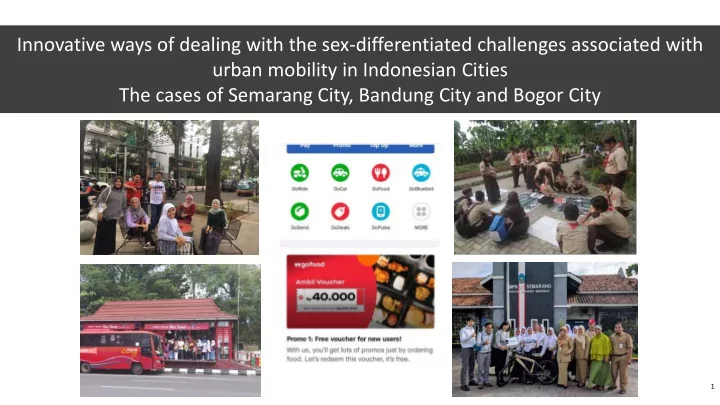
Innovative ways of dealing with the sex-differentiated challenges associated with urban mobility in Indonesian Cities The cases of Semarang City, Bandung City and Bogor City

slide-2
SLIDE 2

Selected Issues on Urban Mobility:

  • 1. Safe walking environments (SDG16.1.4)
  • 2. Emerging and Disruptive Technology based on ICT to improve access to

transport and expanded transport (SDG 11.2.1)

  • 3. Intervention program for behavioral change of young generation (SDG 4.7)
  • 4. Online Shopping and Its impact on waste management (SDG 12.5)
slide-3
SLIDE 3
  • 1. Safe walking environment (non-motorized)

Safety and Security (SDG 16.1.4) as the highest rank among six potentially influential factors on decisions to walk

Case studies in Bandung and Bogor City, Indonesia Hierarchy of walking needs within a Social-Ecological Framework (Alfonzo, 2005)

slide-4
SLIDE 4

Local Initiatives on Pedestrian Improvement Program in Indonesian Cities – The case of Bandung and Bogor

“Panca Trotoar” program in Bandung (i) Bench for resting; (ii) Stone ball to prevent traffic on sidewalk; (iii) Flower pot for decoration; (iv) Garbage bin for cleanliness; (v) Public lighting for security “Dialogue between spaces” which combine three major components: 1) Green Building/Urban Heritage (Summer Palace, National heritage buildings, etc); 2) Urban Green Space (Botanical Garden, Parks and others); and 3) Green Transportation.

slide-5
SLIDE 5

Monitoring the Impacts

  • 1. Transformative actions at city level influence on Citizen’s Lifestyles
  • 2. The modal shift to non-motorized transport reduce GHG emissions and Air Pollution
slide-6
SLIDE 6
  • 2. Access to Transport & Expanded Public Transport

(SDG 11.2.1)

  • Women has less access to private vehicles (motorcycle or car) compare to

household head in Bogor City.

  • Public transport usually is not sufficient in developing cities. Then, the

real contribution of informal transit become significant and it support much-needed mobility.

  • Our study in Jakarta and Bandung (2012) found that there may exist the

fare discrimination regime received by certain group of passengers of Informal Transit System.

  • ICT helps to remove the barrier and improve convenience and comfort to

use transit system, however some issue still remain.

slide-7
SLIDE 7

2.a Local policies on gender aspects in public transport domain

  • Priority or Dedicated seats for certain group (include women)
  • Increasing number of women staffs (40%)
slide-8
SLIDE 8

2.b Use the ICT for non-cash transaction and improve operation and management

slide-9
SLIDE 9
  • 3. Local Intervention Program:

Awareness raising on road safety and encouraging to use public bus for school trip in Semarang City (education for sustainable development and sustainable lifestyles)

a. Most of accident (70%) involve Motorcycle and 29% of young generation below 15 years b. The intensive use of motorcycle for young generation because of many parents allow children (10-14) to ride motorcycle by themselves c. Baseline survey at 3 pilots junior high schools found female students tend to avoid public bus for school trip due to safety and security issues and not allowed by parents

A program or behavioral interventions for young students (12-14) representing a transition phase between childhood and adulthood is more effective to encourage modal shift from private vehicle as well as discouraging the use of motorbike

slide-10
SLIDE 10
  • 4. Online Shopping Behavior and Its Impact on Residential Waste

A case study of online shopping for foods and groceries in Bandung City, Indonesia

  • The new alternative way of online shopping provides

additional options for households to make purchases for daily consumption.

  • The online shopping system removes the barriers especially
  • n travel time availability, accessibility and also removes the

traffic gridlock of traditional shoppers

  • This new lifestyle is not popular for the baby boomer

generation but it is very popular for millennials and very helpful for married people

  • convenience is central to online shopping.
slide-11
SLIDE 11

Several questions are generated by the new services as follows:

  • Has the new convenient way of purchasing increased household consumption?
  • Has the new convenient way of purchasing led to increase the distance required to

purchase some foods, goods and other groceries?

  • Has the new behavior increased the volume of waste and also the types of waste generated

by households?

slide-12
SLIDE 12

Empirical Case Study in Bandung City:

  • The online shopping is not currently leading to an increase in consumption in

household level & Elder people tend to shop less online than younger generations

  • However, we found a clear correlation on the distance to buy food and groceries.

Certainly it may increase the Vehicle Kilometer Travelled (VKT or VMT) at the city level and also GHG Emissions.

  • The online shopping also increase the volume and type of waste generated. This

lifestyle changes may, in turn, redistribute waste management burden from commercial to residential areas at the city level.

slide-13
SLIDE 13

Conclusion

  • Urban city services and urban lifestyles are changing at a fast pace
  • The roles of information and communication technologies become important.
  • However, people decision and mindset are the key and sometimes interventions

program for individual and household level may necessary

  • The new lifestyle may create new negative externality to the environments at

household level and city level

  • Important of monitoring at household level and city level is important and

quantification of the impact

  • These experiments are useful for other cities and for scale-up to other places in

region.

slide-14
SLIDE 14

Source: Meng Kimlong

Thankyou very much for your attention! Please visit: www.iges.or.jp