Innovative Process Monitoring System for Effective Implementation of - - PowerPoint PPT Presentation

innovative process monitoring system for effective
SMART_READER_LITE
LIVE PREVIEW

Innovative Process Monitoring System for Effective Implementation of - - PowerPoint PPT Presentation

Innovative Process Monitoring System for Effective Implementation of Nutrition Programmes i -Monitor Archana Sarkar Advisor- Research, Monitoring & Evaluation Food & Nutrition Security, Enhanced Resilience (FaNS-India) Specific


slide-1
SLIDE 1

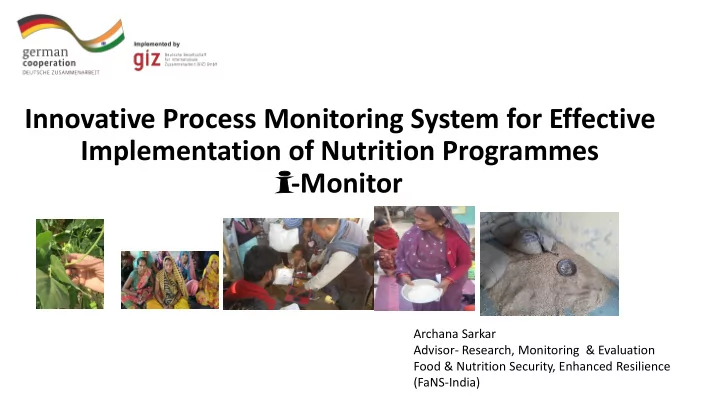
Innovative Process Monitoring System for Effective Implementation of Nutrition Programmes i-Monitor

Archana Sarkar Advisor- Research, Monitoring & Evaluation Food & Nutrition Security, Enhanced Resilience (FaNS-India)
slide-2
SLIDE 2

Specific Objectives of the SOFTWARE….

  • Data base for tracking processes, delivery mechanism and coverage of

nutrition interventions

  • MIS for simple, easy and accurate monitoring of deliverers of the

intervention

  • Knowledge management tool for analysis and cross country sharing of

information on nutrition programmes and surveillance

slide-3
SLIDE 3

Projects included:

  • Food and nutrition security and enhanced resilience (FaNS)
  • Improvement of food security for mothers and infants in

rural areas in Tajikistan (IFS Tajik)

  • Affordable nutritious foods for women (ANF4W)
slide-4
SLIDE 4

Advantages of a Software Based Monitoring Approach

  • Improved data sharing
  • Improved data security
  • Better data integration
  • Minimized data inconsistency
  • Improved data access
  • Improved decision making
  • Increased end-user productivity
slide-5
SLIDE 5

Project implementation team Software User Interface

Database

Project-1 Project-2 Project-3

Progress Indicators 1.Reports 2.Charts 3.Tables

Input Output Data Processing

Schematic Representation of the Monitoring Software

slide-6
SLIDE 6

Features of the Proposed Software

Menu Driven user Friendly Interface with Access Control

slide-7
SLIDE 7

Features of the Proposed Software

User Friendly Data Entry Screens with in-built data quality and consistency checks

slide-8
SLIDE 8

Features of the Proposed Software

Dashboard to offer a snapshot of team performance and overall progress.

slide-9
SLIDE 9

Features of the Proposed Software

Generation of Different Output Format and Graphs

slide-10
SLIDE 10

Global Nutritional Data

  • A platform to study nutritional indicators data under same umbrella.
  • Ability to compile Nutritional Data from different sources, geographical location and

socio economic characteristics.

  • Data mapping feature enabling importing data from excel files where output nutrition

values are calculated into a common database structure.

  • It will have the provision of generating different Output of interest through predefined

reports formats or custom reporting.

slide-11
SLIDE 11
slide-12
SLIDE 12

Pretesting of the Software

  • Pretesting are being done for FaNS and Nutrition project in Tajikistan (IFS Tajik )
  • Helped in assessment of feasibility and utility of the software
  • Software already in use in India (FaNS)
slide-13
SLIDE 13

PRE-TESTING MEETING FOR SOFTWARE AT TAJIKISTAN

  • Software prototype and Monitoring forms were developed

in consultation with GIZ team in Tajikistan.

  • Various stakeholders like Ministry of Health (Head, MCH &

Nutrition), UNICEF, World Food Program in the country were sensitized about the software prototype.

  • The implementing agencies: Aga Khan Foundation and

Mountain Societies Development Support Programme were also sensitized regarding the implementation, demonstration

  • f the software and the forms.
  • Implementation of software in the project will soon be

initiated

slide-14
SLIDE 14
  • NGO participants (10) from Chhatarpur and Sheopur were

trained in using the software

  • Challenges faced while entering the data on the software

were identified

  • Feedback on training module was obtained
  • Previous data (excel based) already uploaded in the software
  • Data entry directly on the software has been initiated

Software Training Workshop for Monitoring of FaNS

slide-15
SLIDE 15

Food and Nutrition Security and Enhanced Resilience (FaNS)

Objective of the project:

  • To improve the access & availability of healthy and diversified food for vulnerable women of

reproductive age & children (6-23 months of age).- MAD, IDDS, MMF

  • To improve the capacities of nutrition frontline health workers so called Anganwadi workers

(AWW) who in turn build the knowledge of women of reproductive age on the importance of nutrition diversity.

Data Capturing

Beneficiary Level Women in reproductive age (15-49 years ) Intermediaries level Health beneficiary level AWW/ other health workers (ANM,/ASHA/Supervisor) / master trainers

slide-16
SLIDE 16

Computerization of the National Food Distribution Programme

The programme provides technical expertise to the Government of India, Ministry of Consumer Affairs, Food and Public Distribution, for implementing computerization and improved distribution and access of subsidized food.  Installation of Point of Sale Devices (PoS)  Supporting the implementation of National Food Security Act (NFSA)  Reactivation of Vigilance Committees for monitoring the distribution of subsidized food grains

slide-17
SLIDE 17

Trainings and Awareness Raising Campaigns on Food and Nutrition Diversity

 Training of Anganwadi Workers –Over 3000 AWWs trained in 4 Participatory Learning Action (PLA) rounds to improve their capacities  Training of Beneficiaries through AWWs reaching more than 100,000 women through 20 sessions on nutrition counselling  Promotion of Kitchen Gardens  Theatre Campaign for raising awareness on the importance of nutritious foods among the community

slide-18
SLIDE 18

Affordable Nutritious Foods For Women (ANF4W)

Objective of the project:

  • Improving supply micronutrient rich foods for improving nutritional status of women and

children. The project is being implemented in 4 countries (Kenya, Bangladesh, Ghana, Tanzania)

Data Capturing

Beneficiary Level Women in reproductive age (15-49 years ) Intermediaries level Smallholder Farmers Small to medium sized enterprises

slide-19
SLIDE 19
  • Nutrient rich foods named by women
  • Mean zinc intake by area for adult woman
  • Minimum Dietary Diversity- Women
  • Household food security status
  • Fortification logo observed

Already completed data collection Few output variable included in the software are:

slide-20
SLIDE 20

Improved Maternal, Infant and Child Nutrition in Rural Tajikistan

Objective of the project:

  • Improve food and Nutrition security among mothers and infants

Data Capturing

Beneficiary Level Women in reproductive age (15-49 years )

Adolescents Young Children (6-23 months)

Intermediaries level PHC Staff Community Nutrition Volunteers (CNV) School Teachers

slide-21
SLIDE 21

The Core Monitoring Level Indicators for Tajikistan project

Training Conducted for PHC Staff

  • No. of training sessions
  • No. of PHC staff trained
  • Increase in knowledge scores

Training Conducted by PHC Staff

  • No. of training sessions in

each PHC

  • No. and type of beneficiaries

trained by each PHC Staff Training Conducted for CNV

  • No. of sessions conducted
  • Increase in knowledge scores

Training Conducted by CNV

  • No. of sessions conducted by

each CNV in

  • Nutrition/Hygiene

Counselling

  • Cooking demonstration
  • Dietary diversity
  • Number and type of beneficiary

trained in each session Diversification Strategies Identified at Household Level

  • No. of household

identified as social mentors

  • No. of household

informed about dietary diversification of food

slide-22
SLIDE 22

Project Intermediaries Topic / Issue FaNS AWW Diversified nutrition practices for women and children Utilization of locally available food and TPDS, ICDS etc. ANF4W Smallholder Farmers Develop food prototypes made from local agricultural commodities Small to medium sized enterprises Agronomic methods, homestead food production and nutrition Tajikistan PHC Staff /Community Nutrition Volunteers Nutrition and basic hygiene

  • Minimum Dietary Diversity Scores ( MDD-W) of Women ( 15-49 years)
  • Minimum Adequacy Diet Scores of Children ( MAD) (6-23 months)
  • Minimum Dietary Diversity Scores of Children ( MDD) (6-23 months)
  • Minimum Meal Frequency Scores of Children ( MMF) (6-23 months)
  • Number of intermediaries show increase in knowledge

Global Level Indicators

  • Number of beneficiaries reached- Coverage/Outreach
slide-23
SLIDE 23

Thank You