
SLIDE 1
Inheritance
Fundamentals of Computer Science
Inheritance Fundamentals of Computer Science Outline Inheritance - - PowerPoint PPT Presentation
Inheritance Fundamentals of Computer Science Outline Inheritance Sharing code between related classes Putting similar objects in the same bucket Extremely common in modern OOP languages Managing many objects Create class
Fundamentals of Computer Science
Sharing code between related classes Putting similar objects in the same bucket Extremely common in modern OOP languages
Create class holding a collection of other objects Let's you simplify your main program Hides details of how you store things
Several classes inheriting from same base class Concrete versus abstract classes
Parent class: shared vars/methods Child class: more specific vars/methods Class declared to extends the parent class
Repeated code is evil
Can lead to simpler implementations
What does an object know? x-position, y-position x-velocity, y-velocity radius What can an object do? Draw itself Update its position, check for
public class Circle { private double x, y, vx, vy, r; public Circle(double x, double y, double vx, double vy, double r) { this.x = x; this.y = y; this.vx = vx; this.vy = vy; this.r = r; } public void draw() { StdDraw.setPenColor(StdDraw.RED); StdDraw.circle(x, y, r); } public void updatePos() { x += vx; y += vy; if ((x < 0.0) || (x > 1.0)) vx *= -1; if ((y < 0.0) || (y > 1.0)) vy *= -1; } public double getX() { return x; } public double getY() { return y; } public double getRadius() { return r; } }
public class CircleClient { public static void main(String[] args) { Circle [] circles = new Circle[30]; for (int i = 0; i < circles.length; i++) circles[i] = new Circle(Math.random(), Math.random(), 0.002 - Math.random() * 0.004, 0.002 - Math.random() * 0.004, Math.random() * 0.1); while (true) { StdDraw.clear(); for (int i = 0; i < circles.length; i++) { circles[i].updatePos(); circles[i].draw(); } StdDraw.show(10); } } }
What does an object know? x-position, y-position x-velocity, y-velocity radius image filename What can an object do? Draw itself Update its position, check for bouncing off walls
public class CircleImage { private double x, y, vx, vy, r; private String image; public CircleImage(double x, double y, double vx, double vy, double r, String image) { this.x = x; this.y = y; this.vx = vx; this.vy = vy; this.r = r; this.image = image; } public void draw() { StdDraw.picture(x, y, image, r * 2, r * 2); } public void updatePos() { x += vx; y += vy; if ((x < 0.0) || (x > 1.0)) vx *= -1; if ((y < 0.0) || (y > 1.0)) vy *= -1; } }
public class CircleImage extends Circle { private String image; // image representing object public CircleImage(double x, double y, double vx, double vy, double r, String image) { super(x, y, vx, vy, r); this.image = image; } public void draw() { StdDraw.picture(getX(), getY(), image, getRadius() * 2, getRadius() * 2); } }
This class is a child
Overridden version of draw() method, this one draws a picture scaled according to the radius.
Calls the Circle constructor which sets all the other instance variables. NOTE: Need getter methods to get at private instance variables declared in parent. We only need our additional instance variable, others inherited from Circle
What does an object know? x-position, y-position x-velocity, y-velocity radius image filename rotation angle What can an object do? Draw itself Update its position, check for bouncing off walls
public class CircleImageRotate extends CircleImage { private int angle; // current rotation angle of image public CircleImageRotate(double x, double y, double vx, double vy, double r, String image) { super(x, y, vx, vy, r, image); } public void draw() { StdDraw.picture(getX(), getY(), getImage(), getRadius() * 2, getRadius() * 2, angle); } public void updatePos() { angle = (angle + 1) % 360; super.updatePos(); } }
Calls the updatePos() in our parent's parent class Circle. Calls the constructor of our parent class CircleImage. Override the draw() method in our parent CircleImage.
12
Circle [] circles1 = new Circle[10]; CircleImage [] circles2 = new CircleImage[10]; CircleImageRotate [] circles3 = new CircleImageRotate[10]; for (int i = 0; i < circles1.length; i++) circles1[i].updatePos(); for (int i = 0; i < circles2.length; i++) circles2[i].updatePos(); for (int i = 0; i < circles3.length; i++) circles3[i].updatePos(); for (int i = 0; i < circles1.length; i++) circles1[i] = new Circle(x, y, vx, vy, r); for (int i = 0; i < circles2.length; i++) circles2[i] = new CircleImage(x, y, vx, vy, r, "dont_panic_40.png"); for (int i = 0; i < circles3.length; i++) circles3[i] = new CircleImageRotate(x, y, vx, vy, r, "asteroid_big.png");
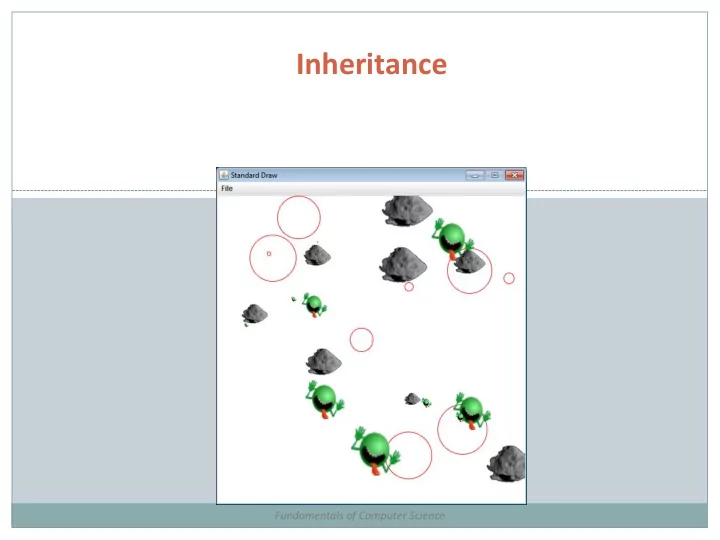
Circle [] circles = new Circle[30]; for (int i = 0; i < circles.length; i++) { int rand = (int) (Math.random() * 3.0); double x = Math.random(); double y = Math.random(); double vx = 0.002 - Math.random() * 0.004; double vy = 0.002 - Math.random() * 0.004; double r = Math.random() * 0.1; if (rand == 0) circles[i] = new Circle(x, y, vx, vy, r); else if (rand == 1) circles[i] = new CircleImage(x, y, vx, vy, r, "dont_panic_40.png"); else circles[i] = new CircleImageRotate(x, y, vx, vy, r, "asteroid_big.png"); } while (true) { StdDraw.clear(); for (int i = 0; i < circles.length; i++) { circles[i].updatePos(); circles[i].draw(); } StdDraw.show(10); }
while (true) { StdDraw.clear(); for (int i = 0; i < circles.length; i++) { circles[i].updatePos(); circles[i].draw(); } StdDraw.show(10); } circles[i] could be: Circle, CircleImage or CircleImageRotate object
x, y, vx, vy, r draw() updatePos()
image draw()
angle draw() updatePos()
Controls if subclasses see instance vars/methods private = only the class itself public = everybody can see no modifier (default) = everybody in package protected = everybody in package, any class that extends it
x, y, vx, vy, r draw() updatePos() Circle image draw() CircleImage angle draw() updatePos() CircleImageRotate private public
Helps hide implementation details You can change how you store things later
Introduce new class Bouncers Holds all the Circle type objects Update and draw them all at once
Bouncers bouncers = new Bouncers(); for (int i = 0; i < 30; i++) bouncers.add(); while (true) { StdDraw.clear(); bouncers.updateAll(); bouncers.drawAll(); StdDraw.show(10); } public class Bouncers
void add() // Add a random type of bouncing object with a // random location, velocity, and radius void updateAll() // Update the position of all bouncing objects void drawAll() // Draw all the objects to the screen
public class Bouncers { private ArrayList<Circle> objs = new ArrayList<Circle>(); public void add() { int rand = (int) (Math.random() * 3.0); double x = Math.random(); double y = Math.random(); double vx = 0.002 - Math.random() * 0.004; double vy = 0.002 - Math.random() * 0.004; double r = Math.random() * 0.1; if (rand == 0)
else if (rand == 1)
else
} ...
I decided to use an ArrayList as my underlying data structure. Note: clients of Bouncers don't know this and don't really have to care.
public void updateAll() { for (Circle obj : objs)
} public void drawAll() { for (Circle obj : objs)
} }
CSCI 136: Fundamentals of Computer Science II • Keith Vertanen
Played on a square N x N grid Each grid location can have one thing: Square letter tile Circular number tile Some other rules To be determined
Array element null if no tile there Otherwise reference to letter/number tile object Start by randomly placing non-overlapping tiles
final int GRID = 8; Tile [][] tiles = new Tile[GRID][GRID];
null null null null null null null null null null null null null null null null null null null null null null null null null null null null null null null null null null null null null null null null null null null null null null null null null null null null null null null null null null null null null null null null
private double size; private char ch; Tile(double size, char ch); char getCharacter(); double getSize(); void draw(double x, double y);
A Tile object doesn't know the number of grid cells or canvas size of screen.
Any other method whose behavior
private double size private char ch Tile(double size, char ch) char getCharacter() double getSize() void draw(double x, double y) Tile LetterTile(double size) void draw(double x, double y) LetterTile extends Tile NumberTile(double size) void draw(double x, double y) NumberTile extends Tile
Classes that make sense to instantiate e.g. LetterTile, NumberTile
Classes that don't make sense to instantiate e.g. Tile Then why have them? Children can inherit common functionality Related objects can live in same container
public abstract class Tile { private double size = 0.0; private char ch = '\0'; public Tile(double size, char ch) { this.size = size; this.ch = ch; } public char getCharacter() { return ch; } public double getSize() { return size; } public abstract void draw(double x, double y); }
Makes the polymorphism work (i.e. we can put any child of Tile into the same array and call draw() on any element in the array).
public class LetterTile extends Tile { public LetterTile(double size) { super(size, (char) StdRandom.uniform((int) 'A', (int) 'Z' + 1)); } public void draw(double x, double y) { StdDraw.setPenColor(StdDraw.BLUE); StdDraw.filledRectangle(x, y, getSize() / 2.0, getSize() / 2.0); StdDraw.setPenColor(StdDraw.WHITE); StdDraw.text(x, y, "" + getCharacter()); } }
public class NumberTile extends Tile { public NumberTile(double size) { super(size, (char) StdRandom.uniform((int) '0', (int) '9' + 1)); } public void draw(double x, double y) { StdDraw.setPenColor(StdDraw.RED); StdDraw.filledCircle(x, y, getSize() / 2.0); StdDraw.setPenColor(StdDraw.WHITE); StdDraw.text(x, y, "" + getCharacter()); } }
Create given # of tiles, grid size, and canvas size Draw itself
private Tile [][] tiles // 2D array storing LetterTile and NumberTile objs private double size // Size of tiles in StdDraw coordinates TileBoard(int numTiles, int gridSize) void draw()
public TileBoard(int numTiles, int gridSize) { tiles = new Tile[gridSize][gridSize]; size = 1.0 / gridSize; int added = 0; // Keep adding tiles until we reach the target number or board limit while ((added < numTiles) && (added < gridSize * gridSize)) { // Choose a random (x, y) grid location for the next tile int x = (int) (Math.random() * gridSize); int y = (int) (Math.random() * gridSize); if (tiles[x][y] == null) { // Randomly choose a letter or number tile if (Math.random() < 0.5) tiles[x][y] = new LetterTile(size); else tiles[x][y] = new NumberTile(size); added++; } } }
public void draw() { StdDraw.setFont(new Font("SansSerif", Font.BOLD, 18)); // Loop over all the x-locations in the grid for (int x = 0; x < tiles.length; x++) { // Loop over all the y-locations in this x row for (int y = 0; y < tiles[x].length; y++) { // Only draw if the grid location contains a tile if (tiles[x][y] != null) tiles[x][y].draw(size * (x + 0.5), size * (y + 0.5)); } } }
33
public class TileGame { public static void main(String [] args) { TileBoard board = new TileBoard(Integer.parseInt(args[0]), Integer.parseInt(args[1])); board.draw(); } }
% java TileGame 10 4 % java TileGame 30 8 % java TileGame 200 16
Sharing code between related classes Putting similar objects in the same bucket Extremely common in modern OOP languages
Create class holding a collection of other objects Let's you simplify your main program Hides details of how you store things
Several classes inheriting from same base class Concrete versus abstract classes
Shapes can calculate area and they can draw themselves Create a class, Circle Create a class, Rectangle