Advanced C++ Topics Inheritance Revisited Inheritance is useful to - - PowerPoint PPT Presentation

advanced c topics inheritance revisited
SMART_READER_LITE
LIVE PREVIEW

Advanced C++ Topics Inheritance Revisited Inheritance is useful to - - PowerPoint PPT Presentation


slide-1
SLIDE 1

Advanced C++ Topics

Inheritance Virtual methods and late binding Friend classes and methods Class templates Overloaded operators Iterators

EECS 268 Programming II 1

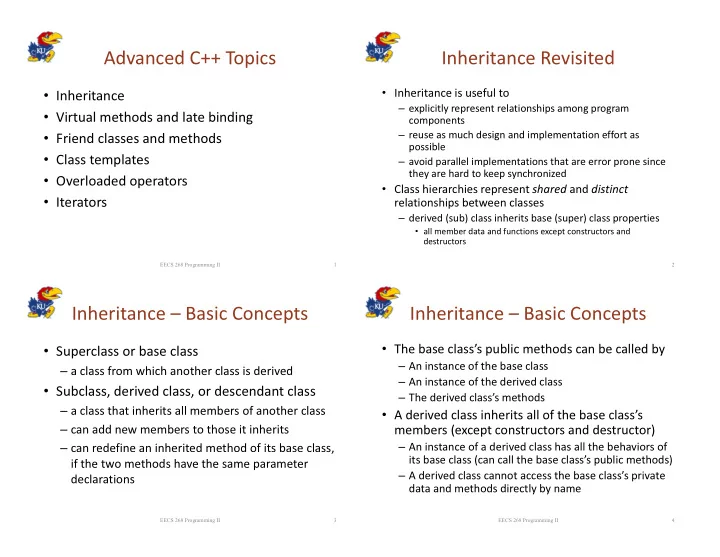
Inheritance Revisited

Inheritance is useful to

explicitly represent relationships among program components reuse as much design and implementation effort as possible avoid parallel implementations that are error prone since they are hard to keep synchronized

Class hierarchies represent shared and distinct relationships between classes

derived (sub) class inherits base (super) class properties

all member data and functions except constructors and destructors

2

Inheritance Basic Concepts

Superclass or base class

a class from which another class is derived

Subclass, derived class, or descendant class

a class that inherits all members of another class can add new members to those it inherits can redefine an inherited method of its base class, if the two methods have the same parameter declarations

EECS 268 Programming II 3

Inheritance Basic Concepts

An instance of the base class An instance of the derived class

members (except constructors and destructor)

An instance of a derived class has all the behaviors of

  • data and methods directly by name

EECS 268 Programming II 4

slide-2
SLIDE 2

Inheritance Revisited

EECS 268 Programming II 5

Inheritance Syntax

class derivedClass: access-modifier baseClass access modifier describes access semantics of base class components inherited by derived class Public methods can be used by any code

client, class member functions, derived classes

Private members

class member functions and friends

Protected

class members, friends, derived classes

EECS 268 Programming II 6

Kinds of Inheritance

Apply most restrictive access based on base access type and inheritance access modifier Public inheritance

Public/Protected Public/Protected derived members

Protected inheritance

Public/Protected Protected derived members

Private Inheritance

Public/Protected Private derived members

Private base class members remain private under all inheritance types

EECS 268 Programming II 7

Inheritance Hierarchy Example

8

Figure 8-1 Inheritance: Relationships among timepieces

slide-3
SLIDE 3

Inheritance Example

Sphere serves as a base class for Ball

some routines inherited, some new, and some are redefined (e.g. display Statistics())

9

Multiple Inheritance

Multiple inheritance

a derived class can have more than one base class we will not study this kind of inheritance

EECS 268 Programming II 10

Inheritance Revisited

private

11

Is-a Relationships

Public inheritance should imply an is-a relationship Object type compatibility

you can use an instance of a derived class anywhere you can use an instance of the base class (but not the other way around)

Example

A ball is a sphere Given the following function declaration:

void displayDiameter(Sphere thing);

The following statements are valid:

Ball myBall displayDiameter(myBall);

EECS 268 Programming II 12

see C8-Sphere.cpp, C8-Ball.cpp

slide-4
SLIDE 4

Sphere/Ball Example

Ball class (derived from Sphere)

both constructors call base class constructors to handle private radius data getName() is a new method setName() gives access to Ball data resetBall() uses both Sphere and Ball access routines as the data is private in both classes

Ball could access name directly

EECS 268 Programming II 13

Sphere/Ball Example 2

Ball class

displayStatistics() redefines the name in the derived class as a local method

theName uses full class::member scope resolution syntax to call displayStatistics()

instance of Ball has two data members

theName and theRadius (inherited) since Sphere::theRadius is defined private (rather than protected or public) it can only be accessed through the public (get/set)Radius() methods

EECS 268 Programming II 14

Has-a Relationships

If the relationship between two classes is not is-a, do not use public inheritance Has-a relationship (also called containment)

a class has an object as a data member cannot be implemented using inheritance

Example: A has-a relationship between a pen and a ball

class Pen {

  • private:

Ball point; };

EECS 268 Programming II 15

As-a Relationships

Uses private inheritance

Example: Implement a stack as a list class Stack: private List

methods the underlying list is hidden from the clients and descendants of the stack

Private inheritance is useful when

a class needs access to the protected members of another class, or if methods in a class need to be redefined

EECS 268 Programming II 16

slide-5
SLIDE 5

As-a relationship Private Inheritance

All public, protected and private elements of the base class are private in the derived class. Client code reference to a public base class routine through the derived class instance is illegal. Derived class completely wraps base class elements. Derived class is implemented using or is implemented in terms of the base class.

EECS 268 Programming II 17

see C8-StackL.cpp, C8-List.cpp

Stack as-a List Example

A stack is not a type a list since it has unique semantics Stack semantics can be implemented in terms on List semantics Private inheritance strongly conceals any list related semantics from the clients

  • nly exposes push()/pop()

cannot access insert()/remove()

Contrast with the Stack has-a List implementation from Chapter 4

just as good; both work

EECS 268 Programming II 18

Inheritance & Class Relationships

Public inheritance

extend or specialize an existing class most common is-a relationship between base/derived classes

Protected inheritance

not very useful; not often used

Private inheritance

to implement one class in terms of another as-a relationship

EECS 268 Programming II 19

Class Relationships

IS-A: derived class is special kind of base class

public inheritance used to implement in C++

AS-A: derived class implemented in terms of base class

private inheritance can be used in C++

HAS-A: object A includes instance of object B as part of its implementation

encapsulation is just as good as inheritance

EECS 268 Programming II 20

slide-6
SLIDE 6

Virtual Functions

Derived class sometimes need to modify or completely replace actions of a base class method

derived class is said to override the inherited method

Base class must give permission for redefinition

by declaring the method as virtual

Redefinition is permitted but not required Redefined methods must have exactly the same signature as the inherited base class methods Derived functions do not need to use the virtual keyword Friend and constructor functions cannot be virtual, but destructors can be

EECS 268 Programming II 21

Virtual Functions 2

Base class Animal gives permission to override breathe() and move() Derived class Fish over- rides both, but denies permission to further

  • verride breathe()

WalkingCatFish over- rides move() but uses inherited breathe()

class Animal { public: ... virtual void breathe( ); // uses a nose virtual void move(); // uses feet ... }; class Fish: public Animal { public: ... void breathe( ); // uses gills virtual void move(); // uses fins ... } class WalkingCatFish: public Fish { void move(); // uses fins as feet }

EECS 268 Programming II 22

Function Overriding Example

EECS 268 Programming II 23

class baseClass{ public: virtual void print(){

  • }

}; class firstClass : public baseClass{ public: void print(){

  • }

}; class secondClass : public baseClass{ }; class thirdClass : public baseClass{ public: void print(){

  • }

}; class fourthClass : public thirdClass{ };

see C8-staticBinding.cpp

Name Binding Time

Binding time can be compile-time or run-time

controls what methods are called in some cases

see C8-staticBinding2.cpp Direct access using b and d instance variable

  • bviously compile time

But what if they point to a different type

  • bject??

bp1 is legal (but bogus) dp2 illegal type conversion

EECS 268 Programming II 24

slide-7
SLIDE 7

Virtual Methods and Late Binding

Methods declared as virtual are tracked at runtime by a virtual method table (VMT)

methods not declared as virtual can be redefined methods declared as virtual are overridden

Use of non-virtual methods is determined at compile- time and references to the function are compiled-in

lower overhead reference method

Use of virtual methods is determined at runtime by consulting the VMT of the object accessed

pointer to calling object (this) given to every method call higher overhead, but avoids some undesirable behaviors

EECS 268 Programming II 25

see C8-bindingTime.cpp

Virtual Methods and Late Binding

Late, or dynamic, binding

the appropriate version of a polymorphic method is decided at execution time a polymorphic method has multiple meanings and

  • verrides a method of the superclass

the outcome of an operation depends upon the

  • bjects on which it acts

Defining class methods as virtual preserves flexibility at the cost of slightly higher VMT

  • verhead.

EECS 268 Programming II 26

Virtual Methods and Late Binding

you do not want derived class to override them. Any class that contains a virtual method is called a polymorphic class

and is extensible, i.e., can add capabilities to a derived

  • Constructors cannot be virtual

Destructors can and should be virtual

  • verridden

EECS 268 Programming II 27

Abstract Base Class

Classes may declare a virtual function prototype without providing an implementation for it

used as a placeholder for an API element, which derived classes are obligated to implement

Method functions declared but not defined in a class are pure virtual virtual type func_name(param_list) = 0; A base class containing a pure virtual function is called an abstract base class No instances of an abstract class can exist since at least one method lacks an implementation.

EECS 268 Programming II 28

slide-8
SLIDE 8

Friend Methods/Classes

Perfect adherence to object encapsulation is not always convenient or clear

access to private, and protected, members of a class by collaborating classes can simplify implementation friend definition is a mechanism for granting other exceptions

Functions and classes can be friends of a class Friend functions can access private and protected Friend functions of a class are not class members Friends of base class are not friends of derived classes

EECS 268 Programming II 29

Friend Methods/Classes

Friend functions permit input and output routines to have access to private and protected class data

general input/output routines can be friends of

  • bjects they are creating and initializing

Useful when one class (A) contains an instance of another class (B) because A HAS-A B as part of its implementation

remember implementing stacks and queues using different mappings onto the List ADT operations

EECS 268 Programming II 30

Friends Example

cannot access private variables in Derived

EECS 268 Programming II 31

class Base{ public: friend void write(Base& b); private: double bvalue; }; void write(Base& b){ cout << b.bvalue << endl; } class Derieved:public Base{ public: private: double dval; }; int main(){ Base b; Derived d; write(b); write(d); }

Friend Methods/Classes

A class List can be a friend of the class ListNode

List can access ListNode members) class ListNode { private:

  • // members item and *next

friend class List; };

32 EECS 268 Programming II

slide-9
SLIDE 9

ADTs List and Sorted List Revisited

Section 8.4 in Carrano provides a good discussion of applying these new concepts to familiar examples

abstract Base Class (BasicADT) pure Virtual Functions virtual Functions

Three level class hierarchy

EECS 268 Programming II 33

BasicADT SortedList List

Class Templates

Way to describe commonality among different solution components.

Situation: same basic structure with different data components lists, stacks, queues, trees, etc. same data structures, different data

Parameterized class definition

data types are the parameters

template <typename T> class NewClass { public: NewClass(); NewClass(T initialData); void setData(T newData); T getData(); private: T theData; };

EECS 268 Programming II 34

Class Templates 2

Declarations and methods must specify the type parameters in creating an instance

int main() { NewClass<int> first; NewClass<double> second(4.8); first.setData(5); cout << second.getData() << endl; }

EECS 268 Programming II 35

template <typename T> void NewClass<T>::setData(T newData){ theData = newData; } template <typename T> T NewClass<T>::getData() { return theData; }

template <typename T> NewClass<T>::NewClass() { } template <typename T> NewClass<T>::NewClass (T initialData): theData(initialData) { } see C8-templareEx1.cpp

Class Templates 3

Precede class definition template with

template <typename T>

Precede each method template with

template <typename T>

EECS 268 Programming II 36

see C8-ListT.cpp

slide-10
SLIDE 10

C8-ListT.h/.cpp

Data Type parameter <T> takes the place of

typedef <listitemtypespec> ListItemType;

Default constructor for the list node cannot initialize the data element

abstract definition of <T> has no information about what the type will be (it can be any type) but copy constructor can

Note the inclusion of the implementation source file at the end of the header file. Templat List class supports client code creating two standard lists holding double and char data

EECS 268 Programming II 37

see C8-ListTClient.cpp

Class Templates 4

Abstract nature of the class description can lead

  • perations

Everything the class does must be valid for every possible type specified for T For example, specified type should overload the

  • Class template specification must thoroughly

document all such operations and other assumptions made by the class implementation

must be satisfied by all classes provided as T

EECS 268 Programming II 38

Class Templates 5

Compiler must know the class specified for T before it can compile the template instance Class template header and source files are defined as normal

but the implementation file is not compiled separately ahead of time implementation file #included at the end of the header file

All client code using the template thus includes it, making the definition available to compiler when it compiles instances for specific T

EECS 268 Programming II 39

Overloaded Operators

Overloaded operator has more than one meaning Overload common operators for classes to enable a particular operator to work correctly on instances of a class Example: a list

Define the equality operator for a list virtual bool operator == (const List& rhs) const Overload the assignment operator to get a deep copy

  • f a list

virtual List& operator = (const List& rhs);

EECS 268 Programming II 40

slide-11
SLIDE 11

Overloading Operators -- Guidelines

Can overload any operator except: ., .*, ::, ?, :, sizeof Cannot define new operators by overloading symbols that are not already operators in C++ Cannot change the standard precedence of a C++

  • perator or the number of its operands

At least one operand of an overloaded operator must be an instance of a class Cannot change the number of arguments for an

  • verloaded method

A typical class should overload the assignment, equality, and relational operators (= == != < <= > >=)

EECS 268 Programming II 41

Iterators

Operation Description * Return the item that the iterator currently references ++ Move the iterator to the next item in the list

  • Move the iterator to the previous item in the list

== Compare two iterators for equality != Compare two iterators for inequality

42

An iterator is an object that traverses a collection of like objects Common iterator operations

Iterators

A header file for the class ListIterator

// List and ListIterator are friend classes of ListNode

  • class ListIterator

{ public: ListIterator(const List *aList, ListNode *nodePtr); const ListItemType & operator*(); ListIterator operator++(); bool operator==(const ListIterator& rhs) const; bool operator!=(const ListIterator& rhs) const; friend class List; private: const List *container //ADT associated with iterator ListNode *cur; //current location in collection };

43 EECS 268 Programming II

Summary

Inheritance Virtual methods and late binding Friend classes and methods Class templates Overloaded operators Iterators All these are ways to express desired semantics in C++ to specify algorithmic solution to a problem.

EECS 268 Programming II 44