Inheritance Many objects have a hierarchical Inheritance - - PDF document

inheritance
SMART_READER_LITE
LIVE PREVIEW

Inheritance Many objects have a hierarchical Inheritance - - PDF document

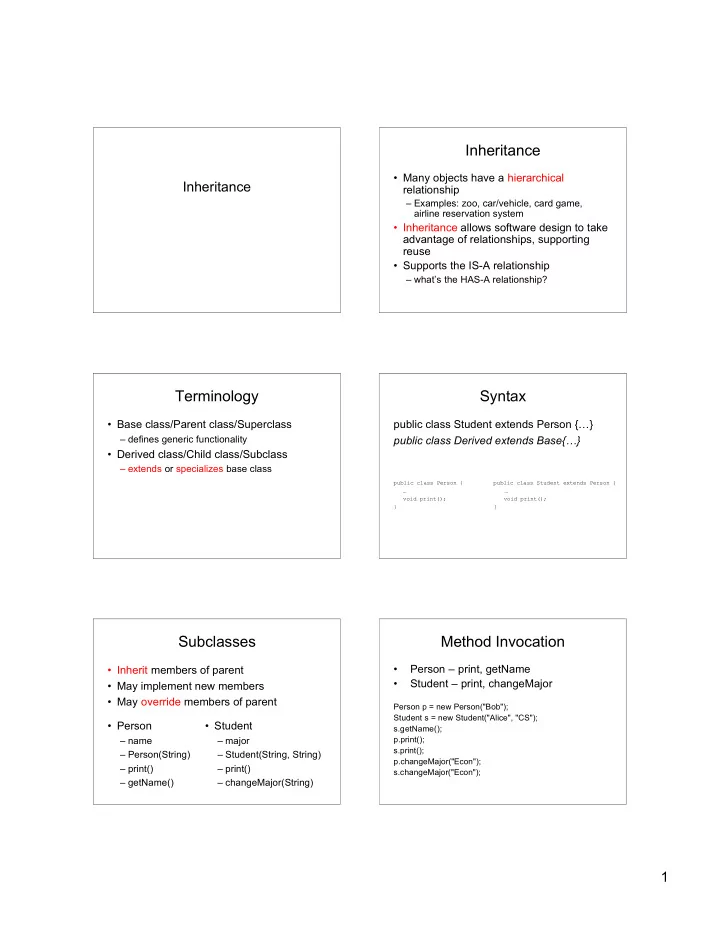
Inheritance Many objects have a hierarchical Inheritance relationship Examples: zoo, car/vehicle, card game, airline reservation system Inheritance allows software design to take advantage of relationships, supporting reuse


slide-1
SLIDE 1

1 Inheritance

Inheritance

  • Many objects have a hierarchical

relationship

– Examples: zoo, car/vehicle, card game, airline reservation system

  • Inheritance allows software design to take

advantage of relationships, supporting reuse

  • Supports the IS-A relationship

– what’s the HAS-A relationship?

Terminology

  • Base class/Parent class/Superclass

– defines generic functionality

  • Derived class/Child class/Subclass

– extends or specializes base class

Syntax

public class Student extends Person {…} public class Derived extends Base{…}

public class Person { public class Student extends Person { … … void print(); void print(); } }

Subclasses

  • Inherit members of parent
  • May implement new members
  • May override members of parent
  • Person

– name – Person(String) – print() – getName()

  • Student

– major – Student(String, String) – print() – changeMajor(String)

Method Invocation

  • Person – print, getName
  • Student – print, changeMajor

Person p = new Person("Bob"); Student s = new Student("Alice", "CS"); s.getName(); p.print(); s.print(); p.changeMajor("Econ"); s.changeMajor("Econ");

slide-2
SLIDE 2

2

Method Invocation

  • Person – print, getName
  • Student – print, changeMajor

Person p = new Person("Bob"); Student s = new Student("Alice", "CS"); s.getName(); //Person getName p.print(); //Person print s.print(); //Student print p.changeMajor("Econ"); //ERROR s.changeMajor("Econ"); //Student changeMajor

Subclasses

  • Person

– name – Person(String) – print() – getName()

  • Student

– major – Student(String, String) – print() – changeMajor(String)

Protected

  • private members of parent not accessible to

child class

  • protected members accessible only to derived

classes

  • examples

public class Person { //will be accessible in Student protected String name; }

Partial Overriding

//in Person class void print() {…} //in Student class void print() { super.print(); //super.methodName(); … }

More on super

public Person(String name) { this.name = name; } public Student(String name, String major) { super(name); //super(params); this.major = major; }

Shadowing Variables

  • Variable (same name) declared in base

class and derived class

  • Generally, a bad idea
  • Example: Student declares a String

variable name

slide-3
SLIDE 3

3

final

  • Classes and methods can be defined with

final modifier

– final public class Student … – final public void print()…

  • final classes cannot be extended
  • final methods cannot be overridden

abstract

  • abstract classes cannot be instantiated
  • Declare abstract class using abstract

keyword

– public abstract class Person …

  • Method can also be abstract

– public abstract void print()

  • A class with an abstract method must be

declared abstract

Polymorphism

  • Many forms
  • A variable is polymorphic if it can refer to

different types of objects at different times Person p = new Person(“Bob”); p = new Student(“Sally”, “History”);

Example

persondb

Student

Person[] persondb = new Person[10]; persondb[0] = new Student(“Sally”, “History”); persondb[1] = new Staff(…); … persondb[9] = new Faculty(…);

Staff

Faculty

Dynamic Binding

  • Determine which method is called based on
  • bject contents

class Person { void print(); } class Student extends Person { void print(); }

Dynamic Binding

Person p = new Person(…); Student s = new Student(…); p.print(); //calls Person print() p = s; //OKAY p.print(); //calls Student print() p.changeMajor(); //ERROR

slide-4
SLIDE 4

4

Casting

Person p; p = new Student(…); Student s = (Student)p; if(p instanceof Student) s = (Student)p;

  • If cast is not successful, runtime error

ClassCastException

  • instanceof operator used to determine

type

Example

Class1 Class2 extends Class1

  • 1. f1
  • 3. f2
  • 2. f2
  • 4. f3

Class1 c1 = new Class2(); Class2 c2 = new Class2(); c1.f3(); c1.f2(); c2 = (Class2)c1; c2.f3();

Object base class

  • All classes derive from Object
  • Defines several methods that can be
  • verridden

– String toString() – boolean equals(Object) – Object clone()