
Inheritance (with C++)
Starting to cover Savitch Chap. 15
More OS topics in later weeks (memory concepts, libraries)
Inheritance Basics
A new class is inherited from an existing class Existing class is termed the base class
– It is the "general" class (a.k.a. superclass, or parent)
New class is termed the derived class
– It is the "specific" class (a.k.a. subclass, or child) – Automatically has (i.e., "inherits") all of the base class's member functions and variables – Can define additional member functions and variables
And override inherited virtual functions (but that's a later topic)
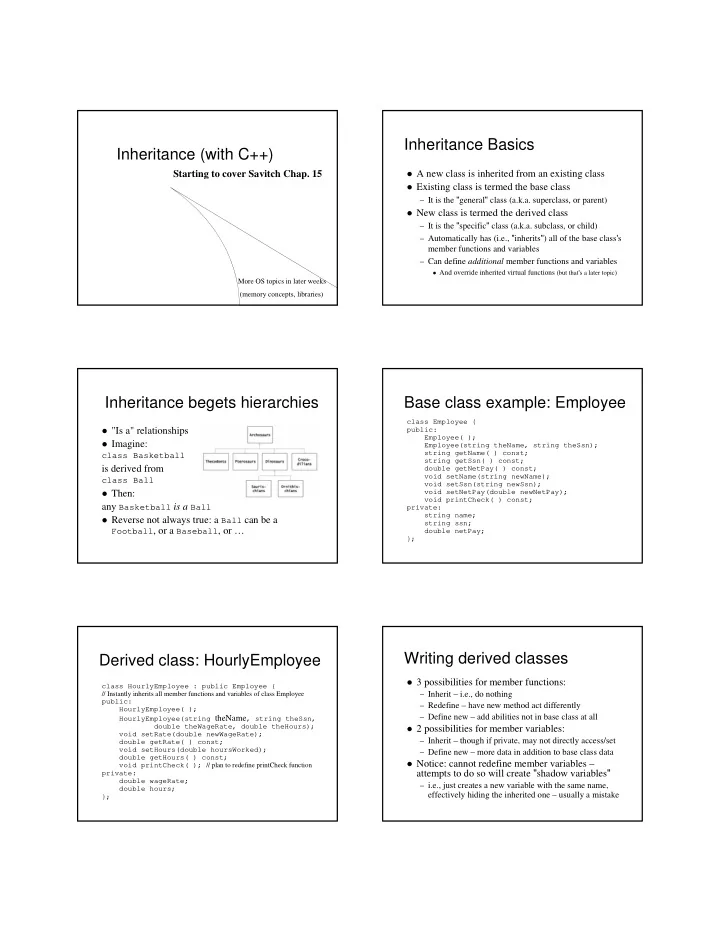
Inheritance begets hierarchies
"Is a" relationships Imagine:
class Basketball
is derived from
class Ball
Then:
any Basketball is a Ball
Reverse not always true: a Ball can be a
Football, or a Baseball, or …
Base class example: Employee
class Employee { public: Employee( ); Employee(string theName, string theSsn); string getName( ) const; string getSsn( ) const; double getNetPay( ) const; void setName(string newName); void setSsn(string newSsn); void setNetPay(double newNetPay); void printCheck( ) const; private: string name; string ssn; double netPay; };
Derived class: HourlyEmployee
class HourlyEmployee : public Employee { // Instantly inherits all member functions and variables of class Employee public: HourlyEmployee( ); HourlyEmployee(string theName, string theSsn, double theWageRate, double theHours); void setRate(double newWageRate); double getRate( ) const; void setHours(double hoursWorked); double getHours( ) const; void printCheck( ); // plan to redefine printCheck function private: double wageRate; double hours; };
Writing derived classes
3 possibilities for member functions:
– Inherit – i.e., do nothing – Redefine – have new method act differently – Define new – add abilities not in base class at all
2 possibilities for member variables:
– Inherit – though if private, may not directly access/set – Define new – more data in addition to base class data
Notice: cannot redefine member variables –