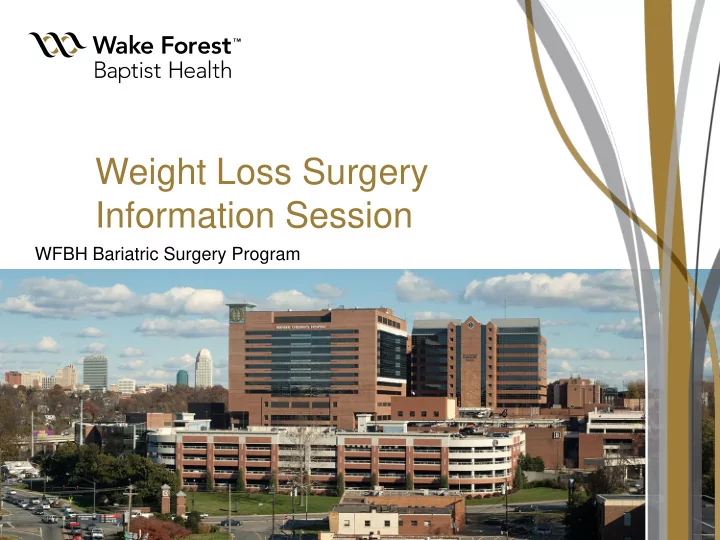
Information Session WFBH Bariatric Surgery Program What makes us - - PowerPoint PPT Presentation

information session
SMART_READER_LITE
LIVE PREVIEW

Information Session WFBH Bariatric Surgery Program What makes us - - PowerPoint PPT Presentation

Weight Loss Surgery Information Session WFBH Bariatric Surgery Program What makes us different? Center of Excellence (COE) High volume center > 1000 procedures since 2003 Less complications than non-COE centers


slide-1
SLIDE 1

Weight Loss Surgery Information Session

WFBH Bariatric Surgery Program

slide-2
SLIDE 2

Wake Forest Baptist Health

What makes us different?

  • Center of Excellence (COE)
  • High volume center
  • > 1000 procedures since 2003
  • Less complications than non-COE centers
  • Multi-disciplinary team approach
  • Pre- and Post-operatively
  • Psychological counseling
  • Exercise consultation
  • Nutritional guidance
  • Message board for patient support
  • Monthly Support Group meetings
slide-3
SLIDE 3

Wake Forest Baptist Health

What is Obesity?

  • A progressive, life-threatening disease which results

from the excess storage of fat with multiple co- morbidities.

  • Morbid Obesity  Clinically severe obesity at which point

serious medical conditions occur as a direct result of the

  • besity.
  • Defined as:
  • ≥ 100 pounds over Ideal Body Weight (IBW)
  • Body Mass Index (BMI) ≥ 40
  • Leading cause of preventable death (Smoking now # 2)
  • Contributing Factors:

1. Lifestyle (environment), dietary choices 2. Genetic, metabolic

slide-4
SLIDE 4

Wake Forest Baptist Health

What is BMI?

Risks of Associated Disease According to BMI and Waist Size

BMI

Waist less than or equal to 40 in. (men) or 35 in. (women) Waist greater than 40

  • in. (men) or 35 in.

(women)

18.5 or less Underweight

  • N/A

18.5 to 24.9 Normal

  • N/A

25.0 to 29.9 Overweight Increased High 30.0 to 34.9 Obese High Very High 35.0 to 39.9 Obese Very High Very High 40 or greater Morbidly Obese Extremely High Extremely High

slide-5
SLIDE 5

Wake Forest Baptist Health

Obesity Related Co-Morbidities

  • Diabetes
  • High Blood Pressure
  • Heart Disease
  • High Cholesterol
  • Sleep Apnea
  • Cancer
  • Venous Stasis Disease
  • Degenerative Joint Disease
  • Acid Reflux Disease

(GERD)

  • Stress Urinary

Incontinence

  • Fatty Liver
  • Depression
slide-6
SLIDE 6

Wake Forest Baptist Health

Who is the Ideal Surgical Candidate?

  • Meets NIH criteria for Bariatric Surgery
  • BMI ≥ 40 OR BMI ≥ 35 with co-morbidities
  • Primary disease states complicated by obesity
  • History of weight loss attempts (5 yr weight history)
  • Diets (Weight Watcher’s, Atkins, Slim Fast, etc.)
  • Exercise
  • Medications (Phentermine, Xenical/Alli, Meridia)
  • No psychological contraindications
  • Smoking cessation
  • Dedicated to Lifestyle Change & Follow Up
slide-7
SLIDE 7

Why Surgery?

  • Non-Surgical treatment
  • ~10% weight loss
  • > 99% failure rate
  • Low risk
  • Surgical treatment
  • 50-75% weight loss
  • ≤ 15% failure rate
  • Medical co-morbidities

resolved or improved

  • Operative risk
slide-8
SLIDE 8

Wake Forest Baptist Health

Improvement of Co-Morbidities after Bariatric Surgery

High Cholesterol 70% GERD 90% Stress Incontinence 87% Diabetes 88% Sleep Apnea 80% High Blood Pressure 81% Osteoarthritis 75%

slide-9
SLIDE 9

Wake Forest Baptist Health

Surgical Treatment Options

at Wake Forest Baptist Health

  • Restrictive
  • Laparoscopic Adjustable Gastric Band (AGB)
  • Laparoscopic Sleeve Gastrectomy
  • Combination (restrictive & malabsorptive)
  • Laparoscopic Roux-en-Y Gastric Bypass (RYGB)
slide-10
SLIDE 10

Laparoscopic Adjustable Gastric Band

  • Restrictive
  • 40-50% excess weight

loss

  • US since 2001
  • Long term results out
  • f Europe and

Australia

  • Reversible

Pouch Band Port site

slide-11
SLIDE 11

Wake Forest Baptist Health

Laparoscopic Adjustable Gastric Band Animation

slide-12
SLIDE 12

How does the Band work?

  • Surgical Factors
  • Restriction of meal size
  • Decreased appetite
  • Adjustable:
  • fluid can be added or removed

based on rate of weight loss and hunger level

  • Patient Factors
  • Caloric intake
  • Exercise
  • Meal composition
slide-13
SLIDE 13

Potential Risks with the LAGB

  • Death  1 in 2000
  • DVT
  • Pulmonary Embolus
  • Erosion
  • Bleeding
  • “Slip”
  • Pouch Dilatation
  • Port site infection or

malfunction

  • Food Intolerances
  • Weight Gain
slide-14
SLIDE 14

Wake Forest Baptist Health

Adjustable Gastric Band Hospital Course

  • Surgery = 1 to 1 ½ hours
  • Outpatient (~23 hours)
  • Same day discharge or overnight

 Sips & chips  clear liquids  Out of bed same day  Walking  Medications: liquid or crushed

slide-15
SLIDE 15

Sleeve Gastrectomy

  • Restrictive, stomach

is 15% original size

  • 40-60% EWL at 4

years

  • Not reversible
  • Bridge procedure for

patients too high risk for RYGB

slide-16
SLIDE 16

Wake Forest Baptist Health

Sleeve Gastrectomy

slide-17
SLIDE 17

How does the VSG work?

  • Surgical Factors
  • Restriction of meal

size

  • Gut hormone

alteration?

  • Decreased appetite
  • Patient Factors
  • Caloric intake
  • Exercise
  • Meal composition
slide-18
SLIDE 18

Potential Risks with Sleeve

  • Death is << 1%
  • DVT
  • Pulmonary Embolus
  • Leak
  • Bleeding
  • Gastric Stenosis
  • GERD
  • Food Intolerances
  • Weight gain
slide-19
SLIDE 19

Wake Forest Baptist Health

Sleeve Gastrectomy Hospital Course

  • Surgery = 1 ½ to 2 hours
  • Outpatient

~1 night stay

 Sips & chips  clear liquids  Out of bed same day  Walking  Medications: liquid or crushed

slide-20
SLIDE 20

Laparoscopic Roux-en-Y Gastric Bypass (RYGB)

  • Combination
  • Extensive research

(1960’s)

  • Not easily reversible
  • 60-75% excess weight

loss

Pouch Bypassed Stomach Duodenum Roux Limb

slide-21
SLIDE 21

Wake Forest Baptist Health

Laparoscopic Roux-en-Y Gastric Bypass (RYGB)

slide-22
SLIDE 22

How does the RYGB work?

  • Surgical Factors
  • Restriction of meal

size

  • Malabsorption
  • Decreased appetite
  • Patient Factors
  • Caloric intake
  • Exercise
  • Meal composition
slide-23
SLIDE 23

Potential Risks with RYGB

  • Death  1 in 300
  • Pulmonary Embolus

(PE)

  • Deep Vein

Thrombosis (DVT)

  • Leaks – 1 to 5%
  • Stomal stenosis

(stricture) – 4 to 6%

  • Ulcers – 5 to 15%
  • Wound infection – 1 to

2%

  • Bowel obstruction
  • Hernias
  • Vitamin/mineral

deficiency

  • Dumping Syndrome
  • Weight Gain
slide-24
SLIDE 24

Wake Forest Baptist Health

Roux-en-Y Gastric Bypass Hospital Course

  • Surgery = 2 to 3 hours
  • Inpatient

~ 2 night stay

 Sips & chips  clear liquids  Out of bed same day  Walking  Medications: liquid or crushed

slide-25
SLIDE 25

Wake Forest Baptist Health

Long Term Lifestyle Changes

  • Moderate to High Protein
  • Lean protein sources  chicken breast, fish, low fat dairy, lean

beef, etc.

  • Moderate carbohydrate intake (types)
  • No high fat foods OR concentrated sweets
  • Adequate fluid intake (no carbonated

beverages or fluids with added sugar)

  • Eat slowly, chew well
  • Limit or avoid alcohol
  • Maintain vitamin and mineral regimen
  • Physical Activity/Exercise
slide-26
SLIDE 26

Wake Forest Baptist Health

Head to Head Comparison

BAND SLEEVE GASTRIC BYPASS Operative Risk Least Least/ Intermediate Most Long Term Risk Most Least Intermediate Death Risk 0.05% 0.3% 0.5% Weight Loss Least Good/ Best Best Disease Improvement Good Better Best

slide-27
SLIDE 27

Wake Forest Baptist Health

Bariatric Surgery Research Studies

STUDY GOAL ELIGIBILITY Intestinally Targeted Therapies for Obesity Study the effect of RYBG surgery on fat absorption and intestinal hormone levels SLEVE RYBG GIP in Human Obesity Measure changes in blood levels of the intestinal hormone GIP-1 after surgery RYGB Pharmacologic Enhancement of LAGB Study whether two FDA approved drugs can increase weight loss after LAGB LAP BAND Exercise Training following Weight Loss Surgery Study how exercise training affects body composition after weight loss surgery All types

  • f surgery
slide-28
SLIDE 28

Wake Forest Baptist Health

Program Steps

  • Weight Loss Surgery Information Session
  • New patient packet
  • Complete “mini” packet tonight or call (336) 716-6099 option 1

to request a packet.

  • Consultation with surgeon of choice:
  • Dr. Adolfo “Fuzz” Fernandez
  • Dr. Stephen McNatt
  • Dr. Myron Powell
  • Once you have an appointment with the surgeon you can

schedule:

  • Psychological Evaluation with Dr. Shenelle Edwards-Hampton or
  • Dr. Jeffrey Smith
  • Nutrition Visits with Amber Norris, RD, LDN or Kerry Patrone,

RD, LDN

  • Exercise Consultation with Erica Hale, MS or Julie Sorensen, MS
slide-29
SLIDE 29

Wake Forest Baptist Health

Insurance Authorization

“Each insurance plan has its own provisions and exclusions”

  • Blue Cross Blue Shield (state specific)
  • NC – 6 month MD supervised diet (effective 9.10.13)
  • Aetna
  • 3 month multi-disciplinary diet
  • Cigna
  • 3 month RD supervised diet
  • Medicare
  • 6 month MD supervised diet
  • Medicaid & Medcost (WFBH employees)
  • 3 month multi-disciplinary diet with bariatric surgery program
  • United Health Care (employer specific)

We encourage each patient to also verify their insurance benefits as coverage can change.

slide-30
SLIDE 30

Wake Forest Baptist Health

Additional Resources

  • Websites
  • www.wakehealth.edu/weightlosssurgery
  • www.obesityhelp.com
  • Recommended Reading
  • “Weight Loss Surgery for Dummies”
  • “The LapBand Solution”
  • “Before & After: Living and Eating Well After Weight

Loss Surgery”

  • “EXODUS from OBESITY: The Guide to Long Term

Success After Weight Loss Surgery”

  • Support Group (schedule available on our website)
slide-31
SLIDE 31

Wake Forest Baptist Health

FAQ’s

  • Return to work?
  • What supplements do I need after surgery?
  • When can I get pregnant after surgery?
slide-32
SLIDE 32

QUESTIONS?