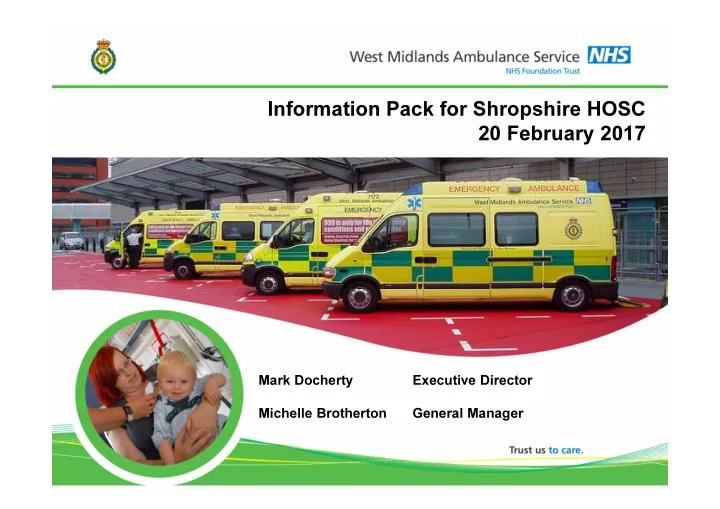
Information Pack for Shropshire HOSC 20 February 2017 Mark Docherty - - PowerPoint PPT Presentation

information pack for shropshire hosc 20 february 2017
SMART_READER_LITE
LIVE PREVIEW

Information Pack for Shropshire HOSC 20 February 2017 Mark Docherty - - PowerPoint PPT Presentation

Information Pack for Shropshire HOSC 20 February 2017 Mark Docherty Executive Director Michelle Brotherton General Manager Items we are covering Background to the Service CQC Rating Vision / Strategic Objectives / Strategic Values

slide-1
SLIDE 1

Information Pack for Shropshire HOSC 20 February 2017

Mark Docherty Executive Director Michelle Brotherton General Manager

slide-2
SLIDE 2

Items we are covering

  • Background to the Service
  • CQC Rating
  • Vision / Strategic Objectives / Strategic Values
  • Two Year Operational Plan
  • Draft Quality Account Priorities
  • Activity, Demand and Performance
  • Physician Response Unit
  • Collaboration with Fire and Rescue Service
  • Ambulance Response Programme
  • The Electronic Record
slide-3
SLIDE 3

Overview

  • Only Ambulance Service to achieve each of the national emergency access

targets 2015/16 and best performing of each

  • Only Ambulance Trust in Segment One of Single Oversight Framework
  • WMASFT remains the top performing service in the Country
  • One of four Ambulance Trusts to achieve statutory Financial duties
  • No Paramedic vacancies – circa 2,500 nationally
  • Lowest sickness absence rate in Country
  • Highest paramedic skill mix ratio in Country
  • Best fleet in the Country
slide-4
SLIDE 4
  • Established in July 2006 merging with Staffordshire in October 2007
  • 5.6 million population (Circa 10.5% of the English population)
  • Over 5,000 square miles, 80% rural
  • Approaching 3000 999 calls per day
  • Over 532,000 emergency journeys annually
  • £250 million budget
  • Fleet of over 850 vehicles
  • 4,500 Staff and 1,000 Volunteers
  • 5 x Helicopters
  • 1 x Motorcycle

Firmograhics

slide-5
SLIDE 5

CQC Rating

slide-6
SLIDE 6

Vision

Delivering the right patient care, in the right place, at the right time, through a skilled and committed workforce, in partnership with local health economies

Strategic Objectives

Achieve Quality and Excellence Accurately assess patient need and direct resources appropriately Establish market position as an Emergency Healthcare Provider Work in Partnership

Values

  • World Class Service
  • Patient Centred
  • Dignity and Respect

for All

  • Skilled Workforce
  • Teamwork
  • Effective

Communication

Strategic Priorities

Business as Usual New Models of Care Business Opportunities Prevention

slide-7
SLIDE 7

Activity

– Evidence of continued growth at around 4% per year, forecast between 2.6% and 3.1% – Regular review of operational model to ensure continued focus on efficiency – Early implementation site for the Ambulance Response Programme (ARP). WMAS taken lead role in developing the way in which calls are categorised with the aim of dispatching the right resource in a timely manner to improve clinical outcomes. – Regular dialogue with commissioners throughout the region

Quality

– Overview of governance arrangements and the process for assessing implications of changes on quality – Quality Account Priority areas for Patient Experience, Patient Safety and Clinical Effectiveness

Workforce

– Arrangements for creating and updating the Workforce Plan – Ambitious recruitment and education programme to support optimum skill mix – Links with Health Education England to address skill shortages

Two Year Operational Plan - Key Messages

slide-8
SLIDE 8

Draft Quality Account Priorities

slide-9
SLIDE 9

Shropshire Response Posts

  • 2 x Hubs
  • 7 x Community

Ambulance Stations

  • 2 x Response posts
slide-10
SLIDE 10

Community Response Scheme Locations

  • Ludlow
  • Tweedale
  • Bridgnorth
  • Oswestry
  • Whitchurch
  • Market Drayton
  • Craven Arms

Response Post Locations

  • Shrewsbury Battlefields
  • Shrewsbury West
slide-11
SLIDE 11

Activity, Demand and Performance

slide-12
SLIDE 12

Hospital Handover Performance

April 2016 to January 2017

  • Performance
  • Over hour delays are considered unacceptable
  • WMAS meets regularly with hospital colleagues

Average Longest Princess Royal At hospital to handover 22 minutes 2 hours 57 minutes At hospital to crew clear 34 minutes 3 hours 1 minute Royal Shrewsbury At hospital to handover 33 minutes 3 hours 37 minutes At hospital to crew clear 42 minutes 4 hours 31 minutes

slide-13
SLIDE 13

Hospital Handover Delays

slide-14
SLIDE 14

Shropshire CCG Financial Year 2011/12 2012/13 2013/14 2014/15 2015/16 2016/17

(to Jan 17)

Assigned Incidents 33,172 36,027 37,512 40,151 41,876 36,047 Annual Growth 8.6% 4.1% 7.0% 4.3% 3.5%

WMASFT Annual Activity Growth

slide-15
SLIDE 15

Ambulance Clinical and Quality Indicators

  • Return of Spontaneous Circulation (ROSC)
  • ST Elevation Myocardial Infarction (STEMI)
  • Survival to discharge

YTD West Mercia 30.34% WMAS 31.66% National Mean 29.51% YTD West Mercia 10.49% WMAS 9.36% National Mean 8.54% YTD West Mercia 79.35% WMAS 80.03% National Mean 79.47%

slide-16
SLIDE 16

Ambulance Clinical and Quality Indicators

  • Stroke Care Bundle

YTD West Mercia 97.96% WMAS 97.92% National Mean 97.75%

slide-17
SLIDE 17

Physician Response Unit

slide-18
SLIDE 18

Background

  • The Scheme launched 11/07/2016
  • All 6 PRU doctors completed their induction and began working with WMAS
  • Week commencing 05/09/2016 PRU were given access to the CAD which enabled

them to self select work

  • Following reported concerns with the operation of the scheme, the decision was taken

to suspend the operating model to allow further discussions to take place

Current Position

  • WMAS has offered to run a similar model to that in Worcester in which:

– Doctors will respond to WMAS calls in their own cars – Blue lights will not be used – The response model will predominantly be a secondary response

  • WMAS is currently awaiting a response to allow this model to be implemented
slide-19
SLIDE 19

Collaboration with the Fire & Rescue Service

slide-20
SLIDE 20

Current Position

  • A meeting took place between WMAS and the Fire and

Service in December

  • A proposal has been presented to the Fire Service
  • Two further meetings are planned in March 2017
slide-21
SLIDE 21

The Ambulance Response Programme (ARP)

slide-22
SLIDE 22

The Ambulance Response Programme (ARP) aims to increase

  • perational efficiency whilst maintaining a clear focus on the clinical

need of patients, particularly those with life threatening illness and injury. NHS England have confirmed that we are not permitted to report any performance at this stage. The evaluation report will be with NHS England for review at the end of February 2017

Ambulance Response Programme

slide-23
SLIDE 23

Phase 2.2 – Categories

Cat 1

  • Cat 1 R (Response)
  • Cat 1 T (Transport)

Cat 2

  • Cat 2 R (Response)
  • Cat 2 T(Transport)

Cat 3

  • Cat 3 R (Response)
  • Cat 3 T(Transport)

Cat 4

  • Green T (Transport)
  • Green H (Hear and Treat)

Referral

slide-24
SLIDE 24
  • Category 1:

Immediately life threatening: cardiac arrest and threatened cardiac arrest. Resuscitation often required.

  • Category 2:

Emergencies requiring assessment and treatment, +/- transport: C2T: Assess, treat, transport C2R: Assess and treat

  • Category 3:

Urgent problems requiring treatment to relieve suffering and/or timely transport C3T: Assess, treat, transport C3R: Assess and treat

  • Category 4:

Non-urgent C4R: Assess and treat +/- transport C4H: Non-ambulance response (“hear and treat”)

slide-25
SLIDE 25

Phase 2.2 – Categories Cat 1

  • Approx 7% of activity
  • 75% in 8 minutes target still remains
  • 19 minute transport target still remains, though now only includes

patients that were transported.

  • Includes Cardiac Arrests – as per old Red 1
  • Also includes:
  • Fitting Now
  • Under 5s only – specific disposition codes.
slide-26
SLIDE 26

Phase 2.2 – Categories Cat 2

  • 45% of activity
  • Focus on getting the right response to the patient, not necessarily the

fastest.

  • Cat 2 R – Assess Treat Transport
  • Cat 2 T – Assess Transport
slide-27
SLIDE 27

Phase 2.2 – Categories Cat 3

  • 40% of activity
  • Focus on getting the right response to the patient, not necessarily the

fastest.

  • Cat 3 R – Assess Treat Transport
  • Cat 3 T – Assess Transport
slide-28
SLIDE 28

Phase 2 – Categories Cat 4

  • Around 10% of activity
  • Cat 4 T - Transport
  • Cat 4 H – Hear and Treat
slide-29
SLIDE 29

ARP – Measuring the Trial

  • The ARP trial, throughout phases 1 and 2.2 is being closely monitored

by NHSE.

  • Monthly data submissions are supplied from all Trusts.
  • Phase 2.2 trial sites are providing daily, weekly and monthly data

returns.

  • Staff Surveys undertaken
  • University of Sheffield are academic partner, and are evaluating the

trial

  • Evaluation report due out to NHSE at end of Feb 17
slide-30
SLIDE 30

Electronic Patient Record

slide-31
SLIDE 31
slide-32
SLIDE 32
slide-33
SLIDE 33

111 222 3333

Demographics are collected including NHS Number The Zoll X Series Monitor is linked to the EPR

slide-34
SLIDE 34

Images can be captured on the device, and are automatically uploaded to the system Once the Destination has been selected then images are available to view

slide-35
SLIDE 35
slide-36
SLIDE 36

Developing for the Future

  • Development following feedback from Staff to further improve the

experience

  • Safeguarding Module
  • Access to previous WMAS Patient Records
  • Barcode entry for WMAS Drugs
  • Decision making software
  • Directory of Services