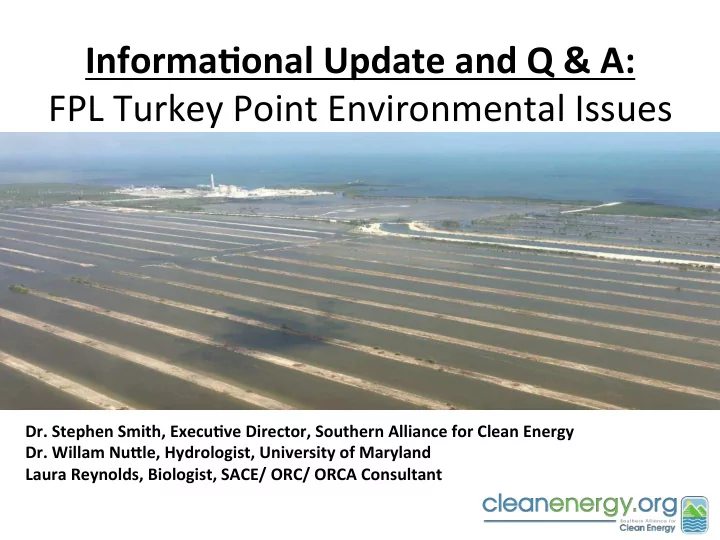
Informa(onal Update and Q & A: FPL Turkey Point Environmental - - PowerPoint PPT Presentation

informa onal update and q a fpl turkey point
SMART_READER_LITE
LIVE PREVIEW

Informa(onal Update and Q & A: FPL Turkey Point Environmental - - PowerPoint PPT Presentation

Informa(onal Update and Q & A: FPL Turkey Point Environmental Issues Dr. Stephen Smith, Execu(ve Director, Southern Alliance for Clean Energy Dr. Willam NuDle, Hydrologist, University of Maryland Laura Reynolds, Biologist, SACE/ ORC/ ORCA


slide-1
SLIDE 1

Informa(onal Update and Q & A: FPL Turkey Point Environmental Issues

  • Dr. Stephen Smith, Execu(ve Director, Southern Alliance for Clean Energy
  • Dr. Willam NuDle, Hydrologist, University of Maryland

Laura Reynolds, Biologist, SACE/ ORC/ ORCA Consultant

slide-2
SLIDE 2

About SACE

For over 30 years, the Southern Alliance for Clean Energy (SACE) has promoted responsible energy choices to address the impacts of global climate change and ensure clean, safe and healthy communi(es throughout the Southeast. SACE has come to occupy the forefront of the poli(cal and social struggles surrounding clean energy and solar freedom in

  • Florida. Our unmatched organiza(onal technical exper(se, media savvy,

and ins(tu(onal knowledge on energy issues has made us the go-to group

  • n energy issues in the Sunshine State.
slide-3
SLIDE 3

Google Maps

slide-4
SLIDE 4
slide-5
SLIDE 5

Solu(on: Install Cooling Towers

Mechanical DraX Towers at Turkey Pt Unit 5

  • Proven, best

available technology

  • Already in use at

Turkey Point Unit 5

  • Proposed for new

Turkey Point reactors

  • Affordable, can be

installed in a (mely manner

slide-6
SLIDE 6

A Closed Loop System?

slide-7
SLIDE 7

Direct Connec(on with Aquifer

slide-8
SLIDE 8

Impacts to Regional Water Resources

  • Public water

supply wells are threatened

  • 7 MGD seepage of

hypersaline water feeds westward plume

  • Interceptor ditch

removes 3.4 MGD freshwater from aquifer

  • Saltwater intrusion

at 600 feet per year

slide-9
SLIDE 9

Plume Encroaches on Supply Wells

slide-10
SLIDE 10

Episodic Discharge into Biscayne Bay

0.5 1 1.5 2 2.5 3 3.5 4 4.5 5 5.5 6

  • 2
  • 1.5
  • 1
  • 0.5

0.5 1 1.5 2 12/15/14 1/9/15 2/3/15 2/28/15 3/25/15 4/19/15 5/14/15 6/8/15 7/3/15 7/28/15 8/22/15 9/16/15 10/11/15 11/5/15 11/30/15 12/25/15 1/19/16 2/13/16 3/9/16 4/3/16 4/28/16 Ammonia, as N Dissolved (mg/L) Average CCS Water Level & Head Difference TPSWCCS-5 and TPBBSW-3

Water Gradient and TPBBSW-6 Ammonia Concentration

Head Difference CCS-5 and BB-3 WaterLevel (ft) Average CCS Water Level TPBBSW-6 Ammonia

East Gradient WestGradient

slide-11
SLIDE 11
  • 30
  • 20
  • 10

10 20 30

Calculated Return Canal Seepage (MGD)

Seepage Toward Biscayne Bay (positive)

  • 1
  • 0.5

0.5 1 1.5 200 400 600 800 1000 1200 1400

2010.5 2011 2011.5 2012 2012.5 2013 2013.5 2014 2014.5 2015 2015.5 2016 CCS Water Level (ft) Daily Rainfall and Pumping (MGD) Rainfall (MGD) Pumping (MGD) CCS water level (feet)

Water Inputs Drive Seepage Events

slide-12
SLIDE 12

Flushing Pollu(on into Biscayne

Water Balance Model: Source FPL

slide-13
SLIDE 13

Discharge of Pollutants into Biscayne Bay

  • CCS discharges pollutants episodically – example Nov

2015 thru Jan 2016.

  • Shallow groundwater seepage into bay occurs when

hydraulic gradients reverse. Reversals occur frequently, but they must be sustained over many days for pollutants to reach the bay. This occurs less frequently.

  • Plant opera(ons affect seepage to Biscayne Bay in two

ways.

– Seepage increases with increased freshwater supply, for example by adding water from canals or wells. – Running the circula(ng pumps decreases seepage. (And, turning them off is bad.)

  • Seepage into Biscayne Bay was detected immediately

aXer the CCS was put into opera(on in the 1970s.

slide-14
SLIDE 14

Cooling Canals prior to Uprate

No other system in the world is like FPL’s Turkey Point cooling canal system

slide-15
SLIDE 15

Algal Bloom Progression

March, 2010 March, 2013 January, 2014

slide-16
SLIDE 16
slide-17
SLIDE 17
  • December 2015-Dec

2016 Tri(um levels in Biscayne bay

  • Tri(um acts as a

fingerprint or tracer

  • Anything above 6.4

pC/L is above background levels

  • There is no doubt the

CCS industrial waste water is leaking into the bay.

slide-18
SLIDE 18

Seepage Detected Immediately aXer Canals Started Opera(ons

50 TU=161.1 pi/cu L 100 TU=322.2 pi/cu L

slide-19
SLIDE 19
slide-20
SLIDE 20

Environmental Degrada(on

  • Ammonia is known to damage fish popula(ons

and cause fish kills

  • Hypersaline condi(ons have degraded the

ecosystems by reducing diversity and abundance of fish and invertebrate species

  • Conflicts with goals of Everglades Restora(on

by making the area more hypersaline and drawing on the adjacent wetlands for water

  • Further study is needed on the total impacts

and degrada(on of Biscayne Na(onal Park and Card and Barns Sound.

slide-21
SLIDE 21

Thank you for having us… Ques(ons?

BECOME A MEMBER | TAKE ACTION @ www.cleanenergy.org FOLLOW US on Twitter.com/cleanenergyorg LIKE US on Facebook.com/cleanenergyorg READ MORE @ blog.cleanenergy.org/

slide-22
SLIDE 22

Q&A Slide Deck

slide-23
SLIDE 23
  • Est. cost: $22.5 Million of tax

payer money for phase 1 AlternaLve O of Biscayne Bay Costal Wetlands

  • Will “improve the ecological

health of Biscayne Bay…by adjusLng the quanLty, quality, Lming, and distribu(on of freshwater entering Biscayne Bay….”

Source: SFWMD

Conflicts with Everglades Restora(on

slide-24
SLIDE 24

FPL Turkey Point Cooling Canal System Salinity since 1973 (reported by FPL)

0.0 10.0 20.0 30.0 40.0 50.0 60.0 70.0 Q3 73 Q3 74 Q3 75 Q3 76 Q3 77 Q3 78 Q3 79 Q3 80 Q3 81 Q3 82 Q3 83 Q3 84 Q3 85 Q3 86 Q3 87 Q3 88 Q3 89 Q3 90 Q3 91 Q3 92 Q3 93 Q3 94 Q3 95 Q3 96 Q3 97 Q3 98 Q3 99 Q3 00 Q3 01 Q3 02 Q3 03 Q3 04 Q3 05 Q3 06 Q3 07 Q3 08 Salinity (ppt)

CCS Maximum Quarterly Salinity

  • Sept. 1973 to Sept. 2008

(Source FL0001562 NPDES Permit Monitoring Reports)

Seawater salinity

slide-25
SLIDE 25

Scien(fic Needs-30% Error

  • Evapora(on: AcousLc Doppler Wind speed sensors and EvaporaLve

Flux meters

  • Rainfall Correc(on: There is only 1 rain gauge on site there should be

8, a correlaLon must be done with the NEXRAD data to ground truth informaLon

  • Flow Meters: Measure the velocity of water circulaLng in the

canals---add in 3 locaLons (Discharge, Mid South end and Intake locaLons)

  • Dye Study: To see exactly where the polluLon plume goes and how

fast---with a ½ life of 12.5 years this is likely influencing areas much farther then the evidence shows

  • Ecosystem Harm: a comprehensive study to determine potenLal

harm to Biscayne Bay and surrounding wetlands

  • Update Models: currently the ESA model does not take into account

flow zones or any informaLon to the east of the canals and there is a 30% error in water budget

slide-26
SLIDE 26
slide-27
SLIDE 27

FPL’s current operaLons at the Turkey Point nuclear power plant are in violaLon of state and federal law –yet DEP lays the groundwork to conLnue operaLons of the CCS beyond 2032, Dade county is calling for it to be shut down

  • Turkey Point is one of Florida’s largest water users and is exacerbaLng

Salt Water Intrusion to the West and consuming our potable water supply

– DEP does nothing to stop the interac2ons with the Biscayne Aquifer – Unknown if extrac2on well plan may cause harm? – According to model analysis there are real concerns the plume will s2ll be moving at depth

  • The impacts from Turkey Point are in direct conflict with the goals of

Everglades RestoraLon and degrading a NaLonal Park

– DEP does nothing to stop the salt loading of 3 Million lbs. per day – DEP does nothing to make FPL iden2fy the most sustainable water source--Reuse

  • Turkey Point is illegally releasing a massive plume of polluLon into

both Biscayne NaLonal Park and the Biscayne Aquifer:

– DEP deny any viola2ons of Numeric Nutrient Criteria Rules – DEP deny any impacts to Biscayne Bay – DEP does not offer a comprehensive solu2on

The DEP Consent Decree

slide-28
SLIDE 28
slide-29
SLIDE 29

1-Model does not account for Evap/ TranspiraLon losses, the model may accurately represent water coming in but not leaving. 2-Model does not accurately show where the SW/FW interface is located—the model does not reflect reality. 3-The two large rock mines are not included in the model, and in fact some of the runs show they are underwater. 4-The L-31 canal is treated as a water source and not a sink, this dampens the simulated impacts to the adjacent wetlands. 5-Some of the model runs even with all of this “extra” water in the system shows more than a 10th of a foot impact on drawdown.

Problems with the FPL Model

slide-30
SLIDE 30

LocaLon of proposed cooling towers

slide-31
SLIDE 31

Solving the Ocean Ouoall Issue

slide-32
SLIDE 32