
SLIDE 1
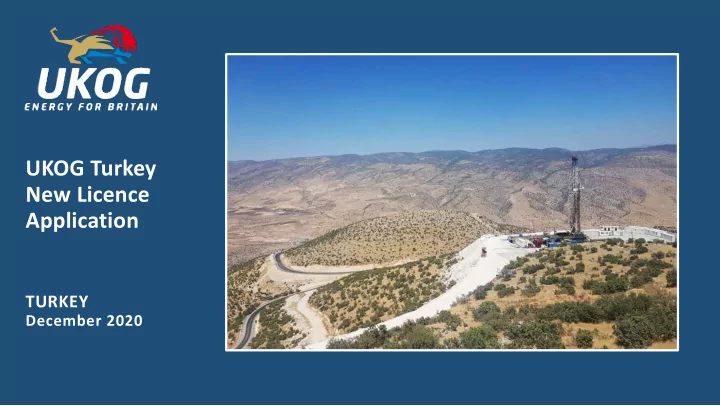
UKOG Turkey New Licence Application TURKEY December 2020 Turkey: - - PowerPoint PPT Presentation
UKOG Turkey New Licence Application TURKEY December 2020 Turkey: New UKOG Turkey Licence Application UKOG Turkey and its 50/50 partner Aladdin Middle East (AME) have applied to the Turkish authorities for three further exploration
2
three further exploration licences in south east Turkey.
Company’s 305 km² Basur-Resan Licence (see RNS releases of July 23 and October 13, 2020).
costs.
anticlines), each geologically similar to the Company’s Basur-Resan oil appraisal project, AME’s producing East Sadak oil field and the Kurdistan Region of Iraq’s oil fields to the south.
any, are awarded to AME/UKOG.
3
Basur-Resan 37 MMbbl
Shaikan 1036 mmbbl
Tawke 614 mmbbl 148
Loxley (UK) 7.1 MMboe Arreton (UK) 2.6 MMbbl Total Weald Basin (all producing fields) 44 MMbbl
East Sadak 28 MMbbl Garzan 47 MMbbl
147 193
Silivanka 18 MMbbl Magrip 18 MMbbl Celikli 6 MMbbl
37 28 47 18 18 6 44
A r e a s
t h
R e s a n t
r a q i B
d e r l i g h t l y e x p l
e d , l i t t l e
n
e i s m i c , f e w w e l l s
Total SE Turkey 572 mmbbl
SE Turkey has 13x UK Weald Basin total proven oil volumes (572 mmbbl vs 44 mmbbl) Kurdistan Region of Iraq (KRI) ~10x SE Turkey SE Turkey and KRI share same petroleum system
Source: UKOG CPR, 2018; Xodus report 6/2020, 8/2020; IHS Energy; JKP website; DNO website, ERCE CPR, 2016; OGA website
4
10 km
Resan structure with good oil indications (4 km²), only 3 wells in remaining 608 km² in 60 years, no real seismic coverage
plus Kedil in same year, where fractured Cretaceous Mardin limestones proven commercial
promote, UKOG pays working interest share
Application Block Seismic line Well
Bukat-1
Kedil Oil Field Resan wells-oil shows
field Basur-Resan discovery
5
(light green) plus possible further significant extension (yellow) to SE on geological trend.
from same reservoir formation as E. Sadak. Bukat geological feature (anticline) extends into application block
identified from satellite and surface geological mapping. Geologically similar to UKOG’s Basur-Resan discovery, AME producing E. Sadak field and small Kedil field. 10 km
Prospective geological feature (surface anticline)
Bukat-1 discovery? Basur-Resan discovery
Application Block Axis of surface geological feature (anticline) Oil field or discovery
Possible Basur-Resan extension ? Kedil Field
6
East Sadak oil field along the same surface geological feature (anticline). Offers possible further extension of Basur-Resan towards E. Sadak
features (anticlines) in south of block
M47-b3 Resan Licence Basur Oil Discovery East Sadak Oil Field Resan Oil Shows
N Prospective geological feature (surface anticline) Application Block Axis of surface geological feature (anticline) Oil field or discovery
7
Sadak oil field
have recovered oil to surface from same Cretaceous-age fractured limestone as East Sadak
surface anticline with deeper Jurassic to Palaeozoic potential
M48-d1
N
Bukat-1 East Sadak Oil Field
Prospective geological feature (surface anticline) Application Block Axis of surface geological feature (anticline) Oil field or discovery
8
field, on parallel geological trend (surface anticline)
fractured Cretaceous Mardin limestones as East Sadak and Basur
M47-c1, c2 Resan Licence Kedil Oil Field Girdara East Sadak Oil Field Basur- Resan Oil Discovery
N Prospective geological feature (surface anticline) Application Block Axis of surface geological feature (anticline) Oil field or discovery
9
Oil
containing folded rocks with an arch-like cross section and oval/lozenge shape plan view and which has the oldest rocks at its core.
mountains such as the Turkish Taurus and Iraq- Iran Zagros. A fold belt is simply a series of anticlines resulting from mountain building i.e. the Taurus-Zagros fold belt
configuration of rocks at surface is called a “surface anticline”. Most of the major anticlines and related oil fields in Turkey, Iraq and Iran have surface expression of the underlying geology, hence why satellite imagery is useful.
feature in which oil & gas are found and account for most of the fields in Iraq, Iran and SE Turkey
Source: https://www.britannica.com/science/petroleum/Accumulation-in-reservoir-beds