Infertility Evaluation and ART Center for Reproductive Health - - PowerPoint PPT Presentation

infertility evaluation and art
SMART_READER_LITE
LIVE PREVIEW

Infertility Evaluation and ART Center for Reproductive Health - - PowerPoint PPT Presentation

10/20/2017 Disclosure No one involved in the planning or presentation of this activity has any relevant financial relationships with a commercial interest to disclose. Infertility Evaluation and ART Center for Reproductive Health Center for


slide-1
SLIDE 1

10/20/2017 1

Infertility Evaluation and ART

Center for Reproductive Health

Evelyn Mok-Lin, MD

Assistant Professor, Obstetrics, Gynecology and Reproductive Sciences Medical Director, UCSF Center for Reproductive Health

2

Disclosure

No one involved in the planning or presentation of this activity has any relevant financial relationships with a commercial interest to disclose. Center for Reproductive Health

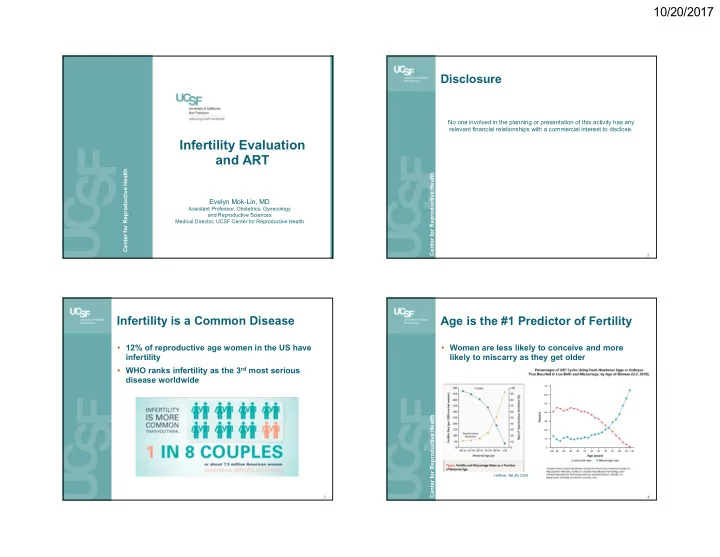
Infertility is a Common Disease

  • 12% of reproductive age women in the US have

infertility

  • WHO ranks infertility as the 3rd most serious

disease worldwide

3 4

Age is the #1 Predictor of Fertility

  • Women are less likely to conceive and more

likely to miscarry as they get older

Center for Reproductive Health

Heffner, NEJM 2004

slide-2
SLIDE 2

10/20/2017 2

5

Decreasing Egg Quantity with Age

Center for Reproductive Health

Wallace and Kelsey, PLoS 2010

  • Finite number of follicles at birth
  • 12% remaining at age 30
  • 3% remaining at age 40

Abnormal Spindles in Older Eggs

20-25 year old eggs

– 17% of eggs with abnormal spindle assembly

40-45 year old eggs

– 83% of eggs with abnormal spindle assembly

6 Battaglia et al, Human Reproduction 1996

Increasing Rates of Chromosomal Abnormalities with Age

7

Aneuploidy Rates in Couples Undergoing IVF

8 Franasiak et al. Fertility and Sterility 2014

slide-3
SLIDE 3

10/20/2017 3

Age at which to start trying to conceive

9 Habbema et al. Human Reproduction 2015 10

Evaluation of the Infertile Couple

Center for Reproductive Health

11

Evaluation of the Infertile Couple

  • Ovarian Reserve Testing
  • Tubal Patency Assessment
  • Semen Analysis
  • Other Indicated Testing

Center for Reproductive Health

12

Ovarian Reserve Testing

  • Anti-Mullerian Hormone (AMH)

– The most reliable predictor – Produced by granulosa cells of pre-antral and small antral follicles – Drawn at any time in the menstrual cycle – Can be drawn while on hormonal contraceptives (long-term use may suppress levels) – The higher the level, the higher the reserve – “Normal” level is age-dependent

Center for Reproductive Health

slide-4
SLIDE 4

10/20/2017 4

13

Ovarian Reserve Testing

  • Follicle Stimulating Hormone (FSH)

– Indirect marker of ovarian reserve – Produced by the pituitary in response to negative feedback from estradiol and inhibin B – Drawn on day 2-3 of the menstrual cycle along with an estradiol (E2) – The higher the level, the lower the reserve – Normal is <10-12 IU/L

Center for Reproductive Health

14

Ovarian Reserve Testing

  • Antral Follicle Count (AFC)

– The number of follicles <10mm – Assessed via transvaginal ultrasound at any time in the cycle – The higher the AFC, the higher the reserve

There is no screening test for egg QUALITY,

  • nly quantity

Center for Reproductive Health

15

Tubal Patency Assessment

  • Hysterosalpingogram (HSG)
  • Sono HSG (FemVue)

Center for Reproductive Health

16

Tubal Patency Assessment

  • Hysterosalpingogram (HSG)

– Oil-based better than water-based

Center for Reproductive Health

Dreyer et al. NEJM 2017

slide-5
SLIDE 5

10/20/2017 5

17

Evaluation of the Infertile Couple

  • Semen Analysis
  • Other Indicated Testing

– Thyroid – Prolactin – PCOS labs – Other imaging

Center for Reproductive Health

18

Optimizing Natural Fertility

Center for Reproductive Health

19

Assisted Reproductive Technology (ART) Options

Center for Reproductive Health

20

Assisted Reproductive Technology (ART) Options

  • Superovulation

– Ovulation of >1 egg to overcome the age effect – Oral agents (Clomid, Letrozole) – Injectable FSH/LH (Gonal-F, Follistim, Menopur) – Often used in conjunction with intrauterine insemination (IUI)

Center for Reproductive Health

slide-6
SLIDE 6

10/20/2017 6

21

Clomiphene Citrate (Clomid)

  • Selective Estrogen

Receptor Modulator (SERM)

  • ER antagonist at

the hypothalamus

  • Inhibits negative

feedback of estrogen

  • Increased GnRH

pulsatility

  • Increased pituitary

FSH and LH secretion

Center for Reproductive Health

22

Clomid Instructions

Center for Reproductive Health

Take 50-150mg (1-3 tabs) daily x 5 days Start on cycle day 3 (days 3-7)

Check ovulation kit starting day 10 until + Intercourse or IUI 12-24 hours after +kit Ultrasound on day 10 Intercourse or IUI 24-36 hours after hCG trigger hCG trigger

Based on a 28 day cycle

23

Potential Side Effects of Clomid

  • Increased multiple pregnancy rate (7%)
  • Mood swings
  • Hot flushes
  • Headaches
  • Bloating
  • Visual symptoms and light sensitivity
  • Decreased endometrial thickness
  • Decreased cervical mucus

Center for Reproductive Health

24

Artificial Insemination (AI) or Intrauterine Insemination (IUI)

Center for Reproductive Health

slide-7
SLIDE 7

10/20/2017 7

25

Letrozole (Femara)

  • Aromatase inhibitor

(AI)

  • Blocks conversion
  • f androgens into

estrogen

  • Inhibits negative

feedback of estrogen

  • Increased GnRH

pulsatility

  • Increased pituitary

FSH and LH secretion

Center for Reproductive Health

26

Letrozole (Femara)

  • 2.5-7.5mg (1-3 tabs) daily x 5 days
  • Not FDA approved for fertility use
  • More expensive
  • Fewer side effects (fatigue and dizziness)
  • Increased success rates in PCOS patients

– Legro et al., NEJM 2014 – 750 infertile women 18-40 years of age – Randomized to Letrozole or Clomid with intercourse for up to 5 cycles – Higher ovulation, pregnancy and live-birth rates in Letrozole group

Center for Reproductive Health

27

Center for Reproductive Health

28

IVF

Center for Reproductive Health

Veeck, Atlas of Human Gametes and Conceptuses

slide-8
SLIDE 8

10/20/2017 8

29

IVF Procedure

Center for Reproductive Health

1 3 5 7 9

FSH+LH

hCG trigger Egg Retrieval

11 13 Days

30

IVF Procedure

Center for Reproductive Health

31

Intracytoplasmic Sperm Injection (ICSI)

Center for Reproductive Health

32

Preimplantation Genetic Screening

  • PGS vs PGD
  • Benefits of PGS for women > 37:

– Decreased risk of early miscarriages from aneuploidy – Decreased risk of chromosomally abnormal pregnancies – Decreased number of embryo transfer attempts – Decreased risk of multiple gestation

Center for Reproductive Health

slide-9
SLIDE 9

10/20/2017 9

33

Preimplantation Genetic Screening

  • Risks of PGS:

– Increased cost – Increased manipulation of the embryo – Decreased total number of embryos for transfer (possible decrease in cumulative pregnancy rate) – Error rates and mosaicism

Center for Reproductive Health

34

Summary

  • Fertility rates decrease and miscarriage rates

increase as women get older

  • Initiate infertility evaluation and refer to REI after 12

months of trying to conceive in a woman < 35 yrs, and after 6 months in a woman > 35 yrs

  • Treatment options include superovulation / IUI and

IVF (+/- PGS)

Center for Reproductive Health

Thank you