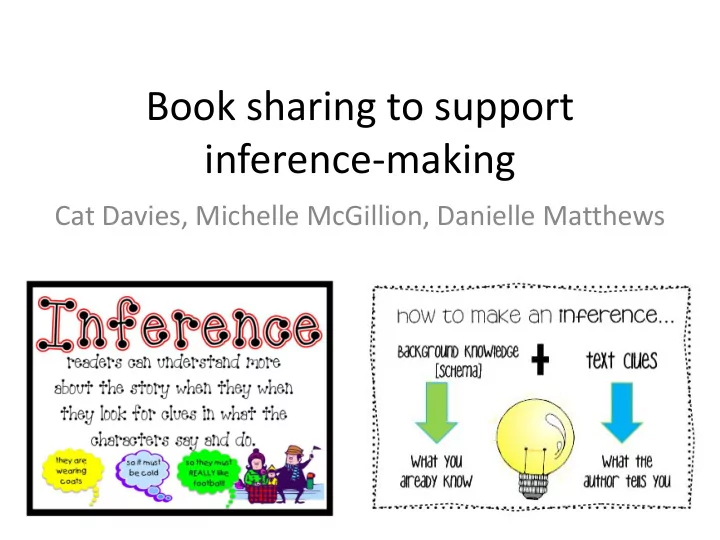
inference-making Cat Davies, Michelle McGillion, Danielle Matthews - - PowerPoint PPT Presentation
Book sharing to support inference-making Cat Davies, Michelle McGillion, Danielle Matthews This session will 1. Review the role of inferencing in language comprehension; 2. Summarise research on the development of inferencing, including
This session will
- 1. Review the role of inferencing in language
comprehension;
- 2. Summarise research on the development of inferencing,
including preliminary results from our randomised controlled trial inferencing intervention;
- 3. Discuss inferencing skills in relation to your practice.
The role of inferencing in language development
Percy began to push the heavy wheelbarrow over a little bridge - SPLASH!
Percy fell into the water
They began by unloading all Percy’s tools and the planks of wood from the wheelbarrow. Percy showed the badger how to use a saw and he showed the squirrel how to knock in nails.
Tools = saw and hammer
Inferencing benefits comprehension
- Inference training improves reading comprehension (McGee &
Johnson, 2003; Yuill & Oakhill, 1988).
- Inferencing skill predicts (later) reading comprehension skill
(Cain & Oakhill, 1999; Silva & Cain, 2015)
- Inference training improves oral comprehension (Bianco et al.,
2010).
- Inferencing skill predicts comprehension of implicit and explicit
- ral information (Florit et al., 2011)
- > Skilled comprehenders strive for coherence (Cain & Oakhill, 1999)
Other skills benefit inferencing
- Vocabulary (Currie & Cain, 2015)
- Oral language skills , i.e. vocabulary and verbal working memory (Lucas &
Norbury, 2015; Cain et al., 2001)
Our study
In this pre-registered randomised control trial, we tested the effect of increasing exposure to inferential questions during shared book reading on 4-year-olds’ inferencing abilities. We used parent-child book reading as a means of scaffolding the development of inferencing skills since some parents naturally ask their children inferential questions about shared stories.
- 100 parent-child dyads were randomly allocated to an intervention
- r control condition according to CONSORT guidelines.
- One third of families in the sample live in the most deprived
neighbourhoods nationwide (IMD deciles 1-3).
- First, parents in both conditions watched a training
video that provided the background and instructions.
- Participants in the training condition were given 10
books with inference-making questions to support inference-eliciting dialogue during book reading.
- Participants in the control condition were given a
maths workbook to work through together.
- Parents in both conditions were asked to use the
materials with their child daily for a month.
- Families in both conditions were given an
intervention diary and asked to record each time they read a particular book or completed a page in the maths workbook.
- Pre- and post-test of inferencing ability.
Quantitative results
- The intervention did not change inferencing ability or
language scores.
- SES background did not affect performance on the
inferencing task or language tests.
Quantitative results
Better language skills = better inferencing skills
Emerging conclusions
- Exposure to complex language may help inferencing
ability.
- Although naturalistic questioning during shared
book reading highlights gaps in texts and encourages children to look for meaning, our data show that it is not sufficient for improving inferencing skills.
- Direct teaching may more effective for developing
inferencing.
Qualitative analysis of engagement
Intervention diary comments
- Repetition of books and questions
– The questions only strengthened his understanding – Answered all questions first time. Refused to answer them again (Sorry, I tried!)
- Some inferences are harder than others
– She found ones about feeling […] most difficult. – He doesn't know what mustard is and its taste
- Concentration and energy levels affect performance
– Wasn’t really focused on the book. Enjoyed looking for Todd
- Useful for parents to explicitly see how much their children
understand
– [I] didn't think he would understand what Mrs Grinding was taking out of her basket but did. He surprised me here
32 returns analysed; median intervention length = 37 days; mean number of reading sessions = 24
Discussion
1. How does this information compare to inferencing training that practitioners receive? 2. How does our intervention compare to the way that inferencing in taught in your context? (e.g. format, age) 3. Why wasn’t the intervention effective?
– Were our children at a developmentally appropriate level for this type of training? – Is asking and answering questions during SBR sufficiently intense?
4. How might our study inform similar interventions or practices?
– Consider age and form of training – Consider other cognitive skills required by the post-test measures.
Thank you
- Participating families
- RAs: Kiera Solaiman, Lowri Thomas, Charlotte
Rowley, Annalise Guild, Lauren Lofthouse, and Rachael Staunton
- Shared book reading project team
References
- Bianco, M., Bressoux, P., Doyen, A.L., Lambert, E., Lima, L., Pellenq, C., Zorman, M. 2010. Early training of
- ral comprehension and phonological skills at preschool: the results of a 3 years longitudinal study.
Scientific Studies of Reading, 14(3), 211-246.
- Cain, K. & Oakhill, J. 1999, 'Inference making ability and its relation to comprehension failure' Reading and
Writing, vol 11, no. 5-6, pp. 489-503.,
- Cain, K., Oakhill, J. V., Barnes, M. A., & Bryant, P. E. 2001. Comprehension skill, inference-making ability,
and their relation to knowledge. Memory & Cognition, 29(6), 850-859.
- Currie, N & Cain, K. 2015. Children’s inference generation: the role of vocabulary and working memory
Journal of Experimental Child Psychology, vol 137, pp. 57-75., 10.1016/j.jecp.2015.03.005
- Florit, E., Roch, M. and Levorato, M. C., 2011. Listening text comprehension of explicit and implicit
information in preschoolers: the role of verbal and inferential skills. Discourse Processes, 48, 119–138.
- Lucas, R. & Norbury, C. 2015. Inferencing from text: It’s vocabulary that matters. Journal of Speech,
Language and Hearing Research. Vol. 58, 1224-1232.
- McGee, A., & Johnson, H. 2003. The Effect of Inference Training on Skilled and Less Skilled Comprehenders.
Educational Psychology, 23(1), 49-59.
- Silva, M & Cain, K 2015. The relations between lower and higher level comprehension skills and their role
in prediction of early reading comprehension' Journal of Educational Psychology, vol 107, no. 2, pp. 321- 331.
- Yuill, N., & Oakhill, J. 1988. Effects of inference awareness training on poor reading-comprehension.
Applied Cognitive Psychology, 2(1), 33-45. Further reading:
- DEPARTMENT FOR CHILDREN, SCHOOLS AND FAMILIES, 2008. Effective Teaching of Inference Skills for
- Reading. DCSF-RR031. London: DfCSF.