INF3490 - Biologically inspired computing Swarm Intelligence, Fuzzy - - PDF document

inf3490 biologically inspired computing
SMART_READER_LITE
LIVE PREVIEW

INF3490 - Biologically inspired computing Swarm Intelligence, Fuzzy - - PDF document

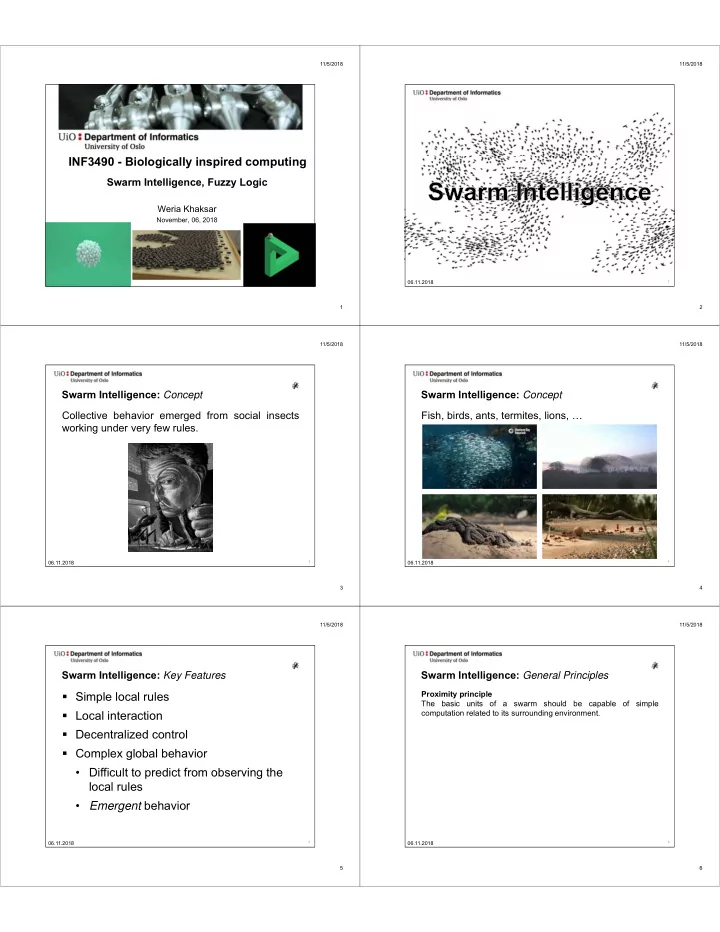
11/5/2018 11/5/2018 INF3490 - Biologically inspired computing Swarm Intelligence, Fuzzy Logic Weria Khaksar November, 06, 2018 06.11.2018 2 1 2 11/5/2018 11/5/2018 Swarm Intelligence: Concept Swarm Intelligence: Concept Collective


slide-1
SLIDE 1

11/5/2018 1

INF3490 - Biologically inspired computing

Swarm Intelligence, Fuzzy Logic

Weria Khaksar

November, 06, 2018

11/5/2018 2

2

06.11.2018 11/5/2018 3

3

Swarm Intelligence: Concept

06.11.2018

Collective behavior emerged from social insects working under very few rules.

11/5/2018 4

4

Swarm Intelligence: Concept

06.11.2018

Fish, birds, ants, termites, lions, …

11/5/2018 5

5

Swarm Intelligence: Key Features

06.11.2018

  • Simple local rules
  • Local interaction
  • Decentralized control
  • Complex global behavior
  • Difficult to predict from observing the

local rules

  • Emergent behavior

11/5/2018 6

6

Swarm Intelligence: General Principles

06.11.2018

Proximity principle The basic units

  • f

a swarm should be capable

  • f

simple computation related to its surrounding environment.

slide-2
SLIDE 2

11/5/2018 7

7

Swarm Intelligence: General Principles

06.11.2018

Proximity principle The basic units

  • f

a swarm should be capable

  • f

simple computation related to its surrounding environment. Quality principle Apart from basic computation ability, a swarm should be able to response to quality factors, such as food and safety.

11/5/2018 8

8

Swarm Intelligence: General Principles

06.11.2018

Proximity principle The basic units

  • f

a swarm should be capable

  • f

simple computation related to its surrounding environment. Quality principle Apart from basic computation ability, a swarm should be able to response to quality factors, such as food and safety. Principle of diverse response Resources should not be concentrated in narrow region. The distribution should be designed so that each agent will be maximally protected facing environmental fluctuations.

11/5/2018 9

9

Swarm Intelligence: General Principles

06.11.2018

Proximity principle The basic units

  • f

a swarm should be capable

  • f

simple computation related to its surrounding environment. Quality principle Apart from basic computation ability, a swarm should be able to response to quality factors, such as food and safety. Principle of diverse response Resources should not be concentrated in narrow region. The distribution should be designed so that each agent will be maximally protected facing environmental fluctuations. Principle of stability and adaptability Swarms are expected to adapt environmental fluctuations without rapidly changing modes since mode changing costs energy.

11/5/2018 10

10

Swarm Intelligence: Particle Swarm Optimization (PSO)

06.11.2018

Mimicking physical quantities such as velocity and position in bird flocking, artificial particles are constructed to “fly” inside the search space of optimization problems.

11/5/2018 11

11

Swarm Intelligence: Particle Swarm Optimization (PSO)

06.11.2018

  • Initially, a population of particles is distributed uniformly

in the search space of the objective function of the

  • ptimization problem.
  • Two quantities are associated with particles, a position

vector 𝑦 and a velocity 𝑤.

11/5/2018 12

12

Swarm Intelligence: Particle Swarm Optimization (PSO)

06.11.2018

  • At each time step, the velocities of particles will be

updated according to the following formula:

slide-3
SLIDE 3

11/5/2018 13

13

Swarm Intelligence: Particle Swarm Optimization (PSO)

06.11.2018 11/5/2018 14

14

Swarm Intelligence: Particle Swarm Optimization (PSO) Example

06.11.2018 PSO algorithm maximizing f(x, y) = -|x**2 - y| (finding squares). 11/5/2018 15

15

Swarm Intelligence: Ant Colony Optimization (ACO)

06.11.2018

The most recognized example of swarm intelligence in real world is the ants. To search for food, ants will start out from their colony and move randomly in all directions.

11/5/2018 16

16

Swarm Intelligence: Ant Colony Optimization (ACO)

06.11.2018

Once an ant finds food, it returns to colony and leave a trail

  • f chemical substances called pheromone along the path.

Other ants can then detect pheromone and follow the same path.

11/5/2018 17

17

Swarm Intelligence: Ant Colony Optimization (ACO)

06.11.2018

The interesting point is that how often is the path visit by ants is determined by the concentration of pheromone along the path. Since pheromone will naturally evaporate

  • ver time, the length of the path is also a factor. Therefore,

under all these considerations, a shorter path will be favored because ants following that path keep adding pheromone which makes the concentration strong enough to against evaporation. As a result, the shortest path from colony to foods emerges.

11/5/2018 18

18

Swarm Intelligence: Ant Colony Optimization (ACO)

06.11.2018

Ant Colony Optimization on Traveling Salesman Problem

slide-4
SLIDE 4

11/5/2018 19

19

Swarm Intelligence: Bee Colony Optimization (BCO)

06.11.2018

Just like ants, bees have similar food collecting behaviors. Instead of pheromones, bees colony optimization algorithm relies on the foraging behavior of honey bees. At the first stage, some bees are sent out to look for promising food sources.

11/5/2018 20

20

Swarm Intelligence: Bee Colony Optimization (BCO)

06.11.2018

After a good food source is located, bees return back to colony and perform a waggle dance to spread

  • ut

information about the source. Three pieces of information are included: (1) distance, (2) direction, (3) quality of food

  • source. The better the quality of food source, the more

bees will be attracted. Therefore, the best food source emerges.

11/5/2018 21

21

Swarm Intelligence: Bee Colony Optimization (BCO)

06.11.2018 11/5/2018 22

22

Swarm Intelligence: Bee Colony Optimization (BCO)

06.11.2018 11/5/2018 23

23

Swarm Intelligence: Bee Colony Optimization (BCO)

06.11.2018 11/5/2018 24

24

Swarm Intelligence: Bee Colony Optimization (BCO)

06.11.2018

slide-5
SLIDE 5

11/5/2018 25

25

Swarm Intelligence: Bee Colony Optimization (BCO)

06.11.2018 11/5/2018 26

26

Swarm Intelligence: Bee Colony Optimization (BCO)

06.11.2018 Using the Bee colony Algorithm to solve the Knight's Tour Problem 11/5/2018 27

27

Swarm Intelligence: Cuckoo Search

06.11.2018

This algorithm is inspired by the brood parasitism behavior

  • f some species of cuckoo. They will lay their eggs in other

bird's nest. If the host bird find out about this, it will either throw away the intruding egg or simply abandon the whole nest and start a new one. However, some species of cuckoo are very good at making their eggs the same as the host's egg, and therefore greatly increase the survival probability of their eggs.

11/5/2018 28

28

Swarm Intelligence: Cuckoo Search

06.11.2018

Basic rules of cuckoo search:

  • Each cuckoo lays one egg at a time and dumps it in a

randomly chosen nest.

  • The best nests with high quality of eggs will be brought to the

next generation.

  • The number of host nests is fixed. A host bird will discover the

egg is laid by cuckoo by a probability 𝑄

∈ 0,1. The host bird

can get rid of the egg or build a new nest.

11/5/2018 29

29

Swarm Intelligence: Cuckoo Search

06.11.2018 11/5/2018 30

30

Swarm Intelligence: Cuckoo Search

Example: Finding the maximum of 2D Michalewicz' function

06.11.2018

slide-6
SLIDE 6

11/5/2018 31

31

Swarm Intelligence: Cuckoo Search

06.11.2018

From left to right: Initial and final positions of the nests marked using dots.

11/5/2018 32

32

Swarm Intelligence: Other Algorithms

06.11.2018

 Artificial Immune Systems  Bacterial Foraging  The Shuffled Frog Leaping  The Cat Swarm  Invasive weed optimization  Monkey Search  Water flow-like algorithm  Biogeography-based optimization  The Fish School Search  Bat-inspired Algorithm  Lion Optimization  Firefly algorithm  Dolphin Partner Optimization  Dolphin echolocation algorithm  Flower pollination algorithm  Krill herd  Wolf search  Grey Wolf Optimizer  Water cycle algorithm  The Social spider optimization  Forest Optimization algorithm  ...

11/5/2018 33

33

References:

06.11.2018

1. Keerthi, S., Ashwini, K., & Vijaykumar, M. V. (2015). Survey Paper on Swarm

  • Intelligence. International Journal of Computer Applications, 115(5).

2. Keerthi, S., Ashwini, K., & Vijaykumar, M. V. (2015). Survey Paper on Swarm

  • Intelligence. International Journal of Computer Applications, 115(5).

3. Cui, X. Swarm Intelligence. 4. Hu, Y. Swarm intelligence. 5. Bonabeau, E., & Meyer, C. (2001). Swarm intelligence: A whole new way to think about business. Harvard business review, 79(5), 106-115.

11/5/2018 34

34

06.11.2018 11/5/2018 35

35

Fuzzy Logic: What is fuzzy thinking?

06.11.2018

Fuzzy logic is determined as a set

  • f

mathematical principles for knowledge representation based on degrees

  • f membership rather than on crisp membership of classical

binary logic. Range of logical values in Boolean and fuzzy logic: (a) Boolean logic; (b) multivalued logic.

11/5/2018 36

36

Fuzzy Logic: What is fuzzy thinking?

06.11.2018

slide-7
SLIDE 7

11/5/2018 37

37

Fuzzy Logic: What is fuzzy thinking?

06.11.2018

...

11/5/2018 38

38

Fuzzy Logic: What is fuzzy thinking?

06.11.2018

Traditional Control Systems:  Need to know detailed physical properties of the system.  Most systems are too complex and have to be idealized to develop a traditional controller.  The condition when traditional controllers will work is usually fairly limited. Fuzzy logic Control Systems:  Do not need much detailed knowledge of the system.  If optimization tools are used like GA, can get away with not knowing much of anything.  The condition when fuzzy logic controller will work are much more robust because they can account for more variability in the inputs.

11/5/2018 39

39

Fuzzy Logic: What is fuzzy thinking?

06.11.2018

 Unlike two-valued Boolean logic, fuzzy logic is multi-

  • valued. It deals with degrees of membership and degrees
  • f truth.

 Fuzzy logic uses the continuum of logical values between 0 (completely false) and 1 (completely true).  Instead of just black and white, it employs the spectrum

  • f colors, accepting that things can be partly true and

partly false at the same time.

11/5/2018 40

40

Fuzzy Logic: What is fuzzy thinking?

06.11.2018

 Let 𝑌 be a classical (crisp) set and 𝑦 an element. Then the element 𝑦 either belongs to 𝑌 𝑦 ∈ 𝑌 or does not belong to 𝑌 𝑦 ∉ 𝑌.  Classical set theory imposes a sharp boundary on this set and gives each member of the set the value of 1, and all members that are not within the set a value of 0.

11/5/2018 41

41

Fuzzy Logic: What is fuzzy thinking?

06.11.2018

Who is tall?

11/5/2018 42

42

Fuzzy Logic: What is fuzzy thinking?

06.11.2018

Fuzzy membership function

slide-8
SLIDE 8

11/5/2018 43

43

Fuzzy Logic: What is fuzzy thinking?

06.11.2018

Let 𝑌 be the universe of discourse and its elements be denoted as 𝑦. In classical set theory, crisp set 𝐵 of 𝑌 is defined as function 𝑔

𝑦 called

the Characteristic Function of 𝐵.

11/5/2018 44

44

Fuzzy Logic: What is fuzzy thinking?

06.11.2018

Let 𝑌 be the universe of discourse and its elements be denoted as 𝑦. In classical set theory, crisp set 𝐵 of 𝑌 is defined as function 𝑔

𝑦 called

the Characteristic Function of 𝐵. Membership Function

11/5/2018 45

45

Fuzzy Logic: What is fuzzy thinking?

06.11.2018

Representation of crisp and fuzzy sets.

11/5/2018 46

46

Fuzzy Logic: What is fuzzy thinking?

06.11.2018

Linguistic variables and hedges

11/5/2018 47

47

Fuzzy Logic: What is fuzzy thinking?

06.11.2018

Fuzzy Rules

11/5/2018 48

48

Fuzzy Logic: What is fuzzy thinking?

06.11.2018

How to reason with fuzzy rules?  Evaluating the rule antecedent  Implication the results to the consequent Monotonic Selection

slide-9
SLIDE 9

11/5/2018 49

49

Fuzzy Logic: Fuzzy Inference

06.11.2018

Fuzzy Inference Style Mamdani Inference Style Sugeno Inference Style

11/5/2018 50

50

Fuzzy Logic: Fuzzy Inference

06.11.2018

Let’s take a look at an example:

Project Funding (adequate, marginal, inadequate) Project Staffing (small, large) Project Risk (low, normal, high) 11/5/2018 51

51

Fuzzy Logic: Fuzzy Inference

06.11.2018

Let’s take a look at an example:

11/5/2018 52

52

Fuzzy Logic: Fuzzy Inference

06.11.2018

Let’s take a look at an example:

The basic structure of Mamdani-style fuzzy inference

11/5/2018 53

53

Fuzzy Logic: Fuzzy Inference

06.11.2018

Step 1: Fuzzification

The first step is to take the crisp inputs, x1 and y1 (project funding and project staffing), and determine the degree to which these inputs belong to each of the appropriate fuzzy sets.

11/5/2018 54

54

Fuzzy Logic: Fuzzy Inference

06.11.2018

Step 2: Rule Evaluation

The second step is to take the fuzzified inputs, 𝜈 0.5, 𝜈 0.2, and 𝜈 0.1, and apply them to the antecedents of the fuzzy rules. If a given fuzzy rule has multiple antecedents, the fuzzy operator (AND or OR) is used to

  • btain a single number that represents the result of the antecedent evaluation.
slide-10
SLIDE 10

11/5/2018 55

55

Fuzzy Logic: Fuzzy Inference

06.11.2018

Step 3: Aggregation of the rule outputs

Aggregation is the process of unification of the outputs of all rules. In other words, we take the membership functions of all rule consequents previously clipped or scaled and combine them into a single fuzzy set. Thus, the input of the aggregation process is the list of clipped or scaled consequent membership functions, and the output is one fuzzy set for each output variable.

11/5/2018 56

56

Fuzzy Logic: Fuzzy Inference

06.11.2018

Step 4: Defuzzification

The last step in the fuzzy inference process is defuzzification. Fuzziness helps us to evaluate the rules, but the final output of a fuzzy system has to be a crisp

  • number. The input for the defuzzification process is the aggregate output fuzzy

set and the output is a single number.

11/5/2018 57

57

Fuzzy Logic: Fuzzy Inference

06.11.2018

Step 4: Defuzzification

How do we defuzzify the aggregate fuzzy set? There are several defuzzification methods, but probably the most popular one is the centroid technique. It finds the point where a vertical line would slice the aggregate set into two equal masses. Mathematically this center of gravity (COG) can be expressed as:

11/5/2018 58

58

Fuzzy Logic: Fuzzy Inference

06.11.2018

Step 4: Defuzzification

How do we defuzzify the aggregate fuzzy set? A centroid defuzzification method finds a point representing the center of gravity

  • f the fuzzy set, 𝐵, on the interval, 𝑏𝑐. In theory, the COG is calculated over a

continuum of points in the aggregate output membership function, but in practice, a reasonable estimate can be obtained by calculating it over a sample

  • f points. In this case, the following formula is applied:

11/5/2018 59

59

Fuzzy Logic: Fuzzy Inference

06.11.2018

Step 4: Defuzzification

How do we defuzzify the aggregate fuzzy set?

11/5/2018 60

60

Fuzzy Logic: Fuzzy Inference

06.11.2018

Step 4: Defuzzification

How do we defuzzify the aggregate fuzzy set?

slide-11
SLIDE 11

11/5/2018 61

61

Fuzzy Logic: Some real applications:

06.11.2018

Fuzzy Logic Application - Automatic Speed Controller by Unity C#

11/5/2018 62

62

Fuzzy Logic: Some real applications:

06.11.2018

NASA | Fuzzy Logic Models for Real-Time Simulations

11/5/2018 63

63

Fuzzy Logic: Prof. Lotfi Zadeh, father of fuzzy logic

06.11.2018

Lotfi zadeh, father of mathematical 'fuzzy logic,' died at 96

11/5/2018 64

64

References:

06.11.2018

1. Lee, C. C. (1990). Fuzzy logic in control systems: fuzzy logic controller. I. IEEE Transactions on systems, man, and cybernetics, 20(2), 404-418. 2. Negnevitsky, M. (2005). Artificial intelligence: a guide to intelligent systems. Pearson Education. 3. Klir, G., & Yuan, B. (1995). Fuzzy sets and fuzzy logic (Vol. 4). New Jersey: Prentice hall. 4. Lochan, K., & Roy, B. K. (2015). Control of two-link 2-DOF robot manipulator using fuzzy logic techniques: A review. In Proceedings of Fourth International Conference on Soft Computing for Problem Solving (pp. 499-511). Springer, New Delhi. 5. Petrosino, A., Loia, V., & Pedrycz, W. (Eds.). (2017). Fuzzy Logic and Soft Computing Applications: 11th International Workshop, WILF 2016, Naples, Italy, December 19– 21, 2016, Revised Selected Papers (Vol. 10147). Springer.

11/5/2018 65 06.11.2018

65