Industry Minister Tony Clement Roundtable on Insolvency Law and - - PDF document

industry minister tony clement roundtable on insolvency
SMART_READER_LITE
LIVE PREVIEW

Industry Minister Tony Clement Roundtable on Insolvency Law and - - PDF document

Industry Minister Tony Clement Roundtable on Insolvency Law and Employee Benefits December 10, 2010, 2 PM to 4 PM Presentation by Diane A. Urquhart, Independent Financial Analyst* (1) Bankruptcy Court Settlement Procedures are Failing to Produce a


slide-1
SLIDE 1

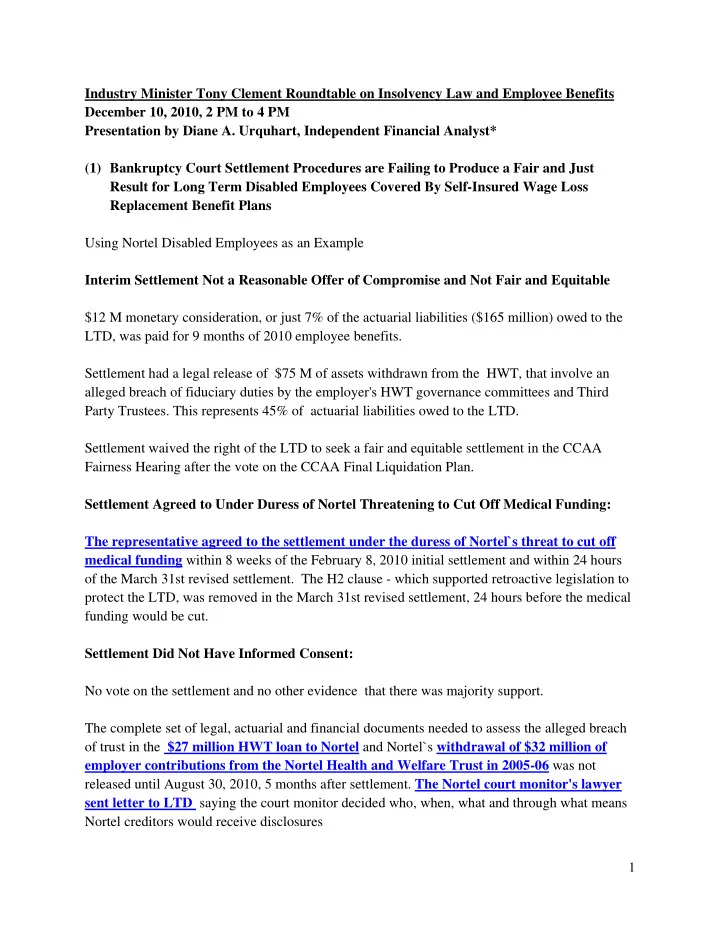
1 Industry Minister Tony Clement Roundtable on Insolvency Law and Employee Benefits December 10, 2010, 2 PM to 4 PM Presentation by Diane A. Urquhart, Independent Financial Analyst* (1) Bankruptcy Court Settlement Procedures are Failing to Produce a Fair and Just Result for Long Term Disabled Employees Covered By Self-Insured Wage Loss Replacement Benefit Plans Using Nortel Disabled Employees as an Example Interim Settlement Not a Reasonable Offer of Compromise and Not Fair and Equitable $12 M monetary consideration, or just 7% of the actuarial liabilities ($165 million) owed to the LTD, was paid for 9 months of 2010 employee benefits. Settlement had a legal release of $75 M of assets withdrawn from the HWT, that involve an alleged breach of fiduciary duties by the employer's HWT governance committees and Third Party Trustees. This represents 45% of actuarial liabilities owed to the LTD. Settlement waived the right of the LTD to seek a fair and equitable settlement in the CCAA Fairness Hearing after the vote on the CCAA Final Liquidation Plan. Settlement Agreed to Under Duress of Nortel Threatening to Cut Off Medical Funding: The representative agreed to the settlement under the duress of Nortel`s threat to cut off medical funding within 8 weeks of the February 8, 2010 initial settlement and within 24 hours

  • f the March 31st revised settlement. The H2 clause - which supported retroactive legislation to

protect the LTD, was removed in the March 31st revised settlement, 24 hours before the medical funding would be cut. Settlement Did Not Have Informed Consent: No vote on the settlement and no other evidence that there was majority support. The complete set of legal, actuarial and financial documents needed to assess the alleged breach

  • f trust in the $27 million HWT loan to Nortel and Nortel`s withdrawal of $32 million of

employer contributions from the Nortel Health and Welfare Trust in 2005-06 was not released until August 30, 2010, 5 months after settlement. The Nortel court monitor's lawyer sent letter to LTD saying the court monitor decided who, when, what and through what means Nortel creditors would receive disclosures

slide-2
SLIDE 2

2 . Settlement Was Not Negotiated in Good Faith from LTD Perspective: Koskie Minsky LLP and the CAW Canada lawyer were in a position of conflict of interest between the Nortel pensioners, and LTD Employees favoring the 22,000 pensioners over the 400 LTD – both groups they represented. Koskie Minsky LLP selected the non-union LTD representative and not the constituent group. The representative signed a Non-Disclosure Agreement (NDA) preventing second opinion legal counsel and expert financial and actuarial advice on the settlement. The Internet Site created to facilitate communications amongst LTD members, the representative and KM, and to allow for VOTING, was SHUT DOWN, as was an on-line VOTE for the LTD

  • n the Settlement after they learned of it.

(2) Unsafe Self-Insured Long Term Disability Wage Loss Replacement and Health Care Plans Failed disability insurance is a completely different matter than underfunded pension plans caused by capital market corrections. Bankruptcy laws should require corporate bankruptcy estates to pay for promised LTD wage loss replacement income and medical benefits before the taxpayers are called upon to fund Canada's social security net. Pay the piper in the end for underfunded LTD wage loss replacement self-insurance, just like there is priority for insurance policyholders over creditors at failed insurance companies. If we can have effective super-priority for credit default swaps with large financial institutions through CDSs being Eligible Financial Contracts, then we can consider LTD wage loss replacement and medical benefit contracts in a similar way as essential peace of mind contracts for very ill Canadians. Canadian employees are told they have safe LTD wage loss replacement benefits and a small proportion of these employees that become disabled cannot buy replacement insurance when their employer goes bankrupt. Very ill Canadians should not be forced to fight for the payment of their essential insurance in the bankruptcy courts. Insolvency Institute of Canada, Canadian Association of Insolvency and Restructuring Professionals and the Canadian Bankers Association have all been irresponsible in their adverse positions taken about priority for LTD benefits over unsecured creditors. They have grossly exaggerated the impact of LTD benefits priority causing a higher cost of credit and causing more

slide-3
SLIDE 3

3

  • liquidations. These associations provide the conclusions of lawyers who are not financial experts

and who have not provided any research from financial experts to support their positions. Furthermore, it is disingenuous, to say the least, that these three associations have not informed the government about the existence of unregulated credit default swaps that have had the impact

  • f causing a financial crisis with massive increases in the cost of credit and the number of

corporation bankruptcy filings in recent years. The financial industry induced financial crisis has had the economic reverberations of higher unemployment and severe cuts in employee benefits in Canada and throughout the world. Priority for LTD benefits will not impact Canadian taxpayers, because private sector paid LTD wage loss replacement avoids the need to increase the CPP Disability Income. Maximum of $13,521 and average of $9,728 per year is below the poverty line and is already in pay. So, the disabled employees bear the full burden of the bankrupt employer's cut in wage loss replacement, leaving them in poverty and even homelessness. "Australia prioritizes employee claims, including unpaid wages, and contributions owed to long-term disability benefits plans and superannuation pension plans, as preferred claims. There is no monetary cap on the amounts preferred." Contributions owed for LTD benefit plans would have to be for the incurred claims prior to bankruptcy. These incurred claims would include the future income promised in these plans, which usually covers income until age 65, death or recovery. Actuarial and insurance principles and practices require full funding of LTD wage loss replacement self-insurance. CRA rules for LTD wage loss replacement plans require full funding. (Priority for employer contributions would have helped the Nortel LTD employees since there is $75 M of assets removed from the HWT and a substantial proportion of these are past employer and employee contributions, as there are not material investment losses in the Nortel HWT.) UK Pension Protection Fund covers 100% wage loss replacement income for long term disabled employees currently in pay to the limit of £29,749 or $47, 509 per year. US Social Security for a Disabled Person with 2 dependent children pays $48, 780 per year, compared to the same disabled parent in Canada paid $18,408. Provincial drug assistance programs, such as Ontario's Trillium Drug Program , need to be preserved for Canadians without employer paid disability income and medical benefits and where bankrupt employers do not have estate assets to cover their benefit promises.

slide-4
SLIDE 4

4 LTD wage loss replacement and medical reimbursement creditor claims are small.  0.90% of employees are LTD  Wage loss replacement + medical reimbursement is at less than 2.5% of payroll ($642 wage loss replacement cost per employee per year, $ 475 medical cost per employee @ PV of $5250 medical cost per disabled person per year, self-insurance of wage loss replacement saves $64 to $128 per employee per year)  12,000 to 23,000 LTD employees at corporations are in self-insured LTD plans  Actuarial liabilities for LTD employees in self-insured plans estimated at $5B to $9B, compared to private sector DBPP liabilities of $415B.  No way of knowing degree of LTD funding in trust accounts, but say LTD deficit of 75% would be $3B to $6B deficit for all self-insured LTD wage loss replacement plans, compared to $50B deficits or 20% of private sector DBPP liabilities.  Cost of credit impact for all employee benefits at preferred status is about 0.20% of investment grade bonds (general agreement on this with RBC PHN and Towers Watson)  The overall impact on Canadian bond market of priority for employee benefits is -1.5%.  LTD deficits are apt to be about 5% of total pension deficit, severance and LTD claims, so, cost of credit impact 1 bps. This means if the cost of credit was 3.25% before it is 3.26% after.  Priority for LTD benefits would likely cause a -0.1% correction of bond price.  Overall impact of bond price decline and higher corporation interest costs PV is $0.8B 5% * (-$3.6B bond market + -$13.1B lower corporation profits pre-tax from higher interest) Insolvency priority for LTD benefits is not mandatory insurance or mandatory full funding so it imposes no increase in operating cost. Employers will also oppose mandatory insurance or mandatory full funding, so insolvency law priority for LTD benefit claims is the lowest cost, least disruptive and most pragmatic solution to unsafe self-insured LTD benefits. LTD persons would rather have no disability insurance than bogus disability insurance, which is not there when the employer goes bankrupt. Then, employees know to buy private LTD

  • insurance. They cannot buy such insurance after the onset of disability.

Canada signed the United Nations Convention for the Rights of Persons With Disabilities on March 11, 2010.

slide-5
SLIDE 5

5 Credit Default Swaps Impact on Induced Bankruptcies and Preference of Liquidations

  • ver Restructurings

CDS innovation has changed the idea that all creditors are losing money in a bankruptcy and that all creditors must accept an equal compromise so that the business may be restructured as an

  • ngoing concern. CDSs provide an incentive for bond owners to seek a court filing for

bankruptcy protection in order to trigger an insurance settlement, that results in no loss of money

  • n their investment. The credit default damages are reimbursed in a cash settlement shortly

after the bankruptcy protection filing. The insured bond owners get to keep their bonds and fully participate in the bankruptcy proceeding, and therefore double-dipping to achieve more than full investment recovery is going on. The old dynamic of preferring a restructuring as an ongoing concern over liquidation no longer applies, since bond owners that were either fully hedged or short the bonds are not persuaded by the need to restructure as an ongoing concern or be worth nothing on liquidation. In fact liquidation becomes the preferred option for these combo CDS- bond owners, because liquidation permits the corporation to walk from the pension deficits, whereas these are not compromised for ongoing concerns. So a new business model is borne and it is called profit from bankruptcies, at the direct expense

  • f retirees, severed and LTD employees. Furthermore, the bias towards liquidation over

restructured ongoing concern causes job losses. Protection of former employees is good social policy for individual Canadians, who are facing dramatic cuts of their income. More importantly, due to the bias created by CDSs to liquidate companies for profit, priority status for pension deficits and severance provides a countervailing force to deter liquidations and to promote restructuring as ongoing concerns. Priority for employee benefits in bankruptcy will overall mean less liquidations. Pension plans and LTD benefit plans are more likely to be fully funded and more prudently invested. Contact Information Diane A. Urquhart Independent Financial Analyst Mississauga, Ontario Tel: (905) 822-7618 Cell: (416) 505-4832 E-mail: urquhart@rogers.com * Diane Urquhart is on an unpaid retainer for the Dissenting Nortel Disabled Employees within the Nortel CCAA Proceedings.