
SLIDE 1 BMVC 2018, Newcastle upon Tyne | Ankush Gupta 1
Ankush Gupta Andrea Vedaldi Andrew Zisserman
Inductive Visual Localisation: Factorised Training for Superior Generalisation
Visual Geometry Group (VGG) University of Oxford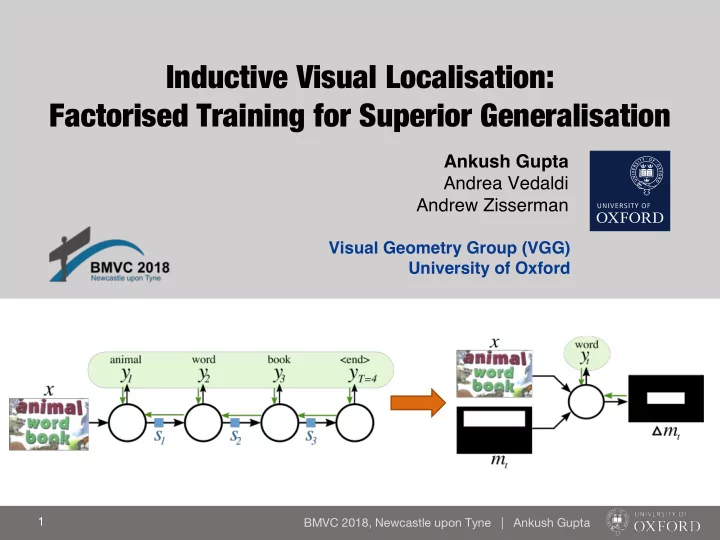
Inductive Visual Localisation: Factorised Training for Superior - - PowerPoint PPT Presentation
Inductive Visual Localisation: Factorised Training for Superior Generalisation Ankush Gupta Andrea Vedaldi Andrew Zisserman Visual Geometry Group (VGG) University of Oxford 1 BMVC 2018, Newcastle upon Tyne | Ankush Gupta RNNs have a
Inductive Visual Localisation: Factorised Training for Superior Generalisation
Visual Geometry Group (VGG) University of Oxford RNNs have a problem. Poor generalization to sequence lengths beyond those in the training set.
Training Testing
Example: Enumerative Counting
Counting objects one-by-one. Total count = 3
Training Stop? 1
Example: Enumerative Counting
Failure when tested on >3 length input Total count = 6
Testing Stop? 1
Why? Non-interpretable recurrent state (st) which is trained end-to-end may not learn the correct loop-invariant.
Our Solution
updates (not end-to-end).
spatial-memory map, which tracks the progress made so far.
Inductive Training
end-to-endinput image Spatial memory map
Stop?
Updated memory
Train for
updates
Results: Enumerative Counting
Coloured Shapes & DOTA Airplanes
train on 3-5 objects, test on >5 objects
Multi-line Text Recognition
Read one line at each step
Results: Multi-line Text Recognition
Synth Text Blocks
train on 1-4 lines, test on up to 10 lines
Results: Multi-line Text Recognition
Inductive Visual Localisation: Factorised Training for Superior Generalisation
Visual Geometry Group (VGG) University of OxfordPoster