
SLIDE 1
8
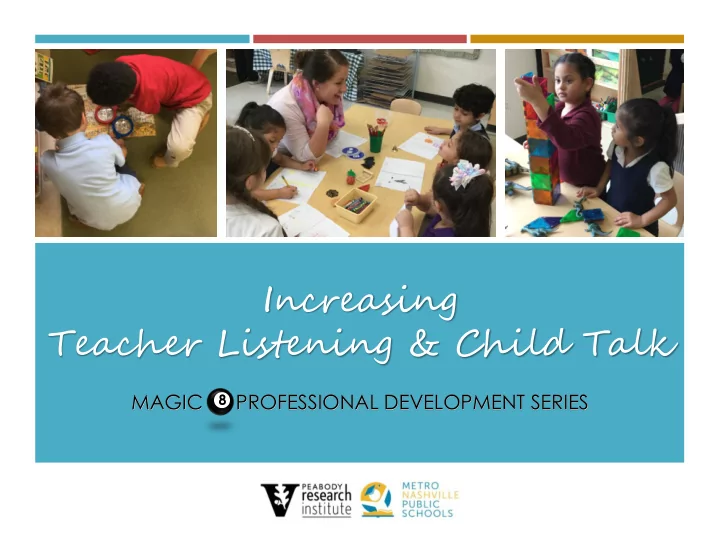
Increasing Teacher Listening & Child Talk MAGIC - - PowerPoint PPT Presentation
Increasing Teacher Listening & Child Talk MAGIC PROFESSIONAL DEVELOPMENT SERIES 8 THE MAGIC 8 CLASSROOM PRACTICES Reduce time spent in transition 1. Improving level of instruction 2. Creating a positive climate 3.
8
Magic 8 Professional Development Series |
INCREASING TEACHER LISTENING & CHILD TALK
8 2
1.
Reduce time spent in transition
2.
Improving level of instruction
3.
Creating a positive climate
4.
5.
Planning sequential activities
6.
Promoting associative and cooperative interactions
7.
Fostering high levels of engagement
8.
Providing math opportunities 2017-18 Initiative: Focus on Literacy
Magic 8 Professional Development Series |
INCREASING TEACHER LISTENING & CHILD TALK
8 3
prosocial skills
Increased T eacher Listening leads to more opportunities for Child Talk.
Children in classrooms with teachers who listened more had greater gains in Math, Vocabulary, and Knowledge of Letters & Sight Words. Children who were
frequently had greater gains in the above- mentioned skills and Self-Regulation. These patterns were particularly true for children who entered pre-k with lower skills than their peers!
SELF-REGULATION LETTER & SIGHT WORD IDENTIFICATION MATH
Communication
VOCABULARY
Magic 8 Professional Development Series |
INCREASING TEACHER LISTENING & CHILD TALK
8 4
ASK AUTHENTIC, OPEN-ENDED QUESTIONS ALLOW WAIT TIME FOR RESPONSES POSITIVELY ACKNOWLEDGE CONTRIBUTIONS EXTEND AND ELABORATE UTTERANCES ENCOURAGE CONVERSATION AMONG PEERS PROVIDE SCAFFOLDS FOR CHILDREN WITH LIMITED LANGUAGE SKILLS PROVIDE SCAFFOLDS FOR LOW-LANGUAGE EXTEND AND ELABORATE UTTERANCES
Remember what if felt like when someone cared about what you thought when you were a child. How can you create those
students?
DISCUSSION POINT:
Magic 8 Professional Development Series |
INCREASING TEACHER LISTENING & CHILD TALK
8 5
Ask questions that show children you really care about what they are thinking!
Avoid simple “yes” or “no” questions, or those with only
Book Discussion Cards provided by Creative
Curriculum (or other curriculum) give excellent examples of
Brainstorm question stems to post at adult height in different areas of the room
This relieves the pressure of having to come up questions on the spot
Strive for Five!
Aim for 5 conversational turns during exchanges with children
What would happen if…
What do you think about… T ell me about…. What would you do… How can we… How did you…
Magic 8 Professional Development Series |
INCREASING TEACHER LISTENING & CHILD TALK
8 6
Silence while waiting for a response during a group discussion can be overwhelming for teachers and children
Try setting up routines and expectations that encourage children to take time to think about their answers
Do you find it challenging to practice wait time? Why? DISCUSSION POINT: It takes time for young children to process information and formulate responses!
When I tell you to ‘think big’, I want you to take some time and think about your answer. Then, touch your nose to show me you are ready.
Magic 8 Professional Development Series |
INCREASING TEACHER LISTENING & CHILD TALK
8 7
Speaking up can feel very risky for children who are shy or less skilled with language.
Keep this in mind, and be enthusiastic about their contributions to the exchange!
Remember the first rule of improvisational comedy!
Differentiate your responses to off-topic comments.
How can you use the “yes, and…” principle in your classroom?
For a child who rarely contributes: Encourage participation and find a way to ask more questions For a child who often contributes: Identify a link between child’s comment and current topic –OR-- Ask them to tell more about it later, and bring attention back to topic at hand. Set aside a time for children to come talk to you.
Magic 8 Professional Development Series |
INCREASING TEACHER LISTENING & CHILD TALK
8 8
Follow children’s interest by observing their play before trying to engage in conversation
Echo what the child says and add on details
Model correct grammar without directly correcting children
Particularly useful for ELL children
CHILD: The Wolf goed to the other house made of rocks and he blewed it down too! TEACHER: Wow, you think the Wolf went to the house made of stone and blew it down? Hmm…What do you think would happen if he couldn’t blow the house down? CHILD: I drive car. TEACHER: You are driving the car down the road! What is one activity or time of the day when you could use “extend and elaborate” strategies with an individual child?
DISCUSSION POINT:
Magic 8 Professional Development Series |
INCREASING TEACHER LISTENING & CHILD TALK
8 9
T each children how to actively listen to what
Keep eyes on the speaker (even if it means turning around)
Do not talk while the speaker is talking
Highlight and compare children’s responses
“Selah, your idea sounds different from Cameron’s…”
Suggest questions for peers to ask each other
“Jayla, why don’t you ask Tyler to tell you what he likes to do when he’s wearing his new shoes. “
Turn & Talk / Shoulder Partners
“Turn to your Shoulder Partner and tell
them…”
Call on a few children to share their
friends’ responses What expectations have you established for speaking and listening during group time?
DISCUSSION POINT: How can we show Charlotte we care about what she’s saying?
Magic 8 Professional Development Series |
INCREASING TEACHER LISTENING & CHILD TALK
8 10
Use picture cards to help children make requests or tell stories
CHILD: Points to “snack” card. TEACHER: You want a delicious snack?
Pair common phrases with sign language or translations from children’s home language
Children’s families can be excellent resources to help bring multilingual materials into the classroom
Use predictable phrases or songs to elicit utterances
TEACHER: Ready, set… CHILD: /g/ TEACHER: That’s right, GO! Do you make a conscious effort to engage children with lower language skills in verbal interactions? How?
DISCUSSION POINT:
Magic 8 Professional Development Series |
INCREASING TEACHER LISTENING & CHILD TALK
8 11
Creative Curriculum discussion cards provide some wonderful questions for checking children’s comprehension and promoting discussion! So, let’s practice!
One teacher and 3-4 children for each group
“Children” will choose a role from a hat (don’t tell your group!)
“Teachers” will ask some of these questions and practice strategies for promoting conversation about the story (feel free to orient “children” to the story elements as needed )
You can shift roles as time permits
Magic 8 Professional Development Series |
INCREASING TEACHER LISTENING & CHILD TALK
8 12
Child Roles:
I REALLY want to tell you about these worms I found
I don’t like this story. The teacher is not listening to me, so I’m going to tell my idea to my neighbor. I have to go to the bathroom. I’m getting frustrated because my friends keep talking over me. I have soooo many questions for you. I’m excited about the story, but I have a misconception. I’m distracted/off- task because I don’t understand the question. I make spontaneous personal experiences or another text. My responses are thoughtful but very hard to hear. I want to answer EVERY question. I need help finding words to express my idea.
13
Magic 8 Professional Development Series |
INCREASING TEACHER LISTENING & CHILD TALK
8
We are grateful to the following MNPS Pre-K Instructional Coaches and Multi-Classroom Leaders for their invaluable feedback in developing these materials: https://my.vanderbilt.edu/mnpspartnership/
REFERENCES: Reese, E., Leyva, D., Sparks, A., & Grolnick, W. (2010) Maternal elaborative reminiscing increases low-income children’s narrative skills relative to dialogic reading. Early Education and Development, 21(3), 318-342. DOI: 10.1080/104092892010481552 Wasik, B.A. & Iannone-Campbell, C. (2012) Developing vocabulary through purposeful, strategic conversations. The Reading T eacher, 66(2), 321-332. DOI:10.1002/TRTR.01095
SeTara DeThrow Carrie Head Susan McClain Stephanie Mullins Holly Stone Ashley Aldridge Wilson Rhiannon Wilson
Magic 8 Professional Development Series |
8
FREQUENTLY USED IMAGES*
Lightbulb | myiconfinder.com
Designed by Vexels.com:
Hand drawn magnifying glass Hand drawn bar graph Pie chart hand drawn doodle Hand drawn wall clock Hand drawn cloud bubble Hand drawn open book Cog wheel hand drawn icon
ADDITIONAL IMAGE SOURCES
Slide 3: Mouth & ear | clipartpanda.com Slide 6: Child gear head | DeviantArt.com Slide 7: Boy raised hand | clipart-library.com Slide 10: Wooden ladder | clipartextras.com
*These graphics are used as icons throughout the
beside most “Discussion Point” questions.