Increasing Breast Conservation Using Oncoplastic Techniques Brian - - PDF document

increasing breast conservation using oncoplastic
SMART_READER_LITE
LIVE PREVIEW

Increasing Breast Conservation Using Oncoplastic Techniques Brian - - PDF document

3/5/2018 Increasing Breast Conservation Using Oncoplastic Techniques Brian J Czerniecki, MD, PhD Chair Department of Breast Oncology No pertinent disclosures For Stage I-III Breast Cancer BCT is Equivalent or Superior to Mastectomy


slide-1
SLIDE 1

3/5/2018 1 Increasing Breast Conservation Using Oncoplastic Techniques

Brian J Czerniecki, MD, PhD Chair Department of Breast Oncology

  • No pertinent disclosures

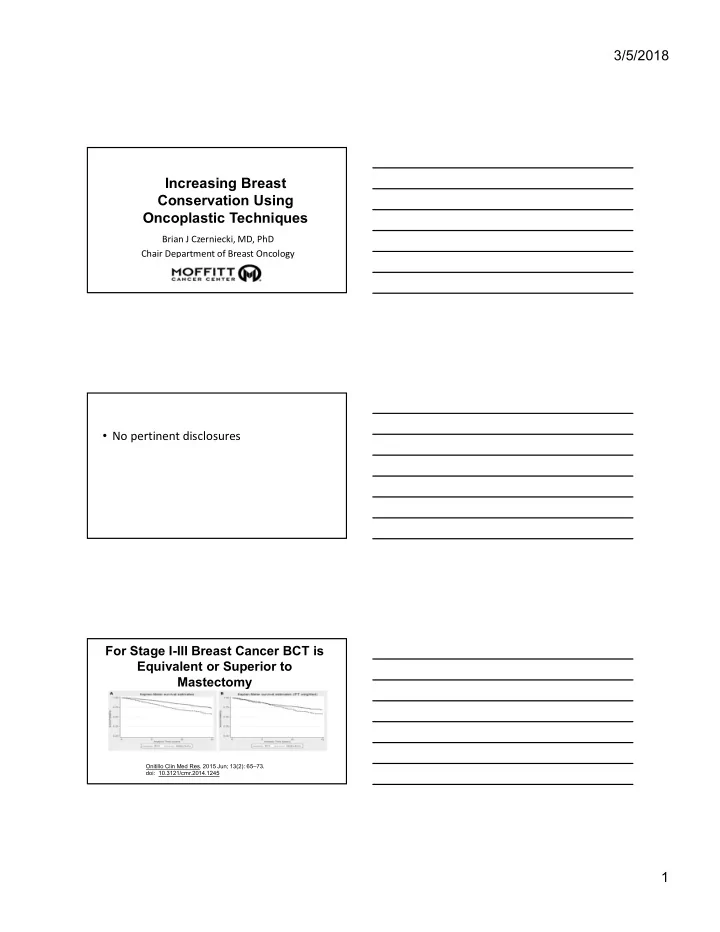
For Stage I-III Breast Cancer BCT is Equivalent or Superior to Mastectomy

Onitillo Clin Med Res. 2015 Jun; 13(2): 65–73. doi: 10.3121/cmr.2014.1245

slide-2
SLIDE 2

3/5/2018 2

What is oncoplastic surgery?

  • In the broadest sense, oncoplastic

surgery is the resection of breast cancer with subsequent reconstruction to achieve an oncologically safe resection and a functional and aesthetically pleasing breast reconstruction

History of oncoplastic surgery Oncoplastic Surgery: Sub-Group Definitions

  • Volume Replacement Oncoplastic Surgery

– The use of locoregional flaps or implants to replace the large volume removed from a partial mastectomy – Used when greater than 50% of breast volume is removed or the patient has smaller to moderate sized breasts. – Minority of oncoplastic operations

slide-3
SLIDE 3

3/5/2018 3

Repairing Cosmetic Defects in Lumpectomy Patients

Spear, Surgery of the Breast, 2011 Latissimus dorsi chapter by Hammond

Oncoplastic Surgery: Definition (Clough et al.) Oncoplastic Surgery: Definition (Clough et al.)

  • Volume Displacement Oncoplastic Surgery

– OPS Level 1:

  • Up to 20% removal of breast tissue with local tissue

rearrangement – OPS Level 2:

  • Up to 50% removal of breast tissue with a mastopexy/reduction

mammaplasty reconstruction design

  • Often needs a contralateral symmetry mastopexy/reduction

mammaplasty

slide-4
SLIDE 4

3/5/2018 4

Oncoplastics and Volume Displacement

Spear, Surgery of the Breast, 2011 Oncoplastic surgery chapter by Losken Spear, Surgery of the Breast, 2011 Oncoplastic surgery chapter by Losken

Oncoplastic Surgery: The Past “Era of Technique Development”

  • The European experience

– Oncoplastic surgery first described in Europe – 1998: Audretsch et al. first described the technique of reconstructing a partial mastectomy defect – Clough further described advanced techniques of large volume displacement oncoplastic surgery and defined levels of oncoplastic surgery – Spread throughout Europe

  • France, Germany, Italy, Britain

– Oncoplastic fellowship open to general surgeons and plastic surgeons

– Development of the “Oncoplastic Surgeon”

  • Outcomes similar in cancer surgery and plastic surgery to America
slide-5
SLIDE 5

3/5/2018 5 European definition of an oncoplastic service: BASO, BAPRAS

EJSO 33 (2007) S1-S23

American definition of oncoplastic surgery

 Unclear  In the US, the oncologic resection and subsequent reconstruction is most commonly done by two separate surgical specialties:

 Breast surgeons (General Surgeons, OB/Gyn, Breast Surgical Oncologists, Surgical Oncologists)  Plastic Surgeons

 Breast oncologic literature and breast surgery meeting topics tend to place oncoplastic surgery more in the realm

  • f volume displacement when it comes to reconstruction

American definition (cont.)

  • Volume displacement

– Local tissue rearrangement – Mastopexy (breast lift) – Reduction mammaplasty (breast reduction)

  • Therefore, presently in the US when one speaks about
  • ncoplastic breast surgery, they most often are referring to

a patient being treated for breast cancer receiving a lumpectomy, some kind of volume displacement surgery, and a contralateral breast symmetry operation.

slide-6
SLIDE 6

3/5/2018 6

Why do oncoplastic breast surgery?

1. Allows for wide local excision with large negative margins

  • Leads to fewer re-excisions
  • May decrease the need for whole breast radiation for DCIS

2. Provides an aesthetically pleasing breast appearance using plastic reconstructive techniques 3. Provides the reconstructive benefits of less neck/upper arm/back pain, rashes, bra strap marks when using a breast reduction (reduction mammoplasty) design for large breasted women 4. Minimizes dead space compared to traditional lumpectomy leading to less nipple inversion especially after combining surgery and radiation

Oncoplastic surgery from a radiation oncologist perspective

  • Perceive it as a very large partial mastectomy
  • Theoretically should have wide, negative margins
  • Oncoplastic surgeon should place clips at the margins

to help direct your boost dose

– Note: incisions most likely are not indicative of where the cancer was present

  • Otherwise, the general principles for radiation should

be the same as for a regular lumpectomy patient coming to your office for a radiation oncology consult

D – Markings 1 D – Markings 2 D – Markings 3 D – Markings 4 D – Markings 5 D – Markings 6 D – Markings 7 D – Markings 8 D – Markings 9 A B C

slide-7
SLIDE 7

3/5/2018 7

Oncoplastic Surgery Level I Doughnut Design

  • Works well central tumors in women

with dense breast tissue or small areola

Post Operative Double Doughnut

slide-8
SLIDE 8

3/5/2018 8 COMPLEX TISSUE REARRANGEMENTS

Oncoplastic Surgery Type II

Hemi-batwing Approach

  • 53 yo female with right

upper outer breast cancer approximately 3cm in size

  • Operation: R sided

batwing oncoplastic resection with SLN bx and L sided vertical mastopexy for symmetry

slide-9
SLIDE 9

3/5/2018 9

Hemi-batwing Approach Final Result

E - Markings E – Before D - After E - After D – Markings C – After C – Intraoperative tacking D - Before C - Intraoperative C – Markings B - After B - Markings C – Before B – Before A

slide-10
SLIDE 10

3/5/2018 10

Mastopexy oncoplastic design

2 months post op

  • T1N0 left breast

cancer

  • Removed with

clear margins

  • Adjuvant radiation
  • Adjuvant

hormonal therapy

C – Before C – During RT B – Before B – After A

slide-11
SLIDE 11

3/5/2018 11

B – Before B – After RT B – After A

Complex Oncoplastic Rescues

  • 49 yo female with history of L

lumpectomy and radiation. Now, has suspicious finding on mammogram with need for L breast excisional biopsy

  • L sided oncoplastic reduction

design and R sided reduction mammoplasty for symmetry

slide-12
SLIDE 12

3/5/2018 12

Oncoplastic Balancing Results

Before After

slide-13
SLIDE 13

3/5/2018 13

After Before

ONCOPLASTIC SURGICAL PROCEDURES

Special Situations

Savi Scout Bracketed Oncoplastic Right Lumpectomy

slide-14
SLIDE 14

3/5/2018 14

Oncoplastics Useful in Elderly Patients with Ptotic Breasts Oncoplastics Useful in Patients with Large Regions of DCIS

Complications

Clough et al. Ann Surg. 2003 Jan; 237(1): 26–34.

slide-15
SLIDE 15

3/5/2018 15

Outcomes and patient satisfaction

Oncoplastic Surgery: The Present “The Era of Validation”

  • Long term outcome studies investigated the long term oncologic

safety of (volume displacement) oncoplastic surgery

  • Meta-analyses investigated the short term oncologic advantages of

(volume displacement) oncoplastic surgery

  • Outcome studies (using validated patient assessment tools)

investigated the reconstructive strengths in (large volume)

  • ncoplastic surgery
  • Cost-utility analyses investigated the value of oncoplastic surgery

Oncoplastic surgery: Long term oncoplastic safety

  • Case matched to compare apples with apples
  • OS and DFS at 10 years similar for T2 group

treated with oncoplastic surgery vs mastectomy

  • No significant difference in locoregional

recurrence

slide-16
SLIDE 16

3/5/2018 16

Oncoplastic Surgery: Surgical Oncologic Advantages

  • 10% positive margin rate for oncoplastic surgery

– Compared to 20-40% positive margin rate for standard

partial mastectomy

Accepted for presentation at the San Antonio Breast Cancer Symposium, December 2017

Oncoplastic Surgery: Outcomes Studies Assessing patient Satisfaction

  • Case Matched
  • Validated patient self related

assessment scores

  • Compared oncoplastic surgery

vs mastectomy with immediate reconstruction

  • Clear benefit in psychosocial

and self related benefit with

  • ncoplastic surgery compared

to mastectomy and immediate reconstruction regardless of radiation effects

slide-17
SLIDE 17

3/5/2018 17

Oncoplastic Surgery: The Future “The Era of the American Oncoplastic Surgeon”

  • Future American Oncoplastic Surgeon

– Consists of General Surgeons and Plastic Surgeons completing an oncoplastic breast fellowship

  • Oncoplastic Surgeon: Is technically and safely able to perform Level and Level 2

volume displacement oncoplastic operations – Oncoplastic fellowship and Certificates

  • Developed with input and joint accreditation from:

– Oncologic Surgery societies: SSO, ASBrS – Plastic Surgery society: ASPS – Goal:

  • Produce a safe and capable surgeon invested in the care of the breast patient
  • Produce a surgeon who can manage his or her own complications in both the oncologic

and reconstructive surgical spectrum

Breast disease: a single surgeon approach

  • Ethical dilemma?
  • Can one surgeon be objective enough to remove the cancer AND

perform the reconstruction? (2nd most common question in my breast oncology fellowship interview process)

  • 1. Hippocratic Oath: Do no harm
  • 2. Most of Europe already does this in addition to a few very good

surgeons in the US

  • 3. Surgeons already remove cancers in the face and reconstruct the

defects

  • 4. What do you think happens down the road after an inadequate
  • ncologic resection?....recurrences destroy the reconstruction…

Why Do Oncoplastic Breast Procedures?

  • Because the patient benefits….
  • One surgeon for diagnosis, resection, reconstruction and

following patient

  • Patient scheduling/post op care is simpler
  • One surgeon is held accountable for ALL outcomes
  • Arguably, breast conservation rates may increase

– Large volume oncoplastic techniques maximize breast conservation options – In the US- breast conservation: mastectomy ratio » 60:40 » This can increase to 80:20 using oncoplastic surgery

  • Oncoplastic techniques lower positive margin rates

compared to standard lumpectomy – Only a 10% positive margin rate
slide-18
SLIDE 18

3/5/2018 18

Oncoplastic Breast Surgery Summary

  • Interdisciplinary communication

– The oncoplastic breast surgeon, radiologist and radiation oncologist should talk about what is to be and was done in the OR to facilitate planning for radiation – Ideally, clips/makers should be placed intraoperatively by the surgeon in the region where the cancer was present

  • Increases patients eligible for BCT
  • Reduces re-excision
  • Consider referral to a plastic or oncoplastic surgeon if you see a lower pole deformity or

nipple inversion in a ptotic or large breasted woman after traditional lumpectomy and radiation

– It is a fixable deformity that should be covered by insurance

BREAST TEAM

THANK YOU