
SLIDE 1
Incorporating Ngāti Waewae values and eco-cultural attributes into the Kawatiri FMU
Presentation by Francois Tumahai & Philippa Lynch for Te Rūnanga o Ngāti Waewae
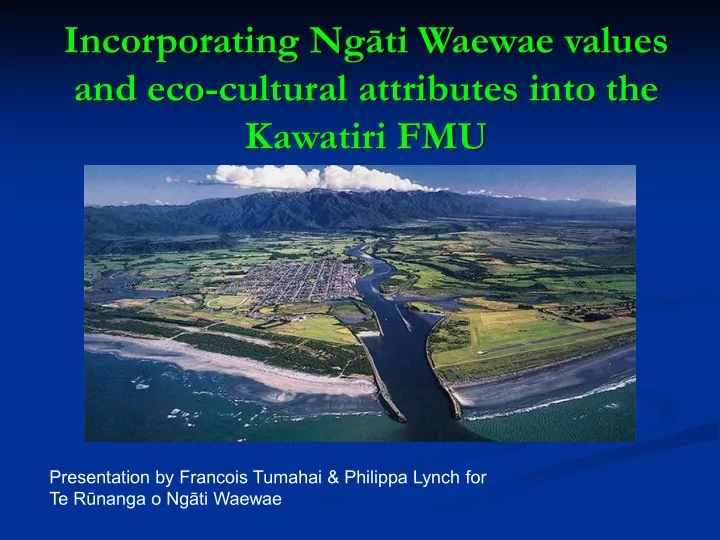
Incorporating Ngti Waewae values and eco - cultural attributes into - - PowerPoint PPT Presentation
Incorporating Ngti Waewae values and eco - cultural attributes into the Kawatiri FMU Presentation by Francois Tumahai & Philippa Lynch for Te Rnanga o Ngti Waewae Presentation outline Ngati Waewae principles for managing
Presentation by Francois Tumahai & Philippa Lynch for Te Rūnanga o Ngāti Waewae
Water is a holistic resource and should be managed
Water is a taonga (treasure) The mauri (life-giving essence) of waterways needs
the cultural, public health & ecological values of
The present generation has an obligation to pass on
Water is a holistic resource and should be managed
Water is a taonga (treasure) The mauri of waterways needs to be maintained or
the cultural, public health & ecological values of water
The present generation has an obligation to pass on
Objective D of the Freshwater NPS states that we
Water has a role in tribal
Role in identity Connections through
Navigational routes –
Water is a taonga Wahi tapu – sacred
Cultural purposes e.g.
Mahinga kai Cultural materials e.g.
Waterways as access
Traditional campsites &
Landscape features central to whakapapa, identity Te Reo, Traditional placenames, stories Water colour & quality A variety of kai from land, water & riparian Distinctive climate, air & light Fibre/materials from land, water & riparian Marae, pa, urupa Navigable waterways Reserves and easements awarded post European settlement
Remnants of historic activities found in the archaeological evidence that remains Variety of resources available to be protected, used & developed by mana whenua
Ecological condition Abundance and good health Access Gathering Historic sites Traditional techniques Spiritual connections and respect
Eco-cultural system
Time Climate and atmospheric condition Landscape condition – incl. land cover Aquatic and riparian biota – vegetation, fish, periphyton, birds, invertebrates Biological processes – life stages, primary production, food, mortality, competition, growth rates Water quantity – (surface flows, groundwater levels, connections to springs) Water quality Stream geomorphology – sediment type, stability Geology Landform Riparian zone condition – cover, temperature control riparian wetlands and springs Instream habitat conditions A
B C D E F G H I
Maunga (important mountains) Taonga species (plants, fish, birds
species & cultural materials) Pounamu Ingoa tawhito (place names) Urupā Ara tawhito to Waitaha (ancient trails) Kāinga, pā, nohoanga Tuhituhi neherā (rock art) Tauranga waka (canoe mooring sites) Wāhi raranga
harakeke (weaving) Waiata (songs) Stories
Eco-cultural attributes can be measured to ensure the values
The ‘Cultural Health Index’ is a monitoirng tool based on
The Index provides a framework to apply traditional
The Index recognises and expresses Maori values and links
Allows the mahinga kai values of a site to be evaluated and
The mahinga kai measure is made up of 4 elements and
The 4 elements include: identification of mahinga kai
Based on eight indicators to give a cultural stream health
The indicators include a description on how each indicator
The indicators include catchment land use, riparian
Assessment of the 8 indicators are combined for each site
The mauri of freshwater is restored where degraded,
Land and water is managed to recognise and enable
Land and water is managed in an integrated manner to
The quality and quantity of water in freshwater bodies
Land and water is managed to maintain healthy