Incentivizing Stable Path Selection in Future Internet Architectures - - PowerPoint PPT Presentation

incentivizing stable path selection in future internet
SMART_READER_LITE
LIVE PREVIEW

Incentivizing Stable Path Selection in Future Internet Architectures - - PowerPoint PPT Presentation

Incentivizing Stable Path Selection in Future Internet Architectures Simon Scherrer Markus Legner Adrian Perrig Stefan Schmid ETH Zurich University of Vienna PERFORMANCE 2020 4 November 2020 1 Central Question of Our Paper: Stability

slide-1
SLIDE 1

Incentivizing Stable Path Selection in Future Internet Architectures

Simon Scherrer Markus Legner Adrian Perrig Stefan Schmid ETH Zurich University of Vienna PERFORMANCE 2020 4 November 2020

1

slide-2
SLIDE 2

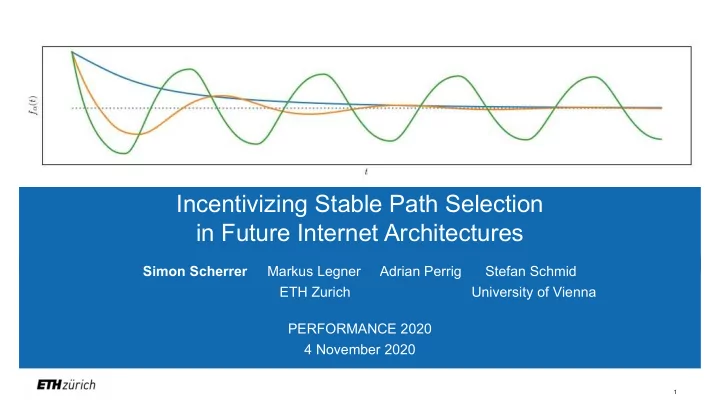
Central Question of Our Paper: Stability of Path-Aware Networks (PAN)

  • Vision: Path-Aware Network (PAN) architectures allow

load-adaptive path selection by end-hosts increase resource utilization

  • Concern: Load-adaptive path selection leads to oscillation

if performed on the basis of outdated information. How can stable (non-oscillatory) path selection be guaranteed in future Internet architectures?

2

slide-3
SLIDE 3

Why Classic Traffic Engineering Does Not Work in a PAN Internet

E1 E2 I1 I2

N1 N2 N3 N4

f22 f21 f11 f12

3

Domain

slide-4
SLIDE 4

Why Classic Traffic Engineering Does Not Work in a PAN Internet

E1 E2 I1 I2

N1 N2 N3 N4

f22 f21 f11 f12 Adaptive traffic-splitting ratios

4

Domain

slide-5
SLIDE 5

Domain

Why Classic Traffic Engineering Does Not Work in a PAN Internet

E1 E2 I1 I2

N1 N2 N3 N4

f22 f21 f11 f12 Adaptive traffic-splitting ratios

5

Domain

slide-6
SLIDE 6

Domain Domain Domain Domain Domain Domain Domain

Why Classic Traffic Engineering Does Not Work in a PAN Internet

E1 E2 I1 I2

N1 N2 N3 N4

f22 f21 f11 f12 With end-host path selection, f11 might have to follow path I1-N1-N3-E1 Adaptive traffic-splitting ratios

6

Domain

slide-7
SLIDE 7

Why Classic Traffic Engineering Does Not Work in a PAN Internet

E1 E2 I1 I2

N1 N2 N3 N4

f22 f2

1

f11 f12 Path-Selection Strategy (PSS) Path-Selection Strategy (PSS)

Shift at most x traffic units per second to more attractive path

7

Domain

slide-8
SLIDE 8

Domain Domain Domain Domain Domain Domain Domain

Why Classic Traffic Engineering Does Not Work in a PAN Internet

E1 E2 I1 I2

N1 N2 N3 N4

f22 f2

1

f11 f12 Path-Selection Strategy (PSS) Path-Selection Strategy (PSS)

Shift at most x traffic units per second to more attractive path

8

Domain

In inter-domain PAN, sources are uncontrolled and self-interested

  • nly adopt PSS that are optimal from their individual perspective
slide-9
SLIDE 9

Inter-Domain Viability of Stable Path-Selection Strategies?

  • Game-theoretic question:

Will the path-selection strategies (PSS) designed for stable path selection be adopted by self-interested sources? Do these stable path-selection strategies form a Nash equilibrium?

9

slide-10
SLIDE 10
  • Non-Oscillatory PSS proposed by Fischer and Vöcking (2009):

○ Path-switching probability is linear in load difference of paths ○ Linear coefficient has to respect a system-dependent upper bound to guarantee convergence

Non-Oscillatory PSS

  • Other PSS such as MATE (2002), Proportional Sticky Routing (2002),

TeXCP (2005) etc. are structurally equivalent ○ Key idea: Reduce the migration rate between paths such that there is a strong congruence between perception and reality of the network state

10

slide-11
SLIDE 11
  • PSS equilibrium:

○ A strategy is a PSS equilibrium strategy iff given that every end-host in the network adopts the strategy, there is no other strategy that allows an individual end-host to reduce its cost

Game-Theoretic Framework: Dynamic Routing Game

11

Selfish sources will only adopt PSS that form PSS equilibria:

slide-12
SLIDE 12

No!

  • Universal adoption of non-oscillatory PSS

makes adoption of oscillatory PSS worthwhile

  • Stable path selection cannot be achieved by relying purely on end-hosts

Incentivize stable path selection with

  • mechanisms

Do Non-Oscillatory PSS Constitute PSS Equilibria?

12

slide-13
SLIDE 13
  • Idea:

○ Mechanism should alter the cost of PSS (with monitoring, punishments, requirements, etc.) such that a non-oscillatory PSS becomes a PSS equilibrium strategy

Incentive-Compatible Stabilization Mechanisms

  • We design two stabilization mechanisms and

formally prove their incentive compatibility: ○ FLOSS mechanism (presented here) ○ CROSS mechanism (see in paper)

13

slide-14
SLIDE 14
  • Idea:

○ Using path during a certain time interval requires a registration (no registration packets are dropped)

Registrations are selectively granted: ■ Loyal end-hosts (end-hosts using the path in the current interval) always get a registration for the next interval ■ The amount of registrations available to end-hosts from other paths is limited restrict arbitrary path migration

Enforce migration volume per interval to iteratively achieve equal load

Flow-Loyalty Oscillation Suppression System (FLOSS)

14

slide-15
SLIDE 15

Flow-Loyalty Oscillation Suppression System (FLOSS)

15

slide-16
SLIDE 16

Flow-Loyalty Oscillation Suppression System (FLOSS)

End-hosts may register for one path to use during I0 (starting at t0)

16

slide-17
SLIDE 17

Flow-Loyalty Oscillation Suppression System (FLOSS)

Selectively grant registrations to end-hosts on α for migration onto β

17

slide-18
SLIDE 18

Flow-Loyalty Oscillation Suppression System (FLOSS)

Selectively grant registrations to end-hosts on α for migration onto β

18

slide-19
SLIDE 19

Flow-Loyalty Oscillation Suppression System (FLOSS)

Stability at equal load No benefit of migration

  • for end-hosts

19

slide-20
SLIDE 20

Flow-Loyalty Oscillation Suppression System (FLOSS)

Mechanism enforcement can be suspended

20

slide-21
SLIDE 21

Summary

21

Our paper presents a game-theoretic framework that allows to analyze whether

  • a path-selection strategy is adopted by rational end-hosts (Does it form a PSS equilibrium?)
  • a stabilization mechanism is incentive-compatible

Game-theoretic perspective is important to consider in path-aware Internet architectures!