
SLIDE 1
in the field of water. The institute confers fully accredited MSc - - PowerPoint PPT Presentation
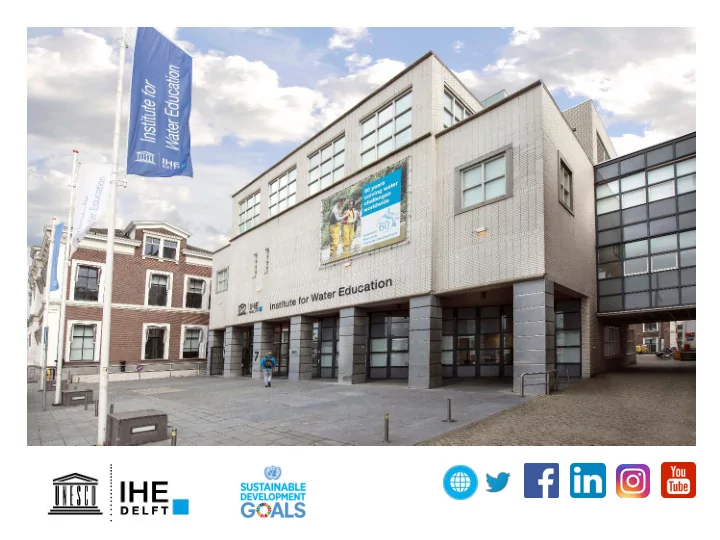
IHE Delft Institute for Water Education is the largest international graduate education institute in the field of water. The institute confers fully accredited MSc degrees and PhDs. Since 1957 the Institute has provided education to more than
IHE Delft Institute for Water Education is the largest international graduate education institute in the field of water. The institute confers fully accredited MSc degrees and PhDs. Since 1957 the Institute has provided education to more than 23,000 water professionals from
developing world. 124 PhD fellows* are currently enrolled in water-related research. The Institute carries out numerous research and capacity development projects throughout the world.
*PhD fellows active per 31-12-2018
Mission IHE Delft works in partnership to strengthen capacity in the water sector to achieve global sustainable development. Ambition Through our overarching work on capacity development, IHE Delft aims to make a tangible contribution to achieving all Sustainable Development Goals in which water is key. We strongly believe that capacity development, in partnership, is the key to addressing today’s water challenges.
Education & Training Research & Innovation Institutional Strengthening
5 accredited MSc programmes in water 200-250 students Short & online courses Tailor made trainings With over 140 academic staff and 124 PhD fellows active in water-related, problem-focused and solution oriented research on development issues. strengthen the programmes of universities and research institutes as well as the knowledge and capacity base of ministries and
IHE Delft offers a wide range of flexible, high quality, specialized educational programmes to respond to the needs of diverse clients from the water sector.
Water Management (106 ECTS) The scientific study of water resources with practical planning and management skills. Urban Water & Sanitation (106 ECTS) Water supply, sanitation and water engineering and management, particularly in urban areas. Environmental Science (106 ECTS) Conservation and prudent use of natural resources for the benefit of society. Water Science & Engineering (106 ECTS) Hydrological and hydraulic processes and modelling tools for improved water management in coastal zones, river basins and agricultural areas. Sanitation (68 ECTS) One-year programme focusing on non-sewered sanitation, delivering graduates with the qualifications required by the sanitation sector.
Joint programmes are offered in collaboration with renowned partner institutes, have varying start and end dates, and part of the programme is given at a partner institute, often in another country/ continent.
Storage deficit (Differences of required storage including EWRs and actual storage, in 106m3)
Source: Gaupp et al., 2015
Slide by Prof vd Zaag
Yield (ton/ha) AETI (mm/season) T (mm/season) Gross WP (kg/m3) Net WP (kg/m3) Gross WP (Yilma, 2017)
Sugarcane 99.85 1,926 1,638 5.22 6.13 5.9-6.6
Yield (ton/ha) AETI (mm/season) T (mm/season) Gross WP (kg/m3) Net WP (kg/m3) Banana 37.59 1,022 793 3.72 4.85 Rice s1 4.15 495 356 0.86 1.25 Rice s2 3.99 503 382 0.82 1.11