SLIDE 1 In Search of the 1836 McLean County Courthouse: Archaeological Investigations on the Public Square, Bloomington, Illinois
by Floyd Mansberger
Fever River Research Springfield, Illinois McLean County Museum of History Bloomington, Illinois February 28, 2015
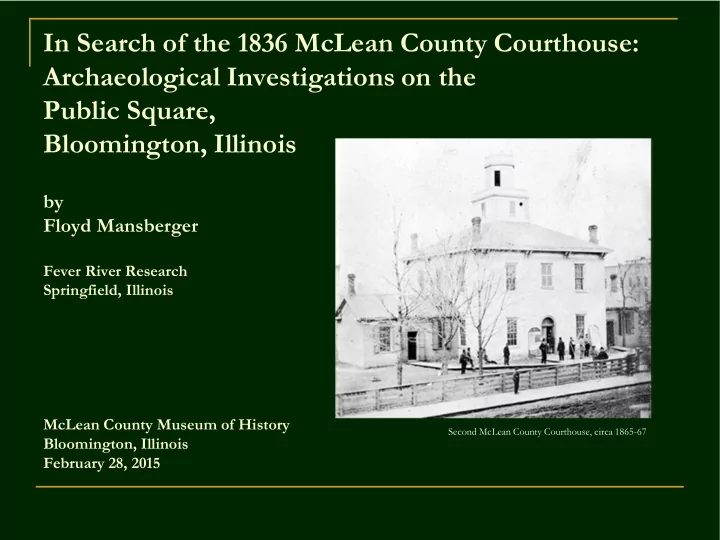
Second McLean County Courthouse, circa 1865-67
SLIDE 2 Archaeology is a methodology that brings a material culture approach to the study of past
- lifeways. It is the goal of
archaeologists to understand the past through the study of the artifacts used and discarded by people in times
- past. By adding the dimension
- f time to the study of
mankind, archaeologists are, in essence, creating ethnographies of the past.
SLIDE 3
And ultimately, archaeology is about people… —whether prehistoric Native Americans or more recent European Americans— … and their adaptation to the environments in which they live in.
SLIDE 4 Archaeologists study artifacts and artifact assemblages. Although individual artifacts can often be significant, to the archaeologist artifact assemblages (a collection of artifacts from a single context)
- ften contain greater research value, as they convey information
relevant to a specific time and place . Archaeologists use the term “feature” in reference to non-portable artifacts such as pits and
- structures. These “archaeological features” often contain large
artifact assemblages.
Middle Woodland pit (100 A.D.) Euro-American house basin (1840 A.D.)
SLIDE 5
So, what does that have to do with Bloomington’s Courthouse Square?
SLIDE 6
Cruisin’ With Lincoln on 66: The Bloomington-Normal Visitors Center/ Heritage Tourism Center
Funded in part by Illinois Department of Commerce and Economic Opportunity (Office of Tourism), Bloomington/Normal Convention and Visitors Bureau, and the McLean County History Museum. The new Visitor’s Center was design by Francois and Associates, AIA (Bloomington).
SLIDE 7
Creation of a Heritage Tourism Center in the lower level of the McLean County Museum of History building and the creation of a new south entrance into the facility…
SLIDE 8
The second McLean County Courthouse was constructed in 1836 on the grounds of the Public Square. It was of brick construction and replaced a much smaller frame structure that had functioned as a courthouse for a few short years. This courthouse was constructed in a “Coffee Mill” design common for early Illinois courthouses.
SLIDE 9 The McLean County Courthouse was an integral part
Judicial Circuit, where a young lawyer named Abraham Lincoln practiced law, honed his legal skills, and met many influential men along the way.
SLIDE 10 Two views of the 1836 Courthouse at mid-century (after construction of the West and East Wings in 1863).
Bird’s Eye View of Bloomington (Ruger 1867) Undated, mid-1860s photograph.
SLIDE 11 View of the backside of the Courthouse, April 1865.
This picture was taken on April 19th, 1865 at the Lincoln Memorial Meeting (mourning Lincoln’s death).
SLIDE 12 The 1836 Courthouse was demolished to make room for a substantially larger building constructed in 1868 and designed by Alfred Piquenard.
Illinois State Register (March 31, 1868)
SLIDE 13
To the dismay of Bloomington citizens, a catastrophic fire engulfed the downtown in June 1900 destroying a large portion of the commercial district as well as the 1868 Courthouse (left). The current courthouse (top) was constructed on the foundations of the earlier building in 1903-04.
SLIDE 14 In an effort to determine the location of the 1836 courthouse in relationship to the existing landscape features, two early maps of the Courthouse Square were
- verlain onto the existing site
plan.
Fell (1836) Price (1855)
SLIDE 15
With the aid of the County Commissioner’s Records, this sketch plan of the 1836 Courthouse with side wings was created…
SLIDE 16
… and overlain onto the current landscape. Its position on this plat was based on the description from the Commissioner’s Records.
SLIDE 17 The areas marked in red represent areas excavated by Fever River Research in 2014 on the Courthouse Square. The area along the east edge of the Square (here marked in blue) had been excavated earlier by Dr. Edward Jelks (Professor Emeritus, Illinois State University) in 1997.
Pre-field archival research strongly suggested that the proposed improvements may encounter remains of the 1836 Courthouse. With this in mind, archaeological investigations were conducted on the Courthouse Square.
SLIDE 18
The current excavations began near the suspected southeast corner of the 1836 courthouse…
Although much archaeological work is done with trowels and brushes, initial exploratory work often is conducted with a backhoe. Nonetheless, the work is conducted in a slow, methodical manner designed to come down flat on the original (circa 1830s) ground surface to expose archaeological features.
SLIDE 19
…and within a few hours the southeast corner of the 1836 courthouse had been located and exposed. No one had seen this structure since its demolition in 1868.
SLIDE 20
SLIDE 21
The project as it progressed…
SLIDE 22 …and a view of the completed courthouse excavations from on top
SLIDE 23
South Entrance base map illustrating area excavated and features.
SLIDE 24
Archaeological features included… Small posts associated with multiple fence lines—which connected the SE and SW corner of the Courthouse with the street. These post holes contained very few artifacts.
SLIDE 25
Large posts arranged around the perimeter of the Courthouse which functioned as scaffolding supports for construction activities in 1836. These posts, which were much larger than the fence line posts, had a large amount of brick rubble in them.
SLIDE 26
Robbed foundation walls, from both the 1836 Courthouse (top left) and the 1863 Wings (bottom left and right). Note the brick impressions in the base of the wall at right.
SLIDE 27
This is the south wall of the 1836 Courthouse, looking west from the southeast corner of the building. This trench contained a variety of nail fragments, window glass, plaster, mortar, and brick.
SLIDE 28 This is the south wall (and southwest corner) of the West Wing, which was constructed in 1863. Note the location of the original brick wall (running down the center of the trench), the original builder’s trench
- n each side of the wall (in
background), and the “over dig” trench dug at the time the wall was dismantled in 1868 (in foreground).
SLIDE 29
Surface (right) and subsurface (left) drainage lines. The deep subsurface drainage line probably had a wood conduit in the base.
SLIDE 30 A single large, deep oval pit, probably associated with construction activity in 1863
- remodeling. At the scraped
surface, this feature appeared to represent two overlapping pits. Upon excavation, it was determined that it was one large pit filled with construction waste (brick). Many of the brick were deformed from over-firing;
- thers appear to have been
paving brick.
SLIDE 31
Similarly, a single small, shallow circular pit was located alongside the western fence line. This shallow pit may represent an ornamental planting. Several small whiskey flask fragments were found in this pit.
SLIDE 32 The archaeological data, combined with the available archival information, allows us to speculate on a landscape plan for the Courthouse as
- riginally constructed (top,
circa 1836-1862), and after construction of the East and West Wings (bottom, circa 1863-1868).
SLIDE 33 Small block excavation units were placed in the SW , NE, and SE quadrants of the
- Square. These were the location of new
burr oak tree plantings. Features pre-dating 1870 were few in number within these three excavation units.
SLIDE 34 Excavation of the Northwest Block uncovered the east end of a shallow brick- walled cellar, which was located beneath the 1848 Jail. This cellar appears to have been filled in circa 1868, after the building was converted into county
Looking West Looking South/Southwest (prior to excavation) Looking North (after excavation)
SLIDE 35
Three views of the Jail cellar excavations…
SLIDE 36
With the aid of Prince’s (1899) published description and sketch (top left), supplemented with the 1867 Bird’s Eye View detail (bottom left), we were able to create this floor plan of the 1848 Jail (right), …
SLIDE 37 …which we superimposed
site map and archaeological data—resulting in a site plan for the Third McLean County Jail (1848-1858).
SLIDE 38
Archival research conducted also has given us new insights into the use of the building from the time it was abandoned as a jail in 1858 until it was demolished in 1868.
SLIDE 39
Although artifact density was low, and individual artifacts were generally very small in size, many artifacts were recovered from good mid-19th century contexts. These artifacts lend themselves well for interpretation (and tell us about both the character of the structures located at this site, as well as the activities undertaken there).
SLIDE 40
Most artifacts recovered from the excavations were associated with Architectural remains (consisting of structural items once associated with buildings—such as these heavily corroded iron nails). Window glass and brick were also common.
Forged nails Machine cut nails
SLIDE 41 Of particular interest were several brick fragments that have remnants of paint
- n their exterior surface, suggesting that the original courthouse was painted a
brick-red during its early years, and later was painted a buff or tan color. The
- riginal courthouse had probably attained its light color by 1865, and contrasted
dramatically with the unpainted wings (see attached photographic detail ).
SLIDE 42
Several small fragments of painted wall and ceiling plaster were found and indicate that several of the rooms within the Jail had been painted a traditional “Prussian Blue” color—which was a common interior color during the middle nineteenth century.
SLIDE 43
Ceramic table and kitchen wares are common artifacts found at domestic sites. These items were also recovered in limited number from contexts around the early Courthouse. As with most middens, the artifacts recovered from this location were small in size, and included a variety of plates, saucers, cups, and utilitarian bowls and jugs. The majority of these artifacts appear to have been deposited during the later 1830s and 1840s.
SLIDE 44 Nonetheless, an interesting assemblage—atypical of such a small assemblage— was noted, and such unusual items as a French manufactured faience salve or
- intment jar (top) and a fragment of an Egyptian Black hollowware item
(potentially a mug or teapot) were found in association with the Courthouse.
SLIDE 45
Artifacts from the Jail were found in a shallow cellar and, although not abundant, were considerably larger in size. These artifacts included painted, printed, and molded wares typical of the late 1840s and 1850s. They were probably deposited in the cellar during the very late 1850s and 1860s. .
SLIDE 46
An small jar (or “pot”) with a printed label for Hollowway’s Ointment also was recovered from the Jail cellar…
Advertisements from Springfield’s Illinois State Journal (1853)
SLIDE 47
Rockingham-glazed yellowware fragments from a large figurine—potentially representing the legs of a dog similar to the one illustrated here—were also found in the Jail cellar. Such items are rare on nineteenth century archaeological sites.
SLIDE 48
Glass bottles from the Jail cellar…
SLIDE 49
Smoking pipes were extremely common in both the Jail cellar, as well as around the Courthouse. Tobacco smoking seems to have been a common leisure activity around this public site. The majority of the pipes originated from northern Europe (including several with French marks).
Marked stems (enlarged)
SLIDE 50
One interesting pipe stem from within the builder’s trench of the West Wing of the Courthouse had a molded reptile on its stem (potentially representing a crocodile or alligator). The symbolism of this reptile on this pipe is unknown.
SLIDE 51
Alcohol consumption was well documented at both the Courthouse and the Jail. Fragments of numerous whiskey flasks (predominately of the scroll variety) and tumblers (drinking glasses) were recovered during the excavations.
SLIDE 52
Not unexpectedly, writing activities also were well documented at both the Courthouse and Jail locations. Slate writing styluses and writing slates (left two images) were present in relative high quantity. Additionally, two copper alloy tubes (one marked COLUMBIAN) (right; middle) probably represent writing pens (like the example noted at top right), and an ink pen nib (right bottom) were found in the robbed builder’s trench of the Courthouse.
SLIDE 53 Also very abundant, and located within the midden around the Courthouse, were fragments of salt-glazed stoneware ink bottles (left) (similar to the whole example at right; not from the excavations). These bottles once held ink manufactured by
- P. and J. Arnold of London, England.
SLIDE 54
Bone preservation was very good at the Old Courthouse Site, and a wide range of it was recovered from the excavations—and will lend itself well for interpretation . This is some of the bone from the Jail cellar (Feature 22). The assemblage documents a variety of large mammal (beef and pork) as well as bird or fowl (particularly chicken) remains.
SLIDE 55
As the previous image depicted, a variety of meat cuts were present, including high-value beef cuts. But the assemblage also indicates that on-site butchering of hogs may have occurred (as indicated by foot and cranial elements at left), and that the pesky rat was ever present (middle). Additionally, fresh oysters from the Gulf of Mexico were consumed (right).
SLIDE 56 As expected, children and women were poorly represented in the artifact
- assemblage. Two items found might suggest the presence of children, and include a
marble (top left) and a fragment of what appears to have been a child’s cup (top right). Similarly, women appear to be represented by several copper-alloy clothing stays (bottom left), which are generally associated with hoop skirts and corsets, and a scent/perfume bottle (bottom right). The marble, clothing stays, and scent bottle were found in the Jail cellar, whereas the cup fragment was found at the Courthouse.
SLIDE 57 Printer’s Lead Type
Several pieces of printer’s lead type (like these illustrated here) were found during the excavations in contexts associated with the demolition of both the Courthouse and Jail (circa late 1860s). These may have been disbursed around the Square in August 1862 during the mob action that destroyed the newspaper
- ffice and printing press of the Bloomington Times, which was located across the
street to the west of the jail. The editors of the newspaper sided a bit too closely with Copperhead sympathies.
SLIDE 58
Security was apparently an issue, as two padlocks were found in an early context—both at the Courthouse and at the Jail. The larger lock was a British manufactured item (marked with an impressed crown, the letters “V.R.” , and the word “SECURE” on the drop plate)—and contrasts with the American-made example at right advertised in the 1865 Russell and Erwin catalog.
SLIDE 59
Artifacts associated with firearms were also found at the Courthouse Site, and include… A. Small caliber lead ball (36- caliber pistol?) B. Small caliber brass shell casing (center fire; 32- caliber Smith & Wesson) C. 30-caliber Danish surplus “blank” round (center fire; post-1950) D. Unfired Springfield Model 1873 cartridge (center fire; 50-caliber ; from Frankfort Armory, 1887)
SLIDE 60 None of the munitions recovered from the Courthouse excavations would have been associated with the 1917 encampment
the Courthouse Square.
SLIDE 61
The archaeological excavations conducted for the new McLean County Visitor’s Center have contributed significantly to our understanding of early use of the Courthouse Square, as well as insights into the mid- century lifeways of the early inhabitants of this region. The data is an invaluable comparative database for understanding urban lifeways in central Illinois.
SLIDE 62
But, also… there was a great deal of interest in our work, and the project proved to be an excellent opportunity for public outreach illustrating the benefits of archaeology, local history, and historic preservation.
SLIDE 63 This project was especially rewarding for me in that two of my mentors from graduate school (Illinois State University) were both able to visit.
- Dr. Edward Jelks (Professor Emeritus, Department of Sociology and Anthropology)
- Dr. William Walters (Professor Emeritus, Department of Geography)
- Dr. Jelks with Museum Director Greg Koos
- Dr. Walters
SLIDE 64
Copies of this paper can be requested at either: IllinoisArchaeology.com or fmansberger@comcast.net
Thank You.