Improving Care for Children with Chronic and Complex Needs: A Look - - PowerPoint PPT Presentation

improving care for children with chronic and complex
SMART_READER_LITE
LIVE PREVIEW

Improving Care for Children with Chronic and Complex Needs: A Look - - PowerPoint PPT Presentation

Improving Care for Children with Chronic and Complex Needs: A Look at the National Care Coordination Standards for CYSHCN National Academy for State Health Policy (NASHP) Webinar: National Care Coordination Standards for CYSHCN October 21,


slide-1
SLIDE 1

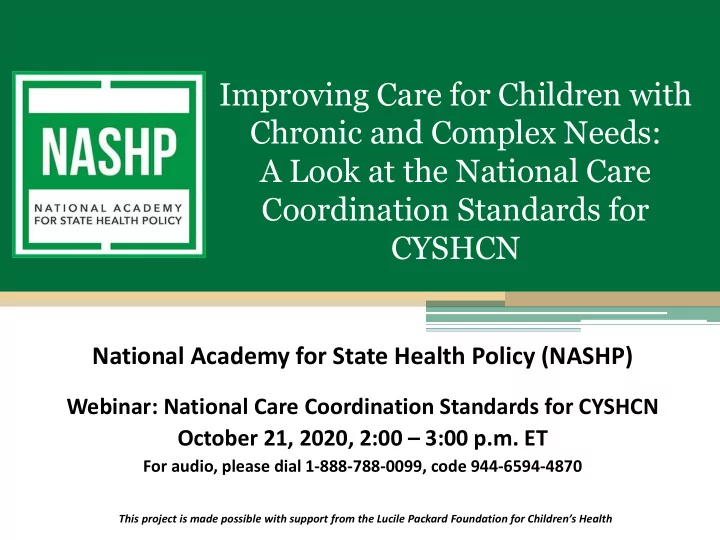
Improving Care for Children with Chronic and Complex Needs: A Look at the National Care Coordination Standards for CYSHCN

National Academy for State Health Policy (NASHP)

Webinar: National Care Coordination Standards for CYSHCN October 21, 2020, 2:00 – 3:00 p.m. ET

For audio, please dial 1-888-788-0099, code 944-6594-4870

This project is made possible with support from the Lucile Packard Foundation for Children’s Health

slide-2
SLIDE 2

Agenda

Welcome, Introductions and Overview Karen VanLandeghem, Senior Program Director, NASHP Why are the National Care Coordination Standards Needed? Provider and Family Perspectives David Bergman, Emeritus Faculty, General Pediatrics, Stanford University School of Medicine Cara Coleman, Program Manager, Family Voices What are the Core Elements of the Standards? An Overview of National Care Coordination Standards for CYSHCN Kate Honsberger, Project Director, NASHP How Can States Use the Standards to Strengthen Care Coordination for CYSHCN? Jeffrey Brosco, State Title V CYSHCN Director, Florida Department of Health, Professor of Clinical Pediatrics, University of Miami Wendy Tiegreen, Director, Office of Medicaid Coordination & Health System Innovation, Georgia Department of Behavioral Health and Developmental Disabilities Q&A, Wrap-up and Resources for Further Information Kate Honsberger, Project Director, NASHP

2

slide-3
SLIDE 3

Why NASHP Developed the National Care Coordination Standards for CYSHCN

  • Care coordination is a core component of state efforts to

improve health outcomes, reduce caregiver and patient burden, decrease health care costs and strengthen systems

  • f care for children and adults with chronic and complex

conditions

▫ Systems have been and are investing in care coordination

  • Highly valued among families, providers and systems that

serve CYSHCN and makes a difference when done well, but need for improvements

  • State health leaders (e.g., Medicaid, public health, mental

health) and others (e.g., families, health plans, providers) expressed a need for care coordination standards that would build upon the National Standards for CYSHCN

3

slide-4
SLIDE 4

National Work Group

4

Richard Antonelli, Boston Children’s Hospital Marlene Asmussen, Oklahoma Health Care Authority Kayzy Bigler, Kansas Department of Health and Environment Jeffrey Brosco, Florida Department of Health Sandra Brown, Virginia Department of Medical Assistance Services Treeby Brown, Health Resources and Services Administration, Maternal and Child Health Bureau Allegra Burrell, Children’s National Medical Center Cara Coleman, Family Voices Meg Comeau, The Catalyst Center at Boston University Mary Daymont, Children’s National Health System Renee Fox, Centers for Medicare & Medicaid Services Deborah Garneau, Rhode Island Department of Health Holly Henry, Lucile Packard Foundation for Children’s Health Dennis Kuo, University of Buffalo, Jacobs School of Medicine and Biomedical Sciences Jennifer Kyle, UnitedHealthcare Carolyn Langer, Fallon Health Eric Levey, The HSC Health Care System, Washington D.C. Marie Mann, Health Resources and Services Administration, Maternal and Child Health Bureau Jeanne McAllister, Indiana University School of Medicine Margaret McManus, The National Alliance to Advance Adolescent Health John Morehous, University of Cincinnati College of Medicine Kathleen Noonan, Camden Coalition of Healthcare Providers Jennifer Oppenheim, Substance Abuse and Mental Health Services Administration Rylin Rodgers, Association of University Centers on Disabilities Heather Smith, Kansas Department of Health and Environment Colleen Sonosky, Department of Health Care Finance, Washington, DC Kate Taft, Association of Maternal and Child Health Programs Wendy Tiegreen, Georgia Department of Behavioral Health and Developmental Disabilities Renee Turchi, Drexel University College of Medicine and School of Public Health Debra Waldron, American Academy of Pediatrics
slide-5
SLIDE 5

Why are the National Care Coordination Standards Needed?

Provider and Family Perspectives

5

slide-6
SLIDE 6

Why are the National Care Coordination Standards Needed? Provider Perspective

6

  • See on average six different providers
  • Interact with up to 30 different agencies
  • Spend 11 – 20 hours a week doing care

coordination Children with Complex Conditions

  • Care coordination is critically important
  • We need help
  • Care coordination standards help to inform the

development of appropriate care coordination services

  • Standards need to be evidence based or evidence

informed Providers

slide-7
SLIDE 7

Why are the National Care Coordination Standards Needed? Provider Perspective

7

  • Most studies are

done at a program level...and if you have seen one program, you have seen one program.

  • It is difficult to show

which individual components of a program are effective.

  • Studies have shown

impact on: Cost and utilization Family well-being Unmet family needs Improvement in clinical outcome (e.g., diabetes)

  • Successful programs

had these components in common: Identified care coordinator Shared Plan of Care Family assessment Family support and advocacy

  • These components

map to the care coordination domains

What is the Evidence?

slide-8
SLIDE 8

Why Families (desperately) Need National Care Coordination Standards

  • Eliminate variability and inequities of services, care and system
  • Eliminate waste in system
  • E.g., 10 care coordinators???
  • Quality care coordination vs. quantity
  • Meaningful, authentic, family-professional partnership
  • “love and marriage”- care coordination, family-centered care, shared

decision making and shared plans of care

  • Right care coordinated for each child’s unique needs

One of the keys to the new standards = Integration of families “Nothing about us, without us”

slide-9
SLIDE 9

What are the Core Elements of the Standards?

An Overview of National Care Coordination Standards for CYSHCN

9

slide-10
SLIDE 10

National Care Coordination Standards Development Process

10 Literature Review

Key Informant Interviews Development of Guiding Principles and Domains Multiple rounds of reviews and consensus building by National Work Group

slide-11
SLIDE 11

Guiding Principles for the Development of the National Care Coordination Standards

11

Family-centered Evidence-based Applicable to various policy contexts and care coordination models, systems, and payers Reflect involvement of service systems outside of health care Acknowledge the impact of social determinants of health Companion to the National Standards Focused on system-level and process Designed for CYSHCN but applicable across ages Considered existing care coordination guidance and federal requirements The result of consensus, not endorsement, from the National Work Group

slide-12
SLIDE 12

12

slide-13
SLIDE 13

Foundational Standards

There are seven foundational standards that are critical for comprehensive care coordination for CYSHCN. High-quality care coordination systems should:

1. Be based on health equity 2. Address social, behavioral, environmental, and health care needs 3. Include families are core partners 4. Use evidence-based, evidence-informed, and promising practices 5. Be culturally competent, linguistically appropriate, and accessible 6. Consider insurance coverage as key to accessibility 7. Assess performance with outcome measures

13

slide-14
SLIDE 14

Care Coordination Standard Domains

14

Child and Family Empowerment and Skills Development Care Coordination Workforce Care Transitions

The foundational standards are used to guide the remaining standards, which are grouped into six domains.

Screening, Identification, and Assessment Shared Plan of Care Team-Based Communication

slide-15
SLIDE 15

Key Components of the Standards

15

Screening, Identification, and Assessment

  • Identifies a family’s strengths, needs, beliefs, culture, and preferences
  • Evaluates the complexity of the child’s health condition and the impact
  • n social determinants of health

Shared Plan of Care

  • Addresses clinical, functional, social, and aspirational issues
  • Identifies contacts for emergent and routine issues

Team-based Communication

  • Outlines clear roles and responsibilities for team members
  • Designates a single point of contact for the family
slide-16
SLIDE 16

Key Components of the Standards

16 Child and Family Empowerment and Skills Development

  • Builds a child’s self-management and efficacy skills
  • Appropriately reimburses people with lived experience

Care Coordination Workforce

  • Is culturally, linguistically, racially, and ethnically diverse
  • Accounts for case complexity when determining case load ratios

Care Transitions

  • Includes policies to facilitate effective transition between entities
  • Collaborates with adult providers for youth transitioning to adult

health care systems

slide-17
SLIDE 17

How Can States Use the Standards to Strengthen Care Coordination for CYSHCN?

17

slide-18
SLIDE 18

What are the common challenges the National Work Group identified as challenges to providing high- quality care coordination to children and youth with special health care needs?

18

  • CYSHCN and their families participating in multiple treatment teams and

care coordination processes

  • CYSHCN and their families not feeling empowered to self-

manage/coordinate care

  • Lack of shared cross-provider Electronic Health Records or data sharing

platforms

  • Establishing mechanisms to finance care coordination
  • Lack of quality measurement of care coordination
  • Authority for care coordination across multiple system and provider types
  • Care coordination services or programs often don’t include or focus on:
  • Other confounding health conditions
  • Social Determinants of Health
  • Cultural/Linguistic family factors
  • Family strengths, preferences, desires, and resilience (i.e., often deficit-

based versus strength-based)

  • Level of coordination need (too much/too little/none)
slide-19
SLIDE 19

How Can States Use the Standards to Strengthen Care Coordination for CYSHCN?

  • How can the National Care Coordination Standards be used to help

address these challenges and strengthen high-quality care coordination?

  • What advice would you give to state officials (and others) who are

interested in using the National Care Coordination Standards?

19

slide-20
SLIDE 20

Q&A

20

slide-21
SLIDE 21

National Standards for CYSHCN Resources

21

National Care Coordination Standards for CYSHCN (PDF, webpage) Blog on National Care Coordination Standards National Standards for Systems of Care for CYSHCN

slide-22
SLIDE 22

Thank You!

Please contact NASHP with any questions:

Karen VanLandeghem, Senior Program Director: KVanLandeghem@nashp.org Kate Honsberger, Project Director: KHonsberger@nashp.org 22