Improving Access to Healthier Foods for Individuals with - - PowerPoint PPT Presentation

improving access to healthier foods for individuals with
SMART_READER_LITE
LIVE PREVIEW

Improving Access to Healthier Foods for Individuals with - - PowerPoint PPT Presentation

Improving Access to Healthier Foods for Individuals with Intellectual Disabilities Living in Home Care Settings through Model Food Service Guidelines Angela Amico, MPH Senior Policy Associate aamico@cspinet.org @CSPI, @angela__amico


slide-1
SLIDE 1

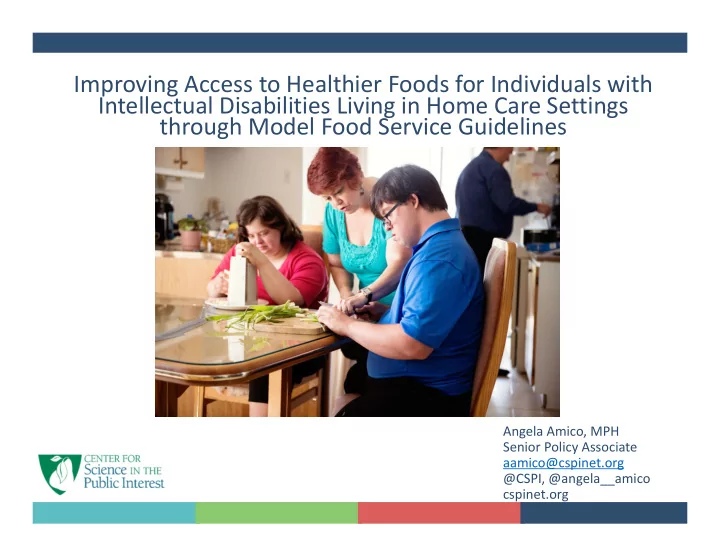
Improving Access to Healthier Foods for Individuals with Intellectual Disabilities Living in Home Care Settings through Model Food Service Guidelines

Angela Amico, MPH Senior Policy Associate aamico@cspinet.org @CSPI, @angela__amico cspinet.org

slide-2
SLIDE 2

Presenter Disclosures

Angela Amico The following personal financial relationships with commercial interests relevant to this presentation existed during the past 12 months: No Relationships to Disclose Funding Disclosure: Work supported by Inclusive Health Innovation Grant, Special Olympics

slide-3
SLIDE 3

Center for Science in the Public Interest

  • Since 1971, CSPI mission:
  • Make it easier to eat healthfully
  • Prevent/mitigate diet‐ and obesity‐related

diseases

  • What do we do?
  • Empower consumers to identify and

choose healthier options

  • Safeguard food supply
  • Transform the food environment to

support healthier eating

  • How do we do it?
  • National, state and local policy
  • Corporate engagement
  • Litigation
  • Consumer education
slide-4
SLIDE 4

Nutrition Recommendations

slide-5
SLIDE 5

Our Actual Food Environment

slide-6
SLIDE 6

Why Healthier Public Places?

  • Model and reinforce other

nutrition and obesity prevention efforts

  • Increase demand for healthier

foods and beverages

  • Encourage product reformulation
  • Reduce prevalence of obesity,

diabetes, heart disease, and diet‐ related diseases

  • Reduce health care costs
slide-7
SLIDE 7

Good Food Transforms the Food System

Increase Demand Increased supply

Policy Reset Shift Industry Practices

slide-8
SLIDE 8

Growing Movement

State County City Other

Adopted Food Service Guideline Policies

slide-9
SLIDE 9

Comprehensive Guidelines Benefit Communities

  • Parks and Recreation
  • Convention Centers
  • Office Buildings
  • Libraries
  • Senior Centers
  • Schools and Universities
  • Hospitals
  • Correctional Facilities
slide-10
SLIDE 10

Special Olympics Center for Inclusive Health

slide-11
SLIDE 11

Understanding Group Home Practices

Worked with American Network of Community Options and Resources (ANCOR), which represents more than 1,400 community providers Interviewed and surveyed service providers for adults with intellectual disabilities

slide-12
SLIDE 12

Intellectual and Developmental Disabilities

Developmental Disability: broad term to encompass both physical and intellectual disability Intellectual (Cognitive) Disability:

  • Intellectual functioning level (IQ) below 70‐75
  • Significant limitations in adaptative skills
  • Condition present from childhood
slide-13
SLIDE 13

Dietary Considerations

Table showing food and liquid texture modifications

slide-14
SLIDE 14

Health Disparities

Adults with intellectual disability are:

  • 5x > diabetes
  • 2x > heart disease
  • Higher risk for
  • besity

Krahn, G.L. & Fox, M.H. (2014). Health disparities of adults with intellectual disabilities: what do we know? What do we do? J Appl Res Intellect Disabil. 27(5), 431‐46.

slide-15
SLIDE 15

Group Homes

Intermediate care facilities: optional Medicaid benefit, offered by all states

  • Higher level of care (active treatment required)
  • Comprehensive services: room and board

Medicaid 1915(c) Home and Community‐based Services Waiver established 1981

  • Community integration 2014, focus on individual
  • Typically lower level of care
  • Can include meal services
slide-16
SLIDE 16

Group Homes

  • Several group homes

may be managed by same organization

  • <10 residents, many

<5 residents

  • Not all group homes

have dietitian (varies

Image Source: Fairfield City Champion

by intermediate care facility and community

  • ptions)
slide-17
SLIDE 17

Example of two week sample menu

slide-18
SLIDE 18

Common Dietary Modifications

  • Nutrition
  • Reduced calorie
  • Reduced sodium
  • Reduced sugar
  • Reduced serving amount
  • Reduced fat
  • Other
  • Medication
  • Modified texture
  • Thickened liquids
  • Adaptive eating equipment
  • Allergens and preferences
slide-19
SLIDE 19

General Guidelines

  • Fruits and vegetables
  • Whole grains
  • Calories
  • Sugar
  • Sodium
  • Saturated fat
slide-20
SLIDE 20

Meal Planning Resources

  • Government resources (e.g. MyPlate) and online

recipes

  • Meals may be planned by third party
  • Food vendor
  • Dietitian
  • Majority did not work with private program or

company for assistance developing menus, some do

  • Services can be comprehensive, including shopping lists and

incentives

  • Cost can be barrier
slide-21
SLIDE 21

Food Shopping

  • Grocery lists developed by

dietitians, group home staff, individuals supported

  • Individuals supported to add

items to grocery list

  • Food Sources:
  • Grocery stores
  • Food distributers (Sysco)
  • Central kitchens
slide-22
SLIDE 22

Food Shopping

  • Shopping by service

providers, individuals supported, food/nutrition staff (dietitian, chef, food service supervisor)

  • Daily Food Budget
  • $4.75‐ $60
  • Based on number of

individuals in home and dietary needs

slide-23
SLIDE 23

Food Preparation

  • By staff members, with some

potential involvement from individuals supported

  • Staff preparing food have

some training (e.g. safe food handling)

  • May not have received culinary training or have
  • ther responsibilities in the home
  • Some homes have specific food preparation staff
slide-24
SLIDE 24

Food Preparation

  • Scratch cooking
  • Combination of prepared foods and scratch

cooked items

  • Pre‐prepared foods (e.g. frozen entrees)
  • Staff do not always follow recipes
  • Lack of culinary training
  • Shortcuts (substituting processed or pre‐prepared items)
  • Wrong ingredients purchased or missing ingredients
  • Staff preference for certain dishes
  • Individuals supported recipe preferences
slide-25
SLIDE 25

Staff Participation

Staff:

  • Eat for free with individuals supported
  • Choose not to eat with individuals supported
  • Pay to eat with individuals supported
  • Eat their own food while serving meals to

individuals supported

slide-26
SLIDE 26

Acceptability

  • General acceptability
  • Preference for meals

made by certain staff members

  • Few regular complaints
  • Individual variation

(some picky eaters, some who generally like everything)

Image Source: Portland Press Herald

slide-27
SLIDE 27

Food Away from Home

  • Packed lunches for day programs
  • Individual purchases at grocery stores and

restaurants

slide-28
SLIDE 28

Challenges

  • Modifications of meals makes general

resources challenging

  • “General resources are not that helpful”
  • Limited time and staff training
  • “Any training would be helpful”
  • “Healthy frozen prepared meals that can be used when

staffing is short or there are a lot of activities to attend to and meal preparation time is short.”

  • High turnover rate among providers
slide-29
SLIDE 29

The Bigger Picture

  • Our food environment is challenging
  • Considering an inclusive health approach

ensures better access to healthier foods for everyone

slide-30
SLIDE 30

Stay Connected

Join our Action Network at

cspinet.org/ActNow

slide-31
SLIDE 31

Inclusive Health Resources

  • Special Olympics Center

for Inclusive Health

  • American Association
  • n Intellectual and

Developmental Disabilities

  • American Academy of

Developmental Medicine and Dentistry

slide-32
SLIDE 32

Food Service Guideline Resources

  • Fact sheets, model policies, and policy summaries

available at https://bit.ly/CSPI‐FSG

  • Healthy Meeting Toolkit and Model Pledge available at

healthymeeting.org

  • Food Service Guidelines Collaborative

foodserviceguidelines.org

  • Learn about new resources and funding opportunities

and network with others working on food service guidelines through our listserv

  • E‐mail: aamico@cspinet.org