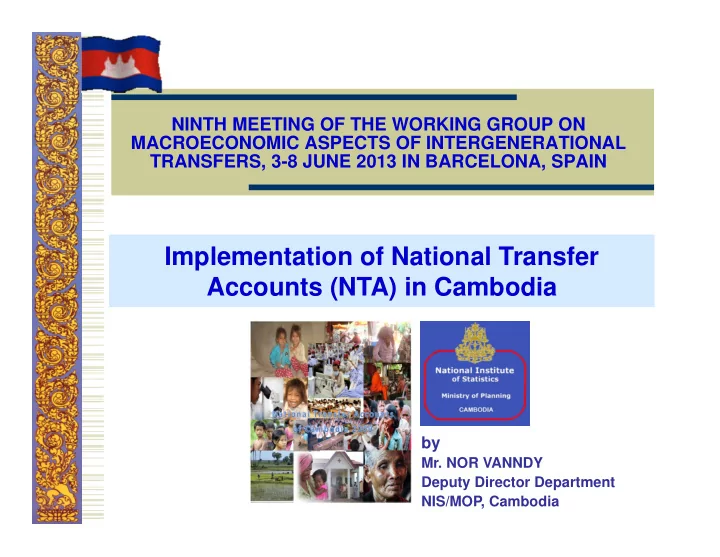
Implementation of National Transfer Accounts (NTA) in Cambodia by - - PowerPoint PPT Presentation

implementation of national transfer accounts nta in
SMART_READER_LITE
LIVE PREVIEW

Implementation of National Transfer Accounts (NTA) in Cambodia by - - PowerPoint PPT Presentation

NINTH MEETING OF THE WORKING GROUP ON MACROECONOMIC ASPECTS OF INTERGENERATIONAL TRANSFERS, 3-8 JUNE 2013 IN BARCELONA, SPAIN Implementation of National Transfer Accounts (NTA) in Cambodia by Mr. NOR VANNDY Deputy Director Department


slide-1
SLIDE 1

NINTH MEETING OF THE WORKING GROUP ON MACROECONOMIC ASPECTS OF INTERGENERATIONAL TRANSFERS, 3-8 JUNE 2013 IN BARCELONA, SPAIN

Implementation of National Transfer Accounts (NTA) in Cambodia

by

  • Mr. NOR VANNDY

Deputy Director Department NIS/MOP, Cambodia

slide-2
SLIDE 2

NIS/MOP Cambodia

Outline

Introduction to NTA of Cambodia Cambodian Population Structure Change,1950-2050 Finding Results: Major NTA indicators Conclusion Policy Response

2

slide-3
SLIDE 3

NIS/MOP Cambodia

Introduction to NTA of Cambodia

National Institute of Statistics (NIS) of Cambodia constructed a framework of NTA compilation since 2011. NIS has compiled the NTA of Cambodia as of 2009 in collaboration with the Nihon University Population Research Institute (NUPRI) to Cambodia joined

  • fficially of the Global NTA Project in January 2013.

3

slide-4
SLIDE 4

NIS/MOP Cambodia

Introduction to NTA of Cambodia

NTA of Cambodia is compiled in consistency with the National Accounts System of Cambodia to explore the major indicators such: labor income, consumption by population age structure. The first demographic dividends, economic life cycle and support ratio by age is also estimated at this round. NTA of Cambodia in 2009 is recently updated for experimental estimates of per Capita labor income and consumption by age, urban and rural.

4

slide-5
SLIDE 5

NIS/MOP Cambodia

Cambodian Population Structure Change

5

1950 – 2050

slide-6
SLIDE 6

NIS/MOP Cambodia

6

1950

250 200 150 100 50 50 100 150 200 250 Male Female

slide-7
SLIDE 7

NIS/MOP Cambodia

7

1960

250 200 150 100 50 50 100 150 200 250 Male Female

slide-8
SLIDE 8

NIS/MOP Cambodia

8

1970

250 200 150 100 50 50 100 150 200 250 Male Female

slide-9
SLIDE 9

NIS/MOP Cambodia

9

1980

250 200 150 100 50 50 100 150 200 250 Male Female

slide-10
SLIDE 10

NIS/MOP Cambodia

10

1990

250 200 150 100 50 50 100 150 200 250 Male Female

slide-11
SLIDE 11

NIS/MOP Cambodia

11

2010

250 200 150 100 50 50 100 150 200 250 Male Female

slide-12
SLIDE 12

NIS/MOP Cambodia

12

2020

250 200 150 100 50 50 100 150 200 250 Male Female

slide-13
SLIDE 13

NIS/MOP Cambodia

13

2030

250 200 150 100 50 50 100 150 200 250 Male Female

slide-14
SLIDE 14

NIS/MOP Cambodia

14

2040

250 200 150 100 50 50 100 150 200 250 Male Female

slide-15
SLIDE 15

NIS/MOP Cambodia

15

2050

250 200 150 100 50 50 100 150 200 250 Male Female

slide-16
SLIDE 16

NIS/MOP Cambodia

Shares(%) of Population by Urban and Rural

16

10 20 30 40 50 60 70 80 90 2008 2009 2010 2011 2012 2013 2014 2015 2020 2025 2030 20 20 20 21 21 22 22 23 25 28 29 80 80 80 79 79 78 78 77 75 72 71

Urban Rural

slide-17
SLIDE 17

NIS/MOP Cambodia

Finding Results

17

Major NTA Indicators

slide-18
SLIDE 18

NIS/MOP Cambodia

Per capita Total Consumption and Labor income by age in 2009

18 500 1000 1500 2000 2500 3000 3500 4000 4500 5000 10 20 30 40 50 60 70 80 90 TotCons'000KHR LaborInc '000KHR

slide-19
SLIDE 19

NIS/MOP Cambodia

Per Capita labor incomes and consumptions by age, urban and rural in 2009, value in riels (Experimental Estimates)

19

slide-20
SLIDE 20

NIS/MOP Cambodia

The effective Cambodian Support Ratio, 1950-2050

20

0.72 0.72 0.75 0.73 0.71 0.78 0.82 0.82 0.81 0.78 0.77

0.60 0.65 0.70 0.75 0.80 0.85 1950 1960 1970 1980 1990 2000 2010 2020 2030 2040 2050

slide-21
SLIDE 21

NIS/MOP Cambodia

The First Demographic dividend, Cambodia 1950-2050

21

1.57

  • 0.59
  • 1.50
  • 1.00
  • 0.50

0.00 0.50 1.00 1.50 2.00 1950 1960 1970 1980 1990 2000 2010 2020 2030 2040 2050

slide-22
SLIDE 22

NIS/MOP Cambodia

22

Conclusion

The support ratio and the first demographic dividend are low which may indicate that productivity in term of labor income is very low because the number of effective consumers are larger than the number of effective producers, which affects economic growth. However, starting 2020, Cambodia will have the potential to increase the number of effective producers and labor income (productivity) because of the age structural changes in the population.

slide-23
SLIDE 23

NIS/MOP Cambodia

23

Policy Implication

Since the proportion of the working age group is

  • increasing. Cambodia can take advantage of this

demographic dividend to increase its economic growth. To create jobs for Cambodian young working group and also make balance population in the country through the promotion of foreign direct investment (FDI) and local investments such small and medium enterprises. Productivity (labor income) in Cambodia is still low, especially in urban and rural area. Thus, investment in human capital development (education, health etc.) and utilization are very important.

slide-24
SLIDE 24

NIS/MOP Cambodia

24

Policy Implication

Encourage capital accumulation during working ages to support retirement consumption during older ages. Cambodia will begin to experience rapid ageing in the not too distant future (will increase from 3.4% in 2009 to 4.5% in 2020 and to 9.6% in 2050) and the current family support system will undergo change. Thus, it is necessary to put in place policies to meet the social security needs of the elderly.

slide-25
SLIDE 25

NIS/MOP Cambodia

25

Policy Implication

Social security system, welfare services and other services for elderly should be strengthened and expanded. The aging population in rural areas in Cambodia is rapidly increasing due to the out-migration of younger aged adults. Therefore, special programs should be implemented to support older adults in rural areas.

slide-26
SLIDE 26

THANK YOU FOR ATTENTION !

NIS/MOP Cambodia

26

Q & A