SLIDE 1
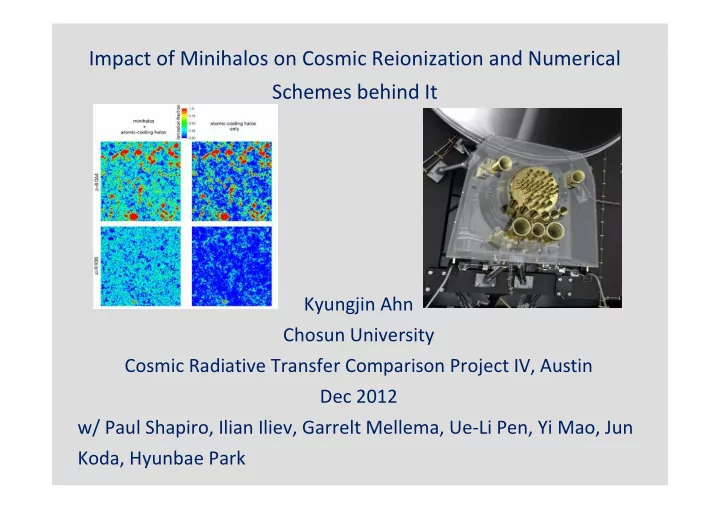
Impact of Minihalos on Cosmic Reionization and Numerical Schemes behind It
Kyungjin Ahn Chosun University Cosmic Radiative Transfer Comparison Project IV, Austin Dec 2012 w/ Paul Shapiro, Ilian Iliev, Garrelt Mellema, Ue-Li Pen, Yi Mao, Jun Koda, Hyunbae Park
SLIDE 2
- When reionization completed (from high- z QSO
spectra)
– GP effect: zov ~ 6.5 ??? (only lower limit to neutral fraction at z>6.5) – z=7 objects: QSO(Mortlock et al. 2011), LAE in LBGs(Pentericci et al. 2011), LAEs(Ota et al. 2010) all indicating neutral fraction > 10% at z=7 !!!!!! (albeit warning from Dayal)
– kinetic Sunyaev- Zeldovich effect on CMB – SPT: z(x=99%)- z(x=20%) ~ 4.4 – 7.9 (2σ level, Zahn et al. 2011; c.f. see Mesinger, McQuinn, Spergel 2012)
- Electron content, in terms of Thomson scattering
- ptical depth of CMB
– τ = 0.085 ± 0.015 (WMAP7, 1σ level)
Current observational constraints on Reionization
SLIDE 3
Current observational constraints on Reionization
z=7.085 QSO (Mortlock et al. 2011)
very small proximity zone high neutral fraction of ~ >0.1 at z=7 (Bolton et al. 2011)
SLIDE 4
Current observational constraints on Reionization James Bolton upgrading on this (Bolton & Haehnelt 2012), but still nHI>0.1 at z~ 7
SLIDE 5
– first stars in minihalos
- Late reionization(zov<7) & high τ conditions: hard to
match simultaneously
– hard w/ observed luminosity function – hard in numerical simulations (Iliev et al.; Zahn et al.; Trac & Cen; )
- Photon starvation (Bolton & Haehnelt 2007) and high
- ptical depth
- Simple answer: minihalos
– hints from semi- analytical studies by Haiman & Bryan (over- boosting τ); Wyithe & Cen; – inhomogeneous physical processes Yes, we still need numerical simulations!!
Motivation / Puzzle / Our answer
SLIDE 6
- lowest- mass host: Minihalos (<~ 108 M)
– hosting First Stars – regulation of only coolant, H2, by Lyman- Werner radiation
- middle - high- mass host: atomic- cooling halos (>~ 108 M)
– immune to Lyman- Werner radiation (high column density) – sub- categorized (feedback from photoheating; Iliev et al.)
- immune to Jeans mass filtering: >~ 109 M
- vulnerable to Jeans mass filtering: <~ 109 M
- Can we achieve full dynamic range on big box?
– subgrid treatment on minihalos – Lyman- Werner band radiative transfer needed
- Done! (N- body source, density radiative transfer)
– 114/h Mpc box – N- body halo resolution: 108 M – minihalos (one 100- 300 M Pop III star/minihalo, M>=105 M) – LW feedback (JLW,th=0.01- 0.1x10- 21 erg cm- 2 s- 1 sr- 1)
- minihalos as sinks: e.g. Ciardi et al. 2006, McQuinn et al. 2007
Reionization simulation with all stellar sources (KA, Iliev, Shapiro, Mellema, Koda, Mao 2012)
SLIDE 7 What’s new?
minihalos (first stars!)
– small- box (6.3/h Mpc) simulation resolving minihalos – correlation between density & minihalo population (nonlinear bias: KA, Iliev, Shapiro & Koda in preparation) – put one Pop III star per minihalo
dissociation of coolant, H2
– calculate transfer of Lyman- Werner Background (KA, Shapiro, Iliev, Mellema, Pen 2009) – remove first star from minihalos, if LW intensity
SLIDE 8 What’s new?
minihalos (first stars!)
– small- box (6.3/h Mpc) simulation resolving minihalos – correlation between density & minihalo population (nonlinear bias: KA, Iliev, Shapiro & Koda in preparation) – put one Pop III star per minihalo
dissociation of coolant, H2
– calculate transfer of Lyman- Werner Background (KA, Shapiro, Iliev, Mellema, Pen 2009) – remove first star from minihalos, if LW intensity
SLIDE 9 Photon-Conserving
- photon-absorption rate = hydrogen-ionization rate
Causal
Short-characteristics for ray-tracing (O~N_source * N_cell)
- from source to cell (fig from Thomas Peters)
Hear more from Garrelt Mellema on Friday (if available)
How ionizing radiation transfer done: C2Ray (Mellema, Iliev, Alvarez, Shapiro 2006)
SLIDE 10 Sources distributed inhomogeneously: Need to sum individual
contribution
One single source is observed as a picket-fence in spectrum Obtain pre-calculated “picket-fence modulation” factor and multiply it
to L/DL
- 2. This becomes mean intensity to be distributed among H2 ro-
vibrational lines.
- Relative flux averaged over E=[11.5 – 13.6] eV
- multi-frequency phenomenon single-frequency calculation with pre-
calculated factor Huge alleviation computationally.
How LW transfer done: Picket-Fence Modulation Factor (KA, Shapiro, Iliev, Mellema, Pen 2009)
SLIDE 11 Numerical techniques (continued)
Retarded time emissivity
New development
Too many sources contributing to
UV background
Before: brute-force summation of
intensities from all sources
Now: Fast Fourier Transformation
(N*logN operation)
How LW transfer done: Retarded-time emissivity/FFT
SLIDE 12
How LW transfer done: Retarded-time emissivity/FFT
SLIDE 13
How LW transfer done: Retarded-time emissivity/FFT
SLIDE 14
- More extended reionization
- Same xe but different morphology, with and
without minihalos (c.f. McQuinn et al. 2007)
- More electron content stronger polarization
- f CMB
- Earlier heating of intergalactic medium
- Earlier Lyα pumping on 21cm
- Earlier whatever
What do we expect
SLIDE 15
114/h Mpc, w/ Minihalo+ACH, M(Pop III star)=300M, JLW,th=0.1x10⁻²¹ erg cm-2 s-1 sr-1
SLIDE 16
With and Without Minihalos
SLIDE 17
– starts reionization – very extended reionization history – 20% ionization, boost in optical depth by ~ 40% possible
– determines when reionization is completed
- Late- reionization- completion prior (z<~ 7)
– small emissivity in massive halo sources required – not large enough optical depth ONLY with massive halo sources
- Early reionization models
– large optical depth possible only with massive halo sources – reionization completes too early (z>~ 8), violating observational constraint
- Late reionization, large optical depth: both can be achieved only
with help of minihalo sources, or namely the first stars
Storyline
SLIDE 18
Early vs. Late Reionization Models No-minihalo vs. Minihalo Models
SLIDE 19
– Aimed at CMB / matter power spectrum (linked with CAMB, also at Antony’s shop at http://cosmologist.info) – Does it all – Can be tailored for generic application – Can be tailored for your custom universe – Publicly available – Parallelized
- COSMOMC allowing for generic ionization histories (Mortonson
& Hu)
– Principal component analysis
Question: hypothesis-testing at what confidence level?
SLIDE 20
Planck Forecast
Hu & Holder; Motonson & Hu: PCA for reionization
SLIDE 21
Planck Forecast
SLIDE 22
Planck Forecast
SLIDE 23 Summary/ prospects
– can satisfy late reionization, high- optical depth conditions simultaneously: puzzle solved – very extended reionization, with plateau in x(z) – Planck can smell the first stars no matter what!
– 21cm (absorption, emission, cosmology (Mao), ) – tSZ, kSZ (related to SPT observation) – NIRB – cosmic archeology / local universe metallicity
- 0th order done, 1st order need be further pursued
– mass of Pop III star, x- ray binary, baryon offset
- Observational constraints needed more (LAE hunters,
QSO hunters, GRB hunters)
- Theoretical constrains needed more (e.g. critical LW
intensity: Norman, Wise, Hasegawa, Susa, )
SLIDE 24 Post-Planck language (if interested in EoR )
- WMAP
- reionization parameterized by two (dependent)
variables: τes, zreion
- was OK with WMAP sensitivity
- Planck
- reionization SHOULD BE parameterized by many
(dependent) variables: τes, m1, m2, m3, …
- probing astrophysics at cosmological scale! (detecting
first star era)
- Hasty conclusion from South Pole Telescope (small-scale
CMB aniostropy)
- Zahn et al. 2012: reionization duration dz < 4.4-7.9
- being debunked by Hyunbae Park et al. in preparation
SLIDE 25