Impact of E-mentoring on Career Awareness and Exploration Doreen H. - - PDF document

impact of e mentoring on career awareness and exploration
SMART_READER_LITE
LIVE PREVIEW

Impact of E-mentoring on Career Awareness and Exploration Doreen H. - - PDF document

Impact of E-mentoring on Career Awareness and Exploration Doreen H. Kinkel, Ph.D. Department of Animal and Wildlife Sciences MSC 228 Texas A&M University-Kingsville 700 University Blvd. Kingsville, TX 78363 voice: (361)-593-3948 e-mail:


slide-1
SLIDE 1

Impact of E-mentoring on Career Awareness and Exploration

Doreen H. Kinkel, Ph.D. Department of Animal and Wildlife Sciences MSC 228 Texas A&M University-Kingsville 700 University Blvd. Kingsville, TX 78363 voice: (361)-593-3948 e-mail: kfdds00@tamuk.edu

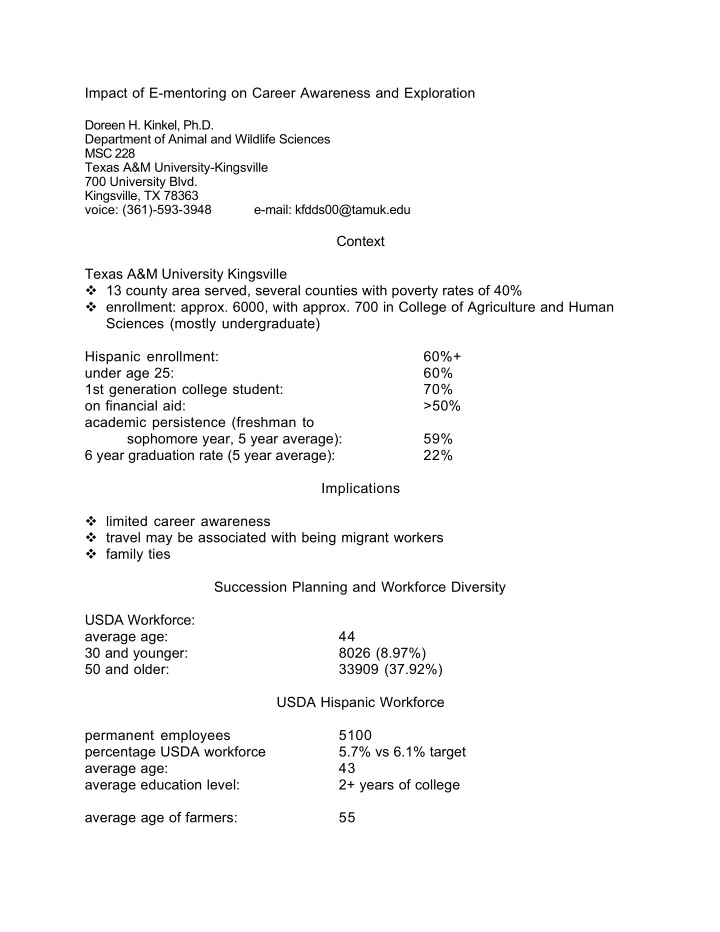
Context Texas A&M University Kingsville  13 county area served, several counties with poverty rates of 40%  enrollment: approx. 6000, with approx. 700 in College of Agriculture and Human Sciences (mostly undergraduate) Hispanic enrollment: 60%+ under age 25: 60% 1st generation college student: 70%

  • n financial aid:

>50% academic persistence (freshman to sophomore year, 5 year average): 59% 6 year graduation rate (5 year average): 22% Implications  limited career awareness  travel may be associated with being migrant workers  family ties Succession Planning and Workforce Diversity USDA Workforce: average age: 44 30 and younger: 8026 (8.97%) 50 and older: 33909 (37.92%) USDA Hispanic Workforce permanent employees 5100 percentage USDA workforce 5.7% vs 6.1% target average age: 43 average education level: 2+ years of college average age of farmers: 55

slide-2
SLIDE 2

Developmental Approach to Career Planning and Preparation Career awareness→career exploration→career development career awareness: learning types of jobs or positions in an area of interest career exploration: learning skills and aptitudes needed for a job or position and characteristics of a job or position, e.g., salary, work environment, job benefits career development: experiential learning through activities associated with a job or position; enhances career decision-making Purpose  impact career awareness and exploration  engage students in career development activities  increase willingness to leave geographic area  improve career decision-making Objectives  improve awareness of careers in food and agricultural sciences of incoming freshman students through e-mentoring and career portfolio  enhance career exploration through e-mentoring and job shadowing  facilitate career development by participation in conferences of professional

  • rganization

Methodology  e-mentoring incorporated into existing freshman course  career portfolio assembled as course requirement  job shadowing of e-mentor following summer  participate in conference of professional organization Results of pre-mentoring Fall 2002, n=15 Fall 2003, n=23 Definition of a mentor: 6 could provide an answer 6 could provide an answer Have you been involved in a formal mentoring relationship? Yes=3 No=1202 Yes=2 No=2103 Please describe:  in 8th grade for a shadowing project for career development I shadowed at an animal clinic in Corpus  with my dad and how he plays the guitar02

slide-3
SLIDE 3

 the Texas A&M University Kingsville Student Activities Mentor Program involved in a mentoring program here at TAMUK03 If you have been involved in a formal mentoring relationship, was it one on one or a group mentored by one or more adults? 2 involved in one on one, 1 in group02 2 involved in one on one, 0 in group03 Have you been involved in a youth group such as 4-H, Boy/Girl Scouts, Boys/Girls Club, church? Yes 12 No 302 Yes 20 No 303 Please describe: 4-H 5 FFA 6 Scouts 4 Church 7 Other 402 4-H 8 FFA 5 Scouts 8 Church 13 Boys/Girls Club 4 Other 103 Circle your response to the following:

  • 1. Willingness to be involved with a mentor:
  • nly if I really have to

sounds OK interested to see what I can get from it 1 2 3 4 5 7% 20% 20% 53% 9% 17% 26% 48%

  • 2. Education is key to a good career:

not especially important kind of important essential 1 2 3 4 5 7% 93% 17% 83%

  • 3. Education is key to a good quality of life:

not especially important kind of important essential 1 2 3 4 5 13% 20% 67% 13% 26% 61%

  • 4. Willingness to relocate to another part of the US:

not a chance maybe definitely-an adventure 1 2 3 4 5 13% 13% 33% 20% 20% 13% 4% 48% 13% 22%

slide-4
SLIDE 4
  • 5. Willingness to do a formal internship away from home or college:

not a chance maybe definitely-an adventure 1 2 3 4 5 40% 27% 33% 9% 30% 26% 35%

  • 6. Can you list or describe at least 5 jobs that involve animals that require a college

degree besides veterinarian and biology teacher? not at all possibly very easily 1 2 3 4 5 7% 47% 13% 33% 9% 13% 57% 13% 9%

  • 7. How much “research” have you done into the career you have chosen?

not much looked at brochures/websites interviewed people doing job 1 2 3 4 5 7% 33% 27% 33% 4% 13% 26% 43% 13%

  • 8. How important is your undergraduate grade point average (GPA) in finding a job

after graduation? not at all sort of important extremely important 1 2 3 4 5 7% 93% 4% 22% 74% About how many people have you discussed your career ideas with? range 0-20; mean 8.602 range 1-35; mean 7.303 About how many people have you talked with about their job/career? range 0-10; mean 4.602 range 0-20; mean 5.403 Who has had the most influence on your career choice up to this point? Why? Parent/Family 33% Teacher 20% Self 20% Other 27%02 Parent/Family 43% Teacher 4% Self 35% Other 26%03  how important it is to do something I love  is the one who pushes me to get up and go study  because he made me realize I need to love what I’m doing or else its work02  me, because no one believes I can do it  I see what he had learn and decided that is what I want to do  he encourages me to excel in a good career  myself, I chose to do this, and when my mind is made up, its hard to change  the Animal Channel  me, because I want to do what makes me happy03

slide-5
SLIDE 5

What are the four most important aspects of the career you have chosen? (02) (03) Animal 40% 70% Pay 27% 22% Enjoy/Fun 27% 26% Communicate/social/help 27% 35% Hands on 20% 13% Other 67% 61% List the types of jobs/careers you know of that involve animals: (02)  research, education  game warden, veterinarian, ag teacher, wildlife biologist  vet, livestock inspector, ranch manager  wildlife management, veterinarian, ag teacher, genetic research, animal scientist  veterinary  veterinarian, USDA inspector, FDA, genetic specialist  zookeeper, wildlife management, vet, biology teacher, ranch management  ag teacher, county agent, feedlot worker, USDA  vet, biomed, ranch management, feedyard management, working for pharmaceutical companies  vet, teachers  vet, zoologist, animal research, marine biologist  border patrol, police, firemen, research, farming, ranching, veterinary  zoology, veterinarian, marine biology, biology  veterinarian, vet tech, ag science teachers, AnSc professors (03)  vet, animal research, USDA, TDA, extension agent  pre-vet, vet, animal shelter worker  zoology, vet tech., vet., biologist  wildlife biologist, livestock inspector, veterinarian, ranch manager  zookeeper, vet, ranchers, breeders, trainers  veterinarian, marine biologist, biology teacher, zoo keeper, zoologist  research on animals, ag teacher, vet., vet tech., and cowhand  vet  wildlife management, vetinarian, biologist  zoo person and breeder  game warden, vet, rancher, wildlife manager  zoo, marine biology, wildlife management, veterinary medicine  ag teacher, county extension agent, vet science, farm and ranch manager  vet, biologist, zoologist, certain scientists  veterinarian, vettech, zookeeper  vet, biologist, rancher/farmer  USDA, vet, ag teacher  1. Zoology, 2. Marine biologist, 3. Veterinarian  zoologist, seeing eye-dogs, assistant dogs, slotter houses, sea world
slide-6
SLIDE 6

 zoologist, zookeeper, veterinarian  veterinarian, ranch/farmer, animal trainer, animal hair stylist Which of the following have you done? (Check all that apply) (02) (03) 13% 26% looked at “Occupational Outlook” relative to your chosen career 67% 78% looked up the average salary for your chosen career 53% 43% looked up the average number of hours worked per week in your chosen career 33% 43% looked up the grade point average (GPA) needed to get into your chosen career 47% 57% developed a resume 40% 35% have a resume that is current 60% 57% had a paying job working for an employer 40% 26% been involved in FFA Career Development Contests 47% 17% been involved in “job shadowing” of someone in the career you have chosen 47% 35% worked for someone in the career you have chosen Results of post-mentoring, students Fall 2002, n=13 Fall 2003, n=18 How many times did you e-mail your mentor? range 3-30; mean 8.102 range 5-15; mean 8.503 Did you contact your mentor once each week or more? Yes 9 No 402 Yes 14 No 403 How many times did your mentor e-mail you? range 2-30; mean 8.302 range 3-15; mean 8.503 Did your mentor contact you once each week or more? Yes 6 No 702 Yes 11 No 703 Give an overall rating of the quality of the interaction with your mentor in the following areas: totally boring somewhat interesting enjoyed the interaction 1 2 3 4 5 31% 23% 46% 6% 22% 22% 50%

slide-7
SLIDE 7

not very caring somewhat caring definitely cared 1 2 3 4 5 8% 8% 38% 46% 22% 33% 44% acted like a parent like a buddy like a friend/guide 1 2 3 4 5 8% 23% 15% 54% 6% 28% 22% 44% told me what to do offered an opinion helped me decide for myself 1 2 3 4 5 46% 31% 23% 6% 33% 28% 33% gave no guidance gave some guidance gave good guidance 1 2 3 4 5 8% 15% 38% 38% 11% 17% 17% 56% Rate the following given the scale: 1=Strongly Disagree (SD) 3=neutral 5=Strongly Agree (SA) SD SA I feel my mentor cared about me 1 2 3 4 5 46% 15% 38% 33% 17% 50% I know more about types of positions and 1 2 3 4 5 careers than when I started 15% 8% 15% 62% 6% 28% 39% 28% My knowledge of careers increased through 1 2 3 4 5 my interaction with my mentor 8% 8% 8% 46% 31% 6% 6% 17% 50% 22% I am more interested in exploring career 1 2 3 4 5

  • ptions than when I started

8% 31% 38% 23% 6% 50% 44% I am more willing to move to another place 1 2 3 4 5 to take a job than when I started 23% 38% 38% 6% 28% 28% 39%

slide-8
SLIDE 8

About what % of your interaction with your mentor was about: (02) (03) careers range 20-100% 5-80% mean 45% 38% personal (interests, family, friends, etc.) range 0-65% 5-75% mean 22% 25% classes, including professors/instructors range 0-50% 5-60% mean 22% 22%

  • ther college related but not classes

range 0-20% 0-50% (housing, food, campus activities, etc.) mean 12% 14% Check all that apply (02) (03) 46% 50% I gave my mentor a chance to help me solve a problem 54% 56% I gave my mentor a chance to help me develop a goal 38% 56% My mentor helped me solve a problem 46% 67% My mentor helped me identify a goal 92% 94% My mentor gave me good advice 69% 72% My mentor helped me have a new perspective on school 69% 72% My mentor helped me have a new perspective on careers 38% 33% I let my mentor know how they could help me 85% 89% I felt my mentor respected me 77% 78% I would like to continue my relationship with my mentor 23% 11% I am glad to end my relationship with my mentor Recommendations  I would definitely like to do this again. It is a good idea to continue for next years freshmen  He was a very interesting guy, I feel like he respected me. I wish I could meet him personally instead of just over internet  Really good mentor. It was worth it and this is a good program  She’s cool!!  I think the next time you do this e-mentor stuff, you should find similarities of the student and the mentor before pairing them up02

slide-9
SLIDE 9

 I really enjoyed having my e-mentor interaction, it was great. I really got to know Luis and I would now consider him a friend  my mentor was really busy, she is always on the road, this made it hard for her to e-mail me  would love to stay in touch with e-mentor  keep the e-mentor program up and running! Its great! Do you keep using the e- mentor program in other classes other than AGRI 1201?  I recommend that e-mentoring be used in future years for this course Results of post-mentoring, mentors Fall 2002, n=7 Fall 2003, n=12 How many times did your mentee e-mail you? range 4-15; mean 6.402 range 2-20; mean 9.003 Did your mentee contact you once each week or more? Yes 2 No 502 Yes 5 No 803 Give an overall rating of the quality of the interaction with your mentee in the following areas: totally boring very interesting 1 2 3 4 5 14% 43% 43% 15% 30% 23% 31% had no impact on mentee felt I had an impact 1 2 3 4 5 14% 29% 29% 29% 8% 15% 23% 46% 8% surface level interaction came to know them as a person 1 2 3 4 5 43% 14% 29% 14% 15% 15% 31% 23% 15% burdensome, dreaded enjoyable, looked forward to 1 2 3 4 5 14% 43% 43% 8% 15% 38% 38%

slide-10
SLIDE 10

parent/authoritarian guide/resource 1 2 3 4 5 14% 43% 43% 38% 42% 25% unsatisfying, unrewarding very satisfying, rewarding 1 2 3 4 5 29% 29% 43% 15% 8% 8% 54% 15% Rate the following given the scale: 1=Strongly Disagree (SD) 3=Neutral 5=Strongly Agree (SA) NA=Not Applicable SD SA I felt... I was able to provide valuable 1 2 3 4 5 NA insight about careers 14% 14% 43% 29% 8% 8% 31% 46% 8% I was able to provide valuable 1 2 3 4 5 NA insight about academics 29% 14% 43% 14% (performance in classes) 15% 15% 31% 15% 23% I was able to provide valuable 1 2 3 4 5 NA insight about personal issues 14% 43% 43% 8% 23% 31% 8% 23% 8% I had a positive affect on mentee 1 2 3 4 5 NA 29% 43% 29% 15% 31% 38% 15% mentee was open to the 1 2 3 4 5 NA interaction of mentoring 14% 57% 29% 15% 8% 23% 23% 31%

slide-11
SLIDE 11

About what % of your interaction with your mentee was about: (02) (03) careers range 10-75% 5-100% mean 41% 35% personal (interests, family, friends, etc.) range 5-35% 0-75% mean 19% 31% classes, including professors/instructors range 10-50% 0-40% mean 25% 22%

  • ther college related but not classes

range 0-40 0-25% (housing, food, campus activities, etc.) mean 14% 12% Check all that apply (02) (03) 29% 25% My mentee asked for help to solve a problem 71% 75% My mentee asked for advice about a matter 43% 75% My mentee asked for goal related guidance 14% 17% I helped my mentee solve a problem 86% 75% I provided advice about a matter 29% 42% I assisted my mentee in identifying or attaining a goal 100% 83% I provided information on a topic to my mentee 86% 100% I shared ideas with my mentee 57% 67% I shared feelings with my mentee 29% 67% My mentee let me know how I could help them 86% 75% I felt my mentee respected me Would you like to continue your e-mentoring relationship with your mentee now that the semester is over? Yes 86% No 14%02 Yes 69% No 31%03 Why or why not?  Initially, I had the impression that my mentee was not all too thrilled in participating in the program. It was fun seeing her evolve to understand that I am just a person that has some similar likes and dislikes. I could tell things piqued her curiosity at times which made the exchange more interesting. What probably makes it worthwhile is acknowledging that you can learn something from someone younger than you also.  Perhaps could be more helpful later after goals became more clear  Yes, if she has time. I know she is really busy.  If my mentee felt that I was helpful I would like to continue our relationship  It was interesting to meet and try to offer guidance to mentee02

slide-12
SLIDE 12

 yes, because I believe that my mentee and I had a positive e-mentoring

  • relationship. I feel I was an outside supporter, encourager, and friend to an

individual longing for a positive influence. I see value in long-term encouragement from a mentor in the same career field as the mentee.  I did not feel that XX was interested in pursuing a mentoring relationship. She took a long time to answer emails and I felt that she waited to the last minute to get things done  I would like to be available to the mentee, but not as structured time is a big factor for me  am willing to help any way that I can  she is a great kid and I really enjoyed our correspondence  I’m interested in her successes  I think he’s a good kid and I can be helpful to him if he decides to pursue a career with hogs  of little value  only heard from mentee twice...he did not seem to be interested in the project03 Liabilities and related matters aside, would you be interested in participating in “job- shadowing” (on site) for 2-3 days by your e-mentee? Yes 43% No 57%02 Yes 92% No 8%03  I don’t have the time in what I am doing right now.02  no comments03 Would you be willing to serve as an e-mentor again next fall? Yes 100% No 0%02 Yes 83% No 17%03  no, out of country, otherwise-yes Were there any issues you felt uncomfortable dealing with in your interaction with your mentee? How did you handle it?  no (5 times)  I felt that mentee had unrealistic ideas about future plans. Waited for opportunity to address it. Opportunity never appeared.  Not really. I felt comfortable with everything my mentee approached me with.02  no (6 times)  I felt that XX did not respect my time; 1st email just to say hello, I wrote back sharing quite a bit of information to start things...she did not reply until a month later when she had some issues about changing majors...again, I answered her with a lot of ideas and suggestions...she didn’t write back until 3 weeks later when she wanted me to fill out an interview survey that needed to be turned in...Long survey!:)...she didn’t write back until 3 weeks later saying that she had overslept and missed deadlines and probably flunked your class. I am not expecting that she’ll write me back.  none came up although I did not contact her as much as I should have03

slide-13
SLIDE 13

Were there any specific problems or areas that I can help with to support the mentoring relationship?  I am not sure. You can only make them ask so many questions. The goal is to have them want to ask questions. I assume much of the rest of the class centers

  • n trying to gain some solid direction for the students. Everybody wants to be pre-

vet/med their first year of college, which is all very general and abstract. To get this to be a little more “real” I am thinking of more questions for the mentor in relation to their goal like: Are there a lot of animal diseases in Texas? What do you think of anthrax? Do you ever think of e. coli in your food? Of course these can’t just be listed questions but peppered in regular email conversations and everyone has a different way of looking at communication, but it is just an after thought to some of my interactions. Best of luck!!  Perhaps you might consider giving the mentees access to background information

  • n us and allowing them to choose someone they might find interesting. Most

students would prefer someone with a practice background I suspect...but even within that area the differences between food and companion animals is strong...and regulatory work is low on the list...however, we could probably be more helpful...build a relationship more quickly...and be more helpful...with someone who has similar interests within the profession.  no (4 times)  you did a great job  Everything went well I really enjoyed this experience. The e-mentoring book is an excellent resource02  requiring mentees to establish weekly/biweekly contact with mentor may be helpful  no (3 times)  I think you’re doing a great job now03 Other recommendations:  This was an excellent learning experience. Communication with young people is an unfamiliar exercise for me and probably others in similar positions. I found it of great value and will hopefully do a better job in the future. Things were awkward at first because of our dissimilar backgrounds...and I had the impression that available time for the mentee was limited. In total it was a great experiment.  Perhaps expand your program to include college seniors who have a little better idea of where they want to go in life.  none02  more often than not, my e-mentee addressed me with personal issues going on in her life. I was more than glad to provide encouragement, yet I wanted to get more involved on the academic side of her life. Almost every time I asked about academics, the e-mentee directed everything to her personal issues. In order to tap into the e-mentee’s academic endeavors, I would recommend more exercises (like the professional survey) to help the students and e-mentors retain some focus on academics. I am not sure what questions should or could be asked.  thanks for asking me to be a part of this program, I see it as a good opportunity to provide guidance and support to young individuals.  ”my” mentee seemed very open and communicative. What more could I ask?

slide-14
SLIDE 14

 professionalism was a bit of an issue with my protégé. A better word to them about the level of the people they are contacting before the start of the program could have helped.  with this mentee, it was obvious that they had no interest in the project and felt it to be a burden on his time...03 Career Portfolio Components  Emotional Intelligence 7 step program  MyRoad.com IDme (major, career, personality profiler)  Holland Hexagram  Informational interview with e-mentor  Informational interview with career professional  MyRoad.com MyPlan (my plan, resume builder)  Academic plan (semester by semester through graduation with estimated cost)  Reflective paper (to include other research on career) Additional career related assignments  “My story” written assignment: used to initiate contact with e-mentor  “10 years from now” written assignment: end of semester, describe a day in your job  Class schedule for spring Career Exploration/Career Development Job shadowing  shadowed e-mentor  at work site for 3-5 days Participation in professional conferences  Minorities in Agriculture, Natural Resources, and Related Sciences (MANRRS) National Career Fair and Training Conference Assessment of MANRRS 2003 Conference n=7 out of 9 attending (4 program participants replied)

  • 1. With how many exhibitors at the Career Fair did you discuss career opportunities?

4-6: 14% 7-10: 43% more than 10: 43%

  • 2. How likely are you to submit a resume or an application with one of the exhibitors
  • r others that you met at the conference?

Not at all Maybe Highly likely 1 2 3 4 5 29% 71%

slide-15
SLIDE 15
  • 3. To what degree did the Career Fair expand your understanding of career
  • pportunities?

Not at all Somewhat Very much so 1 2 3 4 5 57% 43%

  • 4. Attending the MANRRS conference was a worthwhile use of my time and financial

resources. Not at all Maybe Very much so 1 2 3 4 5 43% 57%

  • 5. I would be interested in attending MANRRS conferences in the future

Not at all Maybe Very much so 1 2 3 4 5 14% 14% 14% 57%

  • 6. I found the interaction with other students from other universities to be beneficial

and interesting Not at all Maybe Very much so 1 2 3 4 5 57% 43%

  • 7. Overall, the workshops provided useful information or impacted my thinking

Not at all Maybe Very much so 1 2 3 4 5 29% 29% 43%

  • 8. I would recommend this experience to other students

Not at all Maybe Very much so 1 2 3 4 5 14% 14% 71%

  • 9. I am considering different or additional career opportunities that I had not

considered before because of my attendance at the conference Not at all Maybe Very much so 1 2 3 4 5 14% 29% 43% 14%

  • 10. The USDA-HSI liaison (Jan Melendez) provided useful assistance and support

Not at all Maybe Very much so 1 2 3 4 5 14% 86%

slide-16
SLIDE 16
  • 11. The most important or significant thing I learned from the conference was:

 opportunities to study abroad; USDA positions available  the numerous career opportunities and interacting with professionals  I gained exposure to many possible career opportunities that exist for my degree plan  there are a lot of opportunities for veterinarians other than private practices  how to move around the stock market  how many careers are available that have to do with ag  the different career opportunities out there

  • 12. The best thing about the conference was:

 career fair/meeting and talking with new people, especially USDA  career fair  it was relaxed and we were able to enjoy ourselves  the career fair  the exhibits  the workshops  cultural diversity

  • 13. The worst thing about the conference was:

 racial difference  long meals and lack of diversity  I felt slightly out of place  the food and the dinner meeting  the “closemindedness” of the MANRRS conference  the conferences  that the career fair wasn’t long enough Impact Michelle in May, interviewed, was offered, and accepted USDA internship in Washington DC Summer 2003 Jennifer has modified career plans to be USDA-FSIS veterinarian; expressed interest in applying for USDA-HACU internship for Summer 2005 Noe taken leadership role with on-campus chapter of MANRRS; applied for internships, awaiting decision will be looking at persistence (freshman to sophomore year), GPA, participation rates in internships and undergraduate research programs to assess

slide-17
SLIDE 17

Acknowledgements Pioneer Hi-Bred International, A DuPont Company for providing funding to support job shadowing and participation of students at MANRRS conference USDA-CSREES Hispanic-Serving Institutions Education Grants Program for providing funding to continue development of the program Resources http://education.tamuk.edu/eiconf conference on Emotional Intelligence at Texas A&M University-Kingsville Gary R. Low at gary.low@tamuk.edu or Darwin Nelson at darwin.nelson@tamuk.edu www.mentoring.org/run_a_program/main/common/main.adp?Community=5 provides information about designing an e-mentoring program www.mentoring.org/ementor and www.mentoring.org/ementee

  • nline training program for ementors and ementees

www.mentornet.net is “the award-winning nonprofit e-mentoring network that addresses the retention and success of women in engineering, science and mathematics...provides highly motivated proteges from many of the world’s top colleges and universities with positive, one-on-one, email-based mentoring relationships with mentors from industry and academia www.myroad.com sponsored by collegeboard.com, resource to explore majors, find a college or university, research careers, has instruments for identifying personality types, what majors and careers best suit one’s style preferences, “resume builder,” and more www.its.caltech.edu/~connect/guidelines.html provides guidelines for appropriate e-mail communication in e-mentoring www.3creek.com/newsletters/Masterful_Mentoring_Mar03.pdf characteristics and descriptions of effective mentees and mentors