Illustration case Labour exploitation & Trafficking into the - - PowerPoint PPT Presentation

illustration case labour exploitation trafficking into
SMART_READER_LITE
LIVE PREVIEW

Illustration case Labour exploitation & Trafficking into the - - PowerPoint PPT Presentation

Illustration case Labour exploitation & Trafficking into the Seafood industry Labour Dimensions of Human Trafficking, Understanding the Issue & Effective Responses Lessons from the Greater Mekong Sub-Region , Bangkok, 21-25 July,


slide-1
SLIDE 1

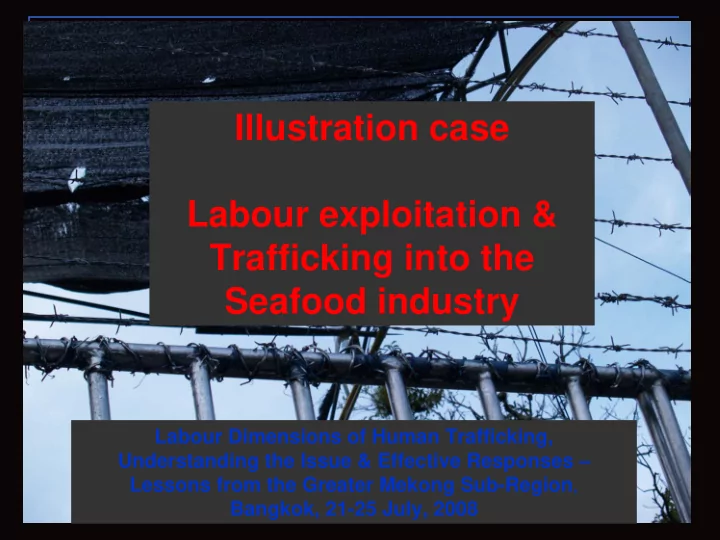
Illustration case Labour exploitation & Trafficking into the Seafood industry

Labour Dimensions of Human Trafficking, Understanding the Issue & Effective Responses – Lessons from the Greater Mekong Sub-Region, Bangkok, 21-25 July, 2008

slide-2
SLIDE 2

A call for help

A male migrant worker came to an ILO partner organization

seeking help for his three sisters and one brother-in-law, who had been brought to work at a at seafood processing factory.

One sister from the factory had been injured and taken to

hospital, which had passed information to her brother.

All four had been brought to the destination country by an agent

to work at the factory, but all wanted to leave because of the working conditions.

Normally workers were prohibited from leaving the factory or

having contact with those outside of the factory.

slide-3
SLIDE 3

Reported situation

The escaped worker reported the following working conditions:

  • Working hours: Were from 24.00-17.00 and sometimes 24.00-20.00

with no days off (17 - 20hours work a day)

  • Wages: The first 3 months of work were unpaid, covering expenses

such as the agent’s fee, mosquito net, sleeping mat and blanket. In the fourth month she received approximately 6USD wages, after deductions such as agent’s fee (75USD), meals, lodging, gloves and

  • utilities. Estimating that she peeled 18-20Kg of shrimp per day, she

should have been earning at least 5USD per day.

  • Working conditions: A two-layer 5-metre tall fence surrounded the

factory premises. Closed circuit security cameras operated inside and

  • utside the factory. An estimated ten non-uniformed armed guards

patrolled inside the factory and a further ten on the grounds around the

  • factory. Anyone caught trying to escape would be beaten in front of the
  • ther workers by the owner or the guards.
slide-4
SLIDE 4

Urgent response needed

The alerted ILO partner organization contacted

  • ther agencies, NGOs and relevant government

departments and with past knowledge of conditions at the factory, a raid of the factory was planned.

In September, Immigration authorities led a raid on

the Seafood Factory, assisted by a coalition of government agencies, a number of NGOs and the police.

slide-5
SLIDE 5

Factory Raid & Victims profile

During the raid more than 280 workers were taken from the

factory.

Workers at the factory were mixed: male, female, adults and

  • children. They were migrant workers (foreign nationals), and had

been working at the factory for different time periods, ranging from months to several years.

65 women and children were assessed to be officially trafficking

victims and were offered to stay at a government shelter

The male workers were not considered to be trafficking victims,

therefore were not taken into care. Some of the men were taken to the border to be sent back by Immigration officials, others went

  • f their own accord and looked for new jobs.
slide-6
SLIDE 6

Exploitative working conditions

In addition to what was initially reported by the escaped workers, post raid interviews were carried out with 15 of the 65 women staying at the Government

  • shelter. The following information was recorded:
  • Excessive Work hours: From midnight until between 6pm and 10pm in the
  • evening. When their day's work ended and just a few minutes after 7pm before

they could prepare their meal the employer would force them to go to sleep.

  • No privacy: Before midnight the owner herself would wake them. As they

washed their faces she would find fault and slap their face without any particular reason.

  • No sick leave: If they developed fever during work hours and ask to take a rest,

they were forced to continue work with a gun aimed at their temple. In cases were the employers accepted they were sick they had to pay 20 cents for

  • medicine. When they ask what medicine was given for treatment they were

beaten, verbally abused and payment was cut.

slide-7
SLIDE 7

Exploitative working conditions

  • Wages far below minimum: They receive a payment of 5 US dollars, every 15

days that adds up to 10 US dollars, a month. From their income the owner would force them to buy spoilt pork she sold. If they complained the employer would deduct money from their payment, as well as verbally abusing them.

  • Physical and threats: If they accidentally peel off the shrimp's head they were

either slapped in their face, their belly was pinched or a gun was aimed at them.

  • No rest / days off: After working a full year they never had one day off during

that period. They were not allowed to rest even when they were sick. If a request was made to take rest a pointed iron rod was forced into their nostrils.

  • Confinement and Physical abuse: If they make a request to go back home, as

a punishment they were taken in front of all the workers and their hair was cut

  • ff, head was shaven in patches making it unsightly, clothes were entirely

stripped off, kept exposed in the sun and the employer would step on their naked breasts.

  • Child labour: Many of the workers were under the age of 15.
slide-8
SLIDE 8

Case follow up

  • Inspectors from the Department of Labour were

the main authority to investigate the employment conditions at the factory. The investigation that followed resulted in eight charges brought against the employer, including:

  • Employment of children under 15 years old;
  • No holidays for workers;
  • No days off for workers.

The total penalty for the employer was a fine of approximately 2000 USD.

slide-9
SLIDE 9

Further response

After the findings of the Labour Department, the ILO partner

  • rganization has worked with the Lawyers’ Council, contesting

the charges as insubstantial on various counts.

For the 65 cases that have been identified as trafficking victims,

lawyers initially pressed for 2 million USD to compensate for unfair wages over the period of their employment, based on 7USD a day due to the hours of work.

After the case had been presented at the National Human Rights

Commission (NHRC) Office, a hearing was convened at the province City Hall. The NHRC commented that the charges brought against the employer were deemed insufficient.