
SLIDE 1
1
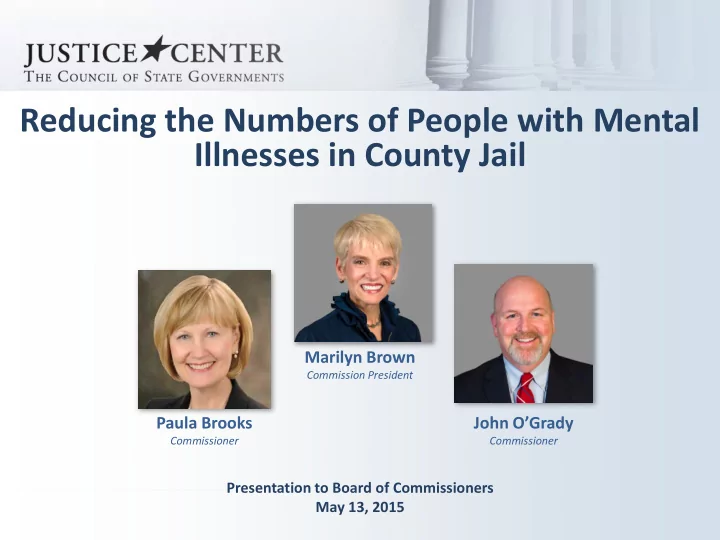
Reducing the Numbers of People with Mental Illnesses in County Jail
Presentation to Board of Commissioners May 13, 2015
Marilyn Brown
Commission President
Paula Brooks
Commissioner
John O’Grady
Commissioner
Illnesses in County Jail Marilyn Brown Commission President Paula - - PowerPoint PPT Presentation
Reducing the Numbers of People with Mental Illnesses in County Jail Marilyn Brown Commission President Paula Brooks John OGrady Commissioner Commissioner Presentation to Board of Commissioners May 13, 2015 1 Overview Project History /
1
Presentation to Board of Commissioners May 13, 2015
Marilyn Brown
Commission President
Paula Brooks
Commissioner
John O’Grady
Commissioner
2
Council of State Governments Justice Center
3
Council of State Governments Justice Center
Council of State Governments Justice Center
4
U.S. Sen. Al Franken (left, D-MN) and U.S. Rep. Richard Nugent (above, R-FL)
Council of State Governments Justice Center
5
6 Johnson County KANSAS Bexar County TEXAS Franklin County OHIO Hillsborough County NEW HAMPSHIRE
Council of State Governments Justice Center
New York City NEW YORK
(5 Counties)
Salt Lake County UTAH
7
Council of State Governments Justice Center
8
Council of State Governments Justice Center
9
Council of State Governments Justice Center
0.0 1.0 2.0 3.0 4.0 5.0 6.0 100,000 200,000 300,000 400,000 500,000 600,000 700,000 800,000 900,000 00 01 02 03 04 05 06 07 08 09 10 11 12 13
YEAR ANNUAL PERCENT CHANGE NUMBER OF INMATES AT MIDYEAR
Source: Bureau of Justice Statistics, “Jail Inmates at Midyear 2013—Statistical Tables,” 2014.
Inmates confined in local jails at midyear and percent change in the jail population, 2000-2013
10
Council of State Governments Justice Center
Source: The City of New York Department of Correction
2005 2012 M Group Non-M Group 76% 63% 37% 24%
AVERAGE DAILY JAIL POPULATION (ADP) AND ADP WITH MENTAL HEALTH DIAGNOSIS
13,576 Total 11,948 Total
NEW YORK CITY
12
Council of State Governments Justice Center
Arrested at disproportionately higher rates
Stay longer in jail and prison Limited access to health care Low utilization of EBPs High recidivism rates More criminogenic risk factors
Council of State Governments Justice Center
13
Council of State Governments Justice Center
14
Council of State Governments Justice Center
15
16
Council of State Governments Justice Center
17
*Included only first bookings and removed cases missing DOB and SSN
SHERIFF’S OFFICE ADAMH Board Community Shelter Board
Matched to SMI Services Flags
1,554
Accessed the Shelter System One Year Prior to Booking
1,168
Council of State Governments Justice Center
2010 Jail Bookings 32,638
Unique Individuals Booked* 21,966
2011 Jail Bookings 2012 Jail Bookings 2013 Jail Bookings
Study Cohort
Used for re-booking recidivism analysis 2009 Jail Bookings 2008 Jail Bookings Used to develop risk proxy
18
Misdemeanor N=14,198 PERCENT REBOOKED IN 3 YEARS Felony N=5,643
* Analysis of first Franklin County jail bookings in 2010
Council of State Governments Justice Center
19
* Analysis of first Franklin County jail bookings in 2010 ** SMI identified using match to behavioral health service utilization data
Non-SMI Flag SMI
N = 20,412 N = 1,554
Council of State Governments Justice Center
20
* Analysis of first Franklin County jail bookings in 2010 ** SMI identified using match to behavioral health service utilization data
SMI Non-SMI
N = 20,412 N = 1,554
Council of State Governments Justice Center
21
* Analysis of first Franklin County jail bookings in 2010 ** SMI identified using match to behavioral health service utilization data
46% 30% 24% 41% 29% 30%
Low Risk Med Risk High Risk
Non-SMI SMI
Council of State Governments Justice Center
22
* Analysis of first Franklin County jail bookings in 2010 ** SMI identified using match to behavioral health service utilization data
No significant differences in charge level Similar proportion booked pretrial vs. sentenced Different ALOS regardless of risk level*
Risk factors include prior jail bookings, age, charge level, and offense type Council of State Governments Justice Center
23
*Analysis of first Franklin County jail bookings in 2010; SMI identified using match to behavioral health service utilization data; ** Shelter flag defined as accessing shelter one year prior to jail booking
N = 20,412 N = 1,554 Council of State Governments Justice Center
45% 56% 63% 76%
Non-SMI flag SMI flag
PERCENT RE-BOOKED IN THREE YEARS
No shelter contact Shelter contact 1 yr prior to booking
24
court
pretrial period
(felony probationers)
Council of State Governments Justice Center
25
People Booked into Franklin County Jail*
Bookings with ALOS > 3 Days
Actual Number of People with SMI Entering Jails is
Matched to ADAMH Data and Identified as SMI Prior to Booking National Estimates**
Jail After 3 Days
**Extrapolated from national data on jail populations. * Analysis of first Franklin County jail bookings in 2010
Council of State Governments Justice Center
26
Bookings with ALOS > 3 Days
Actual Number of People with SMI Entering Jails is
UKNOWN
Matched to ADAMH Data and Identified as SMI Prior to Booking* National Estimates of SMI Population in Jail After 3 Days**
969
People with SMI
2,315
People with SMI
**Extrapolated from national data on jail populations * Analysis of first Franklin County jail bookings in 2010 Council of State Governments Justice Center
609
Received treatment from ADAMH funded provider within a year of release
360
Did NOT receive treatment from ADAMH funded providers within a year of release KNOWN GAP
Treatment following release 609
Received treatment from ADAMH funded provider within a year of release
1,706
As many as 1,706 did NOT receive treatment from ADAMH funded providers within a year of release
POTENTIAL GAP
LOW RISK 40%
HIGH/ MOD RISK 60%
27
Council of State Governments Justice Center
28
Council of State Governments Justice Center
23
15% 85%
Crisis Intervention Training in 2015
CIT Trained Officers Non-CIT Trained Officers
25% 75%
Potential goal for % of CIT Trained Officers
CIT Trained Officers Non-CIT Trained Officers Council of State Governments Justice Center
24
Council of State Governments Justice Center
25
Council of State Governments Justice Center
32
Low Criminogenic Risk (low) Medium to High Criminogenic Risk (med/high)
Low Severity of Substance Abuse (low) Substance Dependence (med/high) Low Severity of Substance Abuse (low) Substance Dependence (med/high) Low Severity of Mental Illness (low) Serious Mental Illness (med/high) Low Severity of Mental Illness (low) Serious Mental Illness (med/high) Low Severity of Mental Illness (low) Serious Mental Illness (med/high) Low Severity of Mental Illness (low) Serious Mental Illness (med/high)
Group 1 I – L
CR: low SA: low MH: low
Group 2 II – L
CR: low SA: low MH: med/high
Group 3 III – L
CR: low SA: med/high MH: low
Group 4 IV – L
CR: low SA: med/high MH: med/high
Group 5 V – H
CR: med/high SA: low MH: low
Group 6 VI – H
CR: med/high SA: low MH: med/high
Group 7 VII – H
CR: med/high SA: med/high MH: low
Group 8 VIII – H
CR: med/high SA: med/high MH: med/high
Council of State Governments Justice Center
33
Council of State Governments Justice Center
34
Council of State Governments Justice Center
35
Council of State Governments Justice Center
36
Council of State Governments Justice Center
37
Council of State Governments Justice Center
Council of State Governments Justice Center
38
39 *Numbers extrapolated from national estimates
2,300 SMI individuals released from jail* Target group who should receive community mental health services 600 received treatment from ADAMH funded provider*
Council of State Governments Justice Center
40
* Analysis of first Franklin County jail bookings in 2010 ** SMI identified using match to behavioral health service utilization data
Non-SMI Flag SMI
N = 20,412 N = 1,554 Council of State Governments Justice Center
41
* Analysis of first Franklin County jail bookings in 2010 ** SMI and AOD identified using match to behavioral health service utilization data
Council of State Governments Justice Center
SMI Non-SMI
N = 20,412 N = 1,554
42
Council of State Governments Justice Center
43
Michael Thompson Director, CSG Justice Center Fred Osher, M.D. Director of Health Systems and Services Policy, CSG Justice Center www.csgjusticecenter.org
The presentation was developed by members of the Council of State Governments Justice Center staff. The statements made reflect the views of the authors, and should not be considered the official position of the Justice Center, the members of the Council of State Governments, or the funding agency supporting the work.
Council of State Governments Justice Center
Please contact Kati Habert at khabert@csg.org with any questions.