SLIDE 1 1
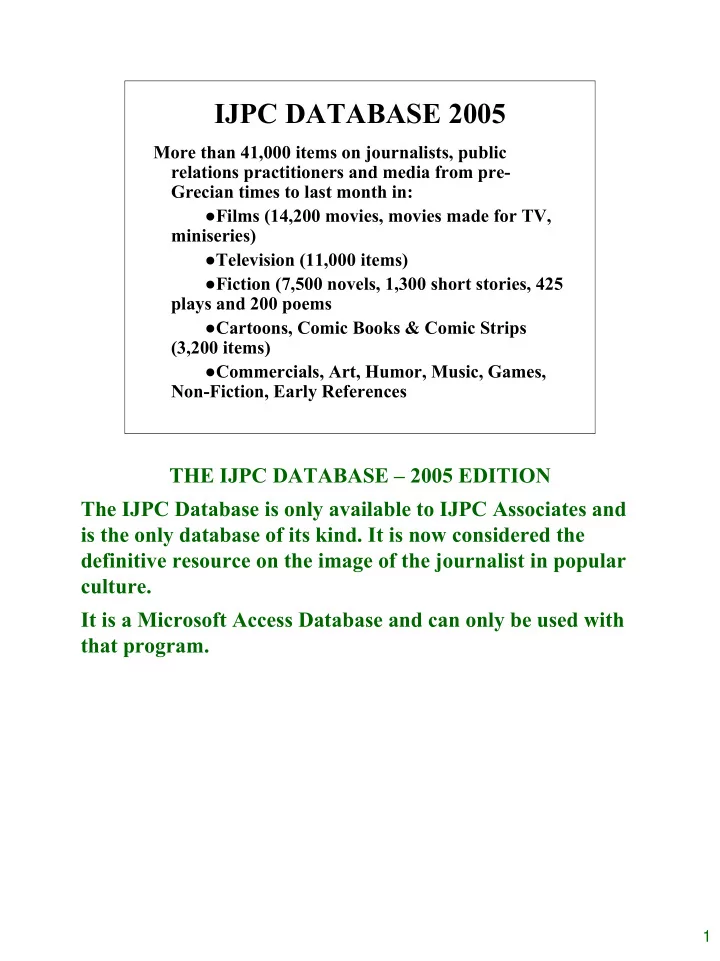
IJPC DATABASE 2005
More than 41,000 items on journalists, public relations practitioners and media from pre- Grecian times to last month in:
- Films (14,200 movies, movies made for TV,
miniseries)
- Television (11,000 items)
- Fiction (7,500 novels, 1,300 short stories, 425
plays and 200 poems
- Cartoons, Comic Books & Comic Strips
(3,200 items)
- Commercials, Art, Humor, Music, Games,
Non-Fiction, Early References
THE IJPC DATABASE – 2005 EDITION The IJPC Database is only available to IJPC Associates and is the only database of its kind. It is now considered the definitive resource on the image of the journalist in popular culture. It is a Microsoft Access Database and can only be used with that program.
SLIDE 2 2
More than 41,000 items filed by:
- YEAR
- TITLE
- TYPE
- FORMAT
- AUTHOR
- REFERENCES
- COMMENTS – OCCUPATIONS
- COMMENTS
IJPC DATABASE 2005
SLIDE 3
3
IJPC 2005 Database
This is how the IJPC Database looks when you call it up alphabetically.
SLIDE 4
4
IJPC 2005 Database by YEAR
By reformatting the database by year, you can go from 1 (the year “1” includes every item B.C.) through 2005. There are more than a thousand entries prior to the 20th century.
SLIDE 5
5
IJPC 2005 Database by YEAR
For example, in the 17th century, Ben Johnson wrote a play called “The Staple of News,” a critique of newsmongers that resonates with anyone in the 21st century who deplores the tabloid press and irresponsible journalism.
SLIDE 6
6
IJPC 2005 Database by YEAR
In the 19th century, almost every major author including David Ross Locke, Henry James, Anthony Trollope, Mark Twain wrote novels including a journalist. Their novels and hundreds of other items are listed in the IJPC Database.
SLIDE 7
7
IJPC 2005 Database by YEAR
In the 1930s, the IJPC Database is dominated by motion pictures such as The Front Page and Sob Sister.
SLIDE 8
8
IJPC 2005 Database by YEAR
In the 1970s, the IJPC Database is dominated by television shows such as The Mary Tyler Moore Show and The Name of the Game.
SLIDE 9
9
IJPC 2005 Database by TITLE
The IJPC Database comes organized by title, alphabetically. There are many titles simply called “Deadline” as illustrated by this IJPC Database Snapshot. By using the IJPC Database, you can distinguish between a mystery novel written in 1971 and a mystery novel written in 1989, each simply called “Deadline.” By scrolling down the database, you can view many novels, films, television programs and short stories simply titled “Deadline.”
SLIDE 10
10
IJPC 2005 Database by TITLE
The IJPC Database includes every title from A to Z.
SLIDE 11 11
IJPC 2005 Database by TYPE
A Art AUD Audiotape C Cartoon CB Comic Book CC Commercials CS Comic Strip D Documentary (Non-Fiction) ER Early References G Games (mostly video games) H Humor (Jokes) M Movies (the largest grouping) MF Foreign Films MS Movie Script MT Movies Made for Television MUS Music (Songs) N Novels NM Novels – Mystery NR Novels – Romance NS Novels – Sports NSF Novels – Science Fiction NW Novels – Western P Plays – Dramas PO Poetry R Radio RS Radio Soap Operas SM Short Stories – Mystery SS Short Stories SSF Short Stories – Science Fiction SW Short Stories – Western T Television (the second largest grouping) TF Foreign Television
The IJPC Database can also be organized by type so you can find all of the art works or cartoons, comic books, commercials, comic strips, films, movies made for television, mystery novels, romance novels, sports novels, science fiction novels, western novels, plays and dramas, poetry, radio programs, music, humor, short stories, and television programs.
SLIDE 12
12
IJPC 2005 Database by TYPE
This IJPC Database Snapshot shows the ending of the M (Film) category and the beginning of the MF (Foreign Films) category.
SLIDE 13
13
IJPC 2005 Database by TYPE
This IJPC Database Snapshot shows the ending of the NJ (Juvenile Novels) category and the beginning of the NM (Mystery Novels) category.
SLIDE 14 14
IJPC 2005 Database by TYPE
You can isolate any type of program, highlight the entries and move them to another Access database for easy
- reference. Here is a IJPC Database snapshot of one page of
television programs including episodes of Hill Street Blues, Max Headroom, Saturday Night Live Weekend Update, The West Wing, and The Dead Zone.
SLIDE 15
15
IJPC 2005 Database by FORMAT
The IJPC Database Format category indicates whether the item is in the IJPC Collection. If there is a number or letter in that box, it means it is in the IJPC Collection.
SLIDE 16 16
IJPC COLLECTION
The IJPC Collection consists of:
- More than 3,000 videotapes, laser and DVD
discs
- More than 5,000 hours of audiotapes, and MP3
files
- More than 8,500 novels, short stories, plays, and
poems (the largest collection of novels and short stories featuring journalists ever assembled)
- Scripts, research materials, articles, art works
and other artifacts.
Any item in the IJPC Collection is available to an IJPC Associate for personal use. The IJPC Collection includes the largest collection of novels and short stories in existence. It includes more out-of-print films and television and radio shows ever collected. All of this is available for personal use by any IJPC Associate.
SLIDE 17
17
IJPC 2005 Database by AUTHOR
The IJPC Database can be alphabetized by Author. You might be surprised at how many famous authors have written novels, short stories, screenplays or comics featuring journalists.
SLIDE 18 18
IJPC 2005 Database by REFERENCES
The References column is a catch-all for source materials, country of origin, and miscellaneous information. For example, the References column explains that Arsenic and Old Lace was a TV program aired on January 5, 1955 as part
- f the Best of Broadway television series.
SLIDE 19
19
IJPC 2005 Database by COMMENTS
The IJPC Database includes five columns of comments (256 characters in each column). The First Column, COMMENTS –OCCUPATION starts with the occupation of the principal journalist or journalists in the entry. “Reporter” and “Journalist” are the largest categories. A sub-category is an ethnic designation: “African-American.”
SLIDE 20 20
IJPC 2005 Database by COMMENTS
By alphabetizing the first column of COMMENTS – OCCUPATION, you can get a quick snapshot of a specific
- ccupation such as TV Anchor.
SLIDE 21
21
IJPC 2005 Database by COMMENTS
The Other COMMENTS columns offer more material on plot and lists every journalist who appears in the entry.
SLIDE 22
22
IJPC 2005 Database - Summary
Here is how the IJPC Database works. By isolating one entry – in this example, Ace in the Hole (The Big Carnival) – you can see the year, type, format (the three numbers in the format indicates there are three copies of this film in the IJPC Collection), and the authors of the screenplay.
SLIDE 23 23
IJPC 2005 Database - Summary
In the first COMMENTS column, the main characters are listed along with a plot of the film. The main character’s
- ccupation – Reporter – is listed first for easy reference.
SLIDE 24
24
IJPC 2005 Database - Summary
Often, key quotes are included in the plot summary.
SLIDE 25
25
IJPC 2005 Database - Summary
Columns III and IV include more information on the plot and characters.
SLIDE 26
26
IJPC 2005 Database - Summary
COMMENTS V often includes reviews of the film. In this case, the final column is used to list every journalist in the film – the character and the actor who plays the character.
SLIDE 27 27
IJPC DATABASE 2005
- You can search the entire database by
a name or a word – i.e. “Clark Gable” or “Gossip Columnist” or “Pulitzer Prize.” Database will create a complete list for you from any specific word or phrase. Anyone familiar with the Microsoft Access Database features knows how “Query” can make searching any database a quick and easy process.
SLIDE 28
28
This IJPC Database Query Snapshot shows you that “Gossip Columnist” yielded 293 references. Here are 2 through 7 references including two of the best films ever made about gossip columnists – Blessed Event and Is My Face Red? Query doesn’t find every reference in the database and a general search is also recommended to find any references not included in the Query Search.
SLIDE 29 29
Image of the Journalist in Popular Culture (IJPC)
A project of the Norman Lear Center Annenberg School for Communication University of Southern California
www.ijpc.org
To take full advantage of the IJPC, you have to become an IJPC Associate. Only IJPC Associates have access to the IJPC Database and the IJPC Collection. Any individual, library or university can apply for IJPC Associate membership. If a university or library becomes an IJPC Associate, every student, faculty member and staff has access to the IJPC Database and Collection. Institutional Membership: $150. Individual Membership: $35. An application form is included on the IJPC Web Site. The IJPC Web site is available to anyone who goes to www.ijpc.org.