IJ To date, neither the proposed agent commission prohibition rule - - PDF document

ij
SMART_READER_LITE
LIVE PREVIEW

IJ To date, neither the proposed agent commission prohibition rule - - PDF document

IJ To date, neither the proposed agent commission prohibition rule nor the agent registration rule has the proposals set fprth in this letter will enable the RAD to achieve its objective while avoiding unintended consequences which would cause


slide-1
SLIDE 1

IJ

GreenbergTraurig

VIA ELECTRONIC SUBMISSION

  • Ms. Marlene H. Dortch

Secretary Federal Communications Commission 445 12th Street, SW Washington, DC 20554 September 5, 2019 Re: WC Docket No. 17-287 - Bridging the Digital Divide fpr Low-Income Consumers WC Docket No. 11-42-Lifeline and Link Up Refprm and Modernization WC Docket No. 09-197

  • Telecommunications Carriers Eligible fpr Universal

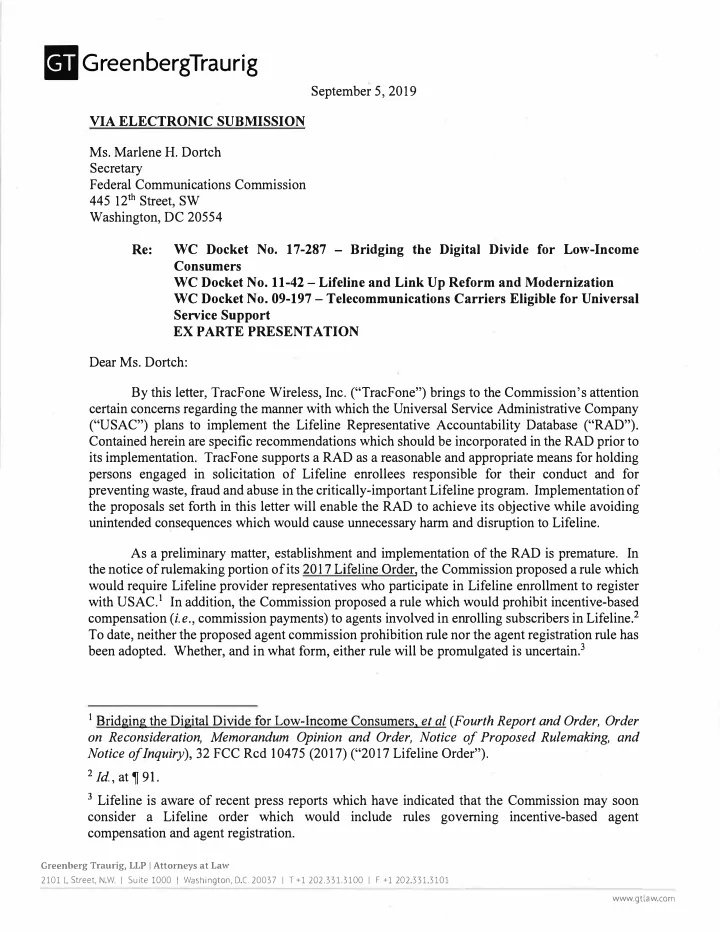
Service Support EX PARTE PRESENTATION Dear Ms. Dortch: By this letter, TracFone Wireless, Inc. ("TracFone") brings to the Commission's attention certain conceros regarding the manner with which the Universal Service Administrative Company ("USAC") plans to implement the Liffline Representative Accountability Database ("RAD"). Contained herein are specifjc recommendations which should be incorporated in the RAD prior to its implementation. TracFone supports a RAD as a reasonable and appropriate means fpr holding persons engaged in solicitation of Liffline enrollees responsible fpr their conduct and fpr preventing waste, fsaud and abuse in the critically-important Liffline program. Implementation of the proposals set fprth in this letter will enable the RAD to achieve its objective while avoiding unintended consequences which would cause unnecessary harm and disruption to Liffline. As a preliminary matter, establishment and implementation of the RAD is premature. In the notice of rulemaking portion of its 2017 Lifeline Order, the Commission proposed a rule which would require Liffline provider representatives who participate in Liffline enrollment to register with USAC. 1 In addition, the Commission proposed a rule which would prohibit incentive-based compensation (i.e., commission payments) to agents involved in enrolling subscribers in Liffline.2 To date, neither the proposed agent commission prohibition rule nor the agent registration rule has been adopted. Whether, and in what fprm, either rule will be promulgated is uncertain.3

1 Bridging the Digital Divide fpr Low-Income Consumers. et al (Fourth Report and Order, Order

  • n Reconsideration, Memorandum Opinion and Order, Notice of Proposed Rulemaking, and

Notice of Inquiry), 32 FCC Red 10475 (2017) ("2017 Liffline Order").

2 /d/,atig91. 3 Liffline is aware of recent press reports which have indicated that the Commission may soon

consider a Liffline order which would include rules goveroing incentive-based agent compensation and agent registration.

Greenberg Trnurig, LLP I Attorneys at Law 2101 L Street, N.W. I Suite 1000 I Washington, D.C. 20037 I T +1 202.331.3100 I F +1 202.331.3101 www.gtlaw.com

slide-2
SLIDE 2
  • Ms. Marlene H. Dortch

September 5, 2019 Page 2 of 4 It appears that USAC has proceeded with development and implementation of the RAD based solely on directions fsom Chairman Pai contained in a July 2017 letter to USAC.4 Although TracFone commends Chairman Pai fpr his suggestions, including the representative registration proposal, a letter to USAC fsom the Chairman does not constitute promulgation of a rule. Substantive agency rules, including rules goveroing the Liffline program, must be promulgated in confprmance with the procedural requirements of the Administrative Procedure Act.5 1. Agents Should be Prohibited fsom Representing More than One Lifeline Provider Mandatory agent registration itself will be insuffjcient to prevent agent fsaud. Currently, there is no prohibition against agents engaged in Liffline enrollment soliciting customers fpr multiple providers - and some agents do so. So long as that is the case, and so long as agents are compensated based on enrollments, such agents are incentivized to solicit customers fpr one provider, and then attempt to receive additional compensation by "moving" those customers to

  • ther Liffline providers. One way to prevent such agent moving of customers fsom one provider

to another would be to allow providers to "freeze" their customer bases fpr specifjed periods of

  • time. However, the Commission has determined to prohibit such "port fseezes" on the basis that

they deny Liffline consumers the ability to exercise choice of providers.6 TracFone is not asking the Commission to revisit its decision to prohibit port fseezes. It is asking the Commission to establish a rule which would prohibit Liffline enrollment agents fsom representing more than one Liffline provider. Such a rule could be implemented in conjunction with the RAD. Agents would be required to register with USAC as representing one - and only one - Liffline provider. Once an agent was registered with USAC as representing a provider, subsequent attempts by that agent to register on behalf of another provider would be rejected by USAC. If such a rule is not suffjcient to prevent agents fsom representing multiple providers, TracFone would encourage the Commission to go fvrther: repeated attempts to register with multiple providers would be grounds fpr mandatory debarment of that agent fsom soliciting Liffline customers fpr any provider. 2. All Agents who are Compensated based on Lifeline Enrollments - Including so-called "Back Offjce" Agents - Should be required to Register with USAC Although the Commission's rulemaking notice was not specifjc, USAC has sought to require all persons involved in making Liffline eligibility determinations to register and to provide certain personal identifzing infprmation as part of the RAD registration process. As Sprint and

  • thers have noted, requiring persons engaged in eligibility verifjcation to register with the RAD

4 Letter fsom Chairman Ajit Pai to Ms. Vickie Robinson, Acting Chief Executive Offjcer and

General Counsel, USAC, dated July 11, 2017, at 4.

5 5 U.S.C.

§ 551 et seq. The rulemaking requirements are codifjed at 5 U.S.C. § 553.

6 2017 Lifeline Order, at§§ 33-40.

Greenberg Traurig, LLP I Attorneys at Law www.gtlaw.com

slide-3
SLIDE 3
  • Ms. Marlene H. Dortch

September 5, 2019 Page 3 of 4 can be problematic since much current eligibility verifjcation is perfprmed at ofgshore locations.7 TracFone also uses persons located ofgshore to conduct Liffline eligibility verifjcations. Such

  • fgshore personnel typically do not have Social Security numbers or certifjcates of naturalization

and ofuen do not have email addresses. Whether or not such "back offjce" personnel should be required to register should not depend on whether they are direct employees of the Liffline provider or are employed indirectly through an agency. Rather, the registration requirement should depend on whether or not the personnel involved in making the eligibility determinations (wherever they are located) are compensated based on the number of successfvl eligibility verifjcations (incentive-based compensation). As with Liffline enrollment personnel, anyone whose compensation is based on the number of successfvl enrollments has an incentive to maximize earoings by enrolling - or verifying - more Liffline subscribers. In TracFone's view, anyone with such incentives - whether company employees or outside agents, and wherever they are located -- whether domestically or at ofgshore venues - should be required to register. No TracFone personnel or agents involved in the eligibility verifjcation process are compensated based on successfvl enrollments

  • 3. RAD Registration of Lifeline Enrollment Agents Should be Required fpr Agents

Operating in All States, Whether or not the National Verifjer has been Launched in a State. All agents receiving incentive-based compensation fpr enrolling customers in any provider's Liffline program should be required to register with the RAD. In this regard, enrollment agents are difgerent fsom "back offjce" ( eligibility verifjcation) agents. Agents involved in soliciting customers fpr Liffline enrollment have economic incentives to fjnd ways to maximize

  • enrollments. TracFone has uncovered situations where unscrupulous agents have devised ways to

fblsifz infprmation and to evade state-administered database checks. Even the National Verifjer may not be fvlly able to detect and prevent such schemes. For that reason, it is imperative that agents be held accountable and that they should be required to register with USAC. Agents engaged in Liffline enrollment who have been determined to have violated Commission rules should be subject to Commission sanctions, including debarment, and including monetary fprffitures subject to the conditions contained at Section 503(b)(5) of the Communications Act (47 U.S.C. § 503(b)(5)).8

7 Letter to Secretary Dortch fsom Norina T. Moy, Director, Governnent Afgairs, Sprint, dated

August 14, 2019.

8 This is a short-term problem as the National Verifjer, when fvlly implemented, will completely

remove Liffline providers fsom the eligibility verifjcation process, except fpr those states (Texas and Califproia) which have opted out. TracFone recommends that the Commission work with USAC and those states to ensure that those states' practices goveroing eligibility verifjcation determinations are as robust as those in the National Verifjer states.

Greenberg Traurig, LLP I Attorneys at Law www.gtlaw.com

slide-4
SLIDE 4
  • Ms. Marlene H. Dortch

September 5, 2019 Page 4 of 4 4. USAC Should Allow fpr Real Time Uploading of Agent Identifjcation Infprmation During a recent USAC webinar, it was announced that Liffline agents seeking to register with RAD who were unable to verify their identity would be required to submit their proof of identity documentation via U.S. mail. USAC fvrther announced that it would take two weeks to process such identity documentation once received. This will result in prolonged and wholly unoecessary delays in completing the RAD registration process fpr many agents. There is no reason why USAC cannot and should not allow agents seeking to register to submit "sofu" copies

  • f their identifzing infprmation electronically. TracFone requests that the Commission direct

USAC to accept such sofu copies of agent personal identifzing infprmation. For the reasons set fprth in this letter, TracFone respectfvlly urges the Commission to promulgate rules goveroing Liffline agent registration and compensation in confprmance with the reviews expressed herein. Pursuant to Section 1.1206 of the Commission's rules, this letter is being fjled electronically in each of the above-captioned dockets. Please direct any questions regarding this letter to undersigned counsel fpr TracFone. cc:

  • Mr. Trent Harkrader
  • Ms. Jodie Griffjn
  • Ms. Michelle Garber

Greenberg Traurig, LLP I Attorneys at Law www.gtlaw.com