II. I. PRELIMINARIES 1. Minkowski space-time , a natural set of null - - PDF document

ii i preliminaries 1 minkowski space time a natural set
SMART_READER_LITE
LIVE PREVIEW

II. I. PRELIMINARIES 1. Minkowski space-time , a natural set of null - - PDF document

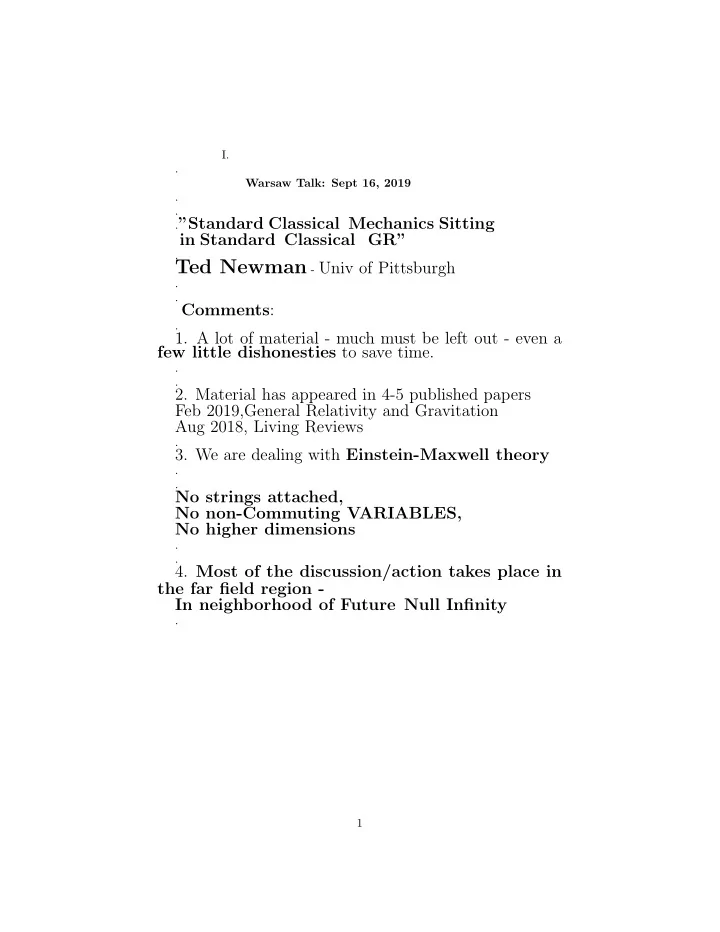
I. . Warsaw Talk: Sept 16, 2019 . . . Standard Classical Mechanics Sitting in Standard Classical GR . Ted Newman - Univ of Pittsburgh . . Comments : . 1. A lot of material - much must be left out - even a few little dishonesties to


slide-1
SLIDE 1

I. . Warsaw Talk: Sept 16, 2019 . . .”Standard Classical Mechanics Sitting

in Standard Classical GR”

.

Ted Newman - Univ of Pittsburgh

. .

Comments:

.

  • 1. A lot of material - much must be left out - even a

few little dishonesties to save time.

. .

  • 2. Material has appeared in 4-5 published papers

Feb 2019,General Relativity and Gravitation Aug 2018, Living Reviews

.

  • 3. We are dealing with Einstein-Maxwell theory

. .

No strings attached, No non-Commuting VARIABLES, No higher dimensions

. .

  • 4. Most of the discussion/action takes place in

the far field region - In neighborhood of Future Null Infinity

. 1

slide-2
SLIDE 2
  • II. I. PRELIMINARIES

1. Minkowski space-time, a natural set of null surfaces (in neighborhood

  • f null infinity) are the asymptotic light cones with origins at arbitrary

spacetime points, xa- they label the surfaces.

  • ie. a four real parameter set of these asymptotic null surfaces.

. The optical parameters of associated family of null generators (the null geodesics) - vanishing [TWIST] AND [SHEAR]. . To each one-parameter family of these asymptotic light cones we can con- struct a one parameter family of associated null coordinate systems. . Now Asymptotically flat space-times. .

  • 2. The major development in gravitational radiation theory (1960s)

was Bondi’s introduction of one-parameter families of null surfaces (Bondi sur- faces) in the neighborhood of future null infinity. . The null generators of the surfaces (the null geodesics) HAVE VANISH- ING TWIST but have NON-VANISHING asymptotic SHEAR. [Aside; This asymptotic shear, σ0(u, ζ, ζ), is the free data for the descrip- tion of gravitational radiation.] .

  • 3. Transitioning from Minkowski space to asymptotically flat space
  • one could choose to use the null geodesics that are [either] TWIST-FREE

OR SHEAR FREE. Bondi ( naturally) chose the TWIST FREE path. . We suggest its preferable to chose the other path, I.E. use asymptotically SHEAR FREE null geodesics near null infinity - RATHER then TWIST- FREE. This is THE MAJOR INNOVATION here 2

slide-3
SLIDE 3

III. 4. CLAIM; choosing the asymptotically SHEAR-FREE version leads to both Bondi’s results and to a NEW set of remarkable results. . Initially the asymptotically shear-free version is beset with prob- lems, – they can be overcome. .

  • 5. Back to asymptotically flat spacetimes: Working with the asymp-

totically shear free null geodesics requires some technology — discussed very superficially. .

  • a. The asymptotically shear free geodesics sets are labeled by four

complex parameters, za ... Defining a complex 4-space i.e., H-space. Each H-space point refers to a SET (a bundle) of null rays in the physical spacetime. . The imaginary part of za is a measure of the TWIST - the real part determines the average position of the set. (a gen- eralization of light-cones.) . We have four real parameters to work with at INFINITY - as IN the Minkowski case .

  • b. A curve in H-space, za= ξa(t) =

ξRa(t) + iξIa(t) corresponds in the physical spacetime to a null geodesic congruence with TWIST. Each congru- ence can be used to construct an asymptotic coordinate & tetrad system − an ASYMPTOTICALLY SHEAR FREE system. .

  • c. A VERY special H-space-curve exists:

The COMPLEX CENTER OF MASS System 3

slide-4
SLIDE 4
  • IV. Quick Review - HERE just to see what we are talking about

.

  • II. - Asymptotic Einstein-Maxwell Eqs

. 1. Spin-coefficient description of asymptotic Weyl and Maxwell Tensor & Definitions - Here just to be seen Ψ0 = Ψ0

0r−5 + O(r−6),

Ψ1 = Ψ0

1r−4 + O(r−5),

Ψ2 = Ψ0

2r−3 + O(r−4),

Ψ3 = Ψ0

3r−2 + O(r−3),

Ψ4 = Ψ0

4r−1 + O(r−2).

φ0 = φ0

0r−3 + O(r−4),

φ1 = φ0

1r−2 + O(r−3),

φ2 = φ0

2r−1 + O(r−2),

with Ψ0

n

= Ψ0

n(u, ζ, ¯

ζ), φ0

n

= φ0

n(u, ζ, ¯

ζ). . The remaining (non-radial) Bianchi Identities and Maxwell equations yield the evolution equations: ˙ Ψ0

2

= − Ψ0

3 + σ0Ψ0 4 + kφ0 2 ¯

φ0

2,

(1) ˙ Ψ0

1

= − Ψ0

2 + 2σ0Ψ0 3 + 2kφ0 1 ¯

φ0

2,

(2) ˙ Ψ0 = − Ψ0

1 + 3σ0Ψ0 2 + 3kφ0 0 ¯

φ0

2,

(3) k = 2Gc−4, (4) . ˙ φ0

1

= − φ0

2,

(5) ˙ φ0 = − φ0

1 + σ0φ0 2.

(6) Overdot denotes u-derivative. 4

slide-5
SLIDE 5

V. DEFINITIONS OF PHYSICAL VARIABLES .

  • a. (a little lie) Def 1, Bondi-Sachs mass and linear-Momentum

l=0&1 harmonics of Ψ0

2

(Classical) All constants taken as =1, i.e. c=h=G=k=1 Ψ0

2 = M + P iY1i

(7) .

  • b. Def

2 Complex Mass Dipole: NEW Mass Dipole plus i Angular Momentum - . (Di

(complex) = Di (mass) + ic−1Ji),

l = 1 harmonic of Ψ0

1;

Ψ0

1 =

(Di

(mass) + ic−1Ji)Y 1 1i + . . . .

(8) . Def 3 Complex E&M dipole, (electric and i magnetic dipoles, . Di

complex = (Di Elec + iDMag)

the l = 1 harmonic component of φ0

0 . (STANDARD)

φ0

0 = 2(Di Elec + iDMag)Y 1 1i.

(9) . 5

slide-6
SLIDE 6

VI.

  • III. MAJOR STEP

. Choose a complex world in H-Space, za

CCofM= ξa(t) =ξa R(t) + iξa I (t)

with its associated ASYMPTOTICALLY SHEAR FREE system so that COM- PLEX MASS DIPOLE VANISHES - DEFINITION . Di

(complex) = (Di (mass) + ic−1Ji) = 0

(10) . This H-Space curve (and its physical space uniquely associated null geodesic congruence) define the COMPLEX CENTER OF MASS . . and a unique ASYMPTOTICALLY SHEAR FREE system - the CENTER OF MASS SYSTEM. 6

slide-7
SLIDE 7

VII.

  • IV. RESULTS - & no more definitions

. BY transforming from the CENTER OF MASS SYSTEM back to a Bondi system we obtain a series surprising and remarkable results. . Result #1 Expressions for Mass DIpole and Spin and Orbital Angular Momentum - NOT DEFINITIONS but derived . Di

(mass)

= MBξi

R − c−1P k Bξj Iǫjki + . . . ,

(11) Ji = cMBξi

I + P k Bξj Rǫjki + . . . .

(12)

  • r
  • D(mass)

= MB r + c−2M −1

B

PB x S, (13)

  • r = ξi

R = (ξ1 R, ξ2 R, ξ3 R),

(14) − → S = cMBξj

I = cMB(ξ1 I, ξ2 I, ξ3 I),

(15)

  • J =

S + rx P. (16) . Result #2 From Bianchi Identities the Kinematic Linear Momentum P i

B = MBξi′ R − 2q2

3c3 ξi′′

R

(17) . Result #3 in Bianchi Identities - Angular Momentum Conservation. Ji ′ = 2q2

3c3 (ξj′ Rξk′′ R + ξk′ I ξk′′ I )ǫkji, (18)

Exactly the same as L & L plus spin loss- no derivation - JUST sitting in the BI. 7

slide-8
SLIDE 8

VIII. Result: V - Energy loss M ′

B = − G

5c7 (Qjk′′′

MassQjk′′′ Mass+Qjk′′′ SpinQjk′′′ Spin)−4q2

3c5 (ξi′′

R ξi′′ R +ξi′′ I ξi′′ I )−

4 45c7 (.. (19) . Bondi Energy loss & E&M dipole & quadrupole energy loss . Result: 5 - Newton’s 2nd Law P i′

B = F i recoil

(20) F i

recoil has many non-linear radiation terms – time derivatives of the gravita-

tional quadrupole and the E&M dipole and quadrupole moments. . Substitute momentum expression, Eq.(P i

B = MBξi′ R − 2q2 3c3 ξi′′ R ), into

Momentum lose Eq.(P i′

B = F i recoil) leading to Newton’s second law – with

Rocket Force and Radiation Reaction Force. . ****Result: 6 - Rocket Force and Radiation Reaction Force****** . MBξi′′

R = F i ≡ M ′ Bξi′ R + 2q2

3c3 ξ i′′′

R

+ F i

recoil.

(21) . WE believe: remarkable - exact Abraham-Lorentz-Dirac radiation reaction force - NO mass renormalization. No derivation - just sitting there to be observed in the l = 1 part of a BI. 8

slide-9
SLIDE 9

IX. Conclusions: . These results of C.M. and E&M theory are clearly sitting in GR. . It is not at all clear what are the implications or even the mean- ing????? . Do they fit into a quantum theory? A Schrodinger Eq???? If so HOW? . What happens with the runaway behavior resulting from the ra- diation reaction term in the EQS of motion - is there a term that suppresses the runaway behavior. ????? . Is it possible to get two body eqs of motion from this type of analysis???? or other classical results???? 9