IHI Virtual Expedition Improving Transitions to Post Acute Care - - PDF document

ihi virtual
SMART_READER_LITE
LIVE PREVIEW

IHI Virtual Expedition Improving Transitions to Post Acute Care - - PDF document

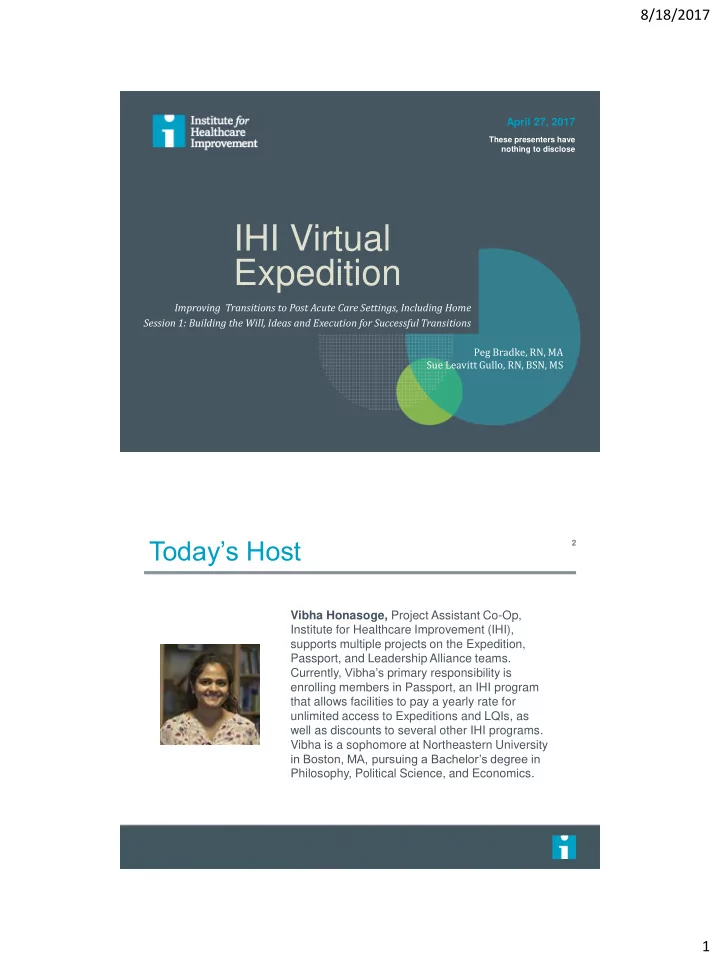
8/18/2017 April 27, 2017 These presenters have nothing to disclose IHI Virtual Expedition Improving Transitions to Post Acute Care Settings, Including Home Session 1: Building the Will, Ideas and Execution for Successful Transitions Peg


slide-1
SLIDE 1

8/18/2017 1

IHI Virtual Expedition

Improving Transitions to Post Acute Care Settings, Including Home Session 1: Building the Will, Ideas and Execution for Successful Transitions April 27, 2017

These presenters have nothing to disclose

Peg Bradke, RN, MA Sue Leavitt Gullo, RN, BSN, MS

Today’s Host

2

Vibha Honasoge, Project Assistant Co-Op, Institute for Healthcare Improvement (IHI), supports multiple projects on the Expedition, Passport, and Leadership Alliance teams. Currently, Vibha’s primary responsibility is enrolling members in Passport, an IHI program that allows facilities to pay a yearly rate for unlimited access to Expeditions and LQIs, as well as discounts to several other IHI programs. Vibha is a sophomore at Northeastern University in Boston, MA, pursuing a Bachelor’s degree in Philosophy, Political Science, and Economics.

slide-2
SLIDE 2

8/18/2017 2

Audio Broadcast

3

You will see a box in the top left hand corner labeled “Audio broadcast.” If you are able to listen to the program using the speakers on your computer, you have connected to the audio broadcast.

Phone Connection (Preferred)

4

To join by phone: 1) Click on the “Participants” and “Chat” icon in the top, right hand side of your screen to open the necessary panels 2) Click the button on the right hand side of the screen. 3) You can select to call in to the session, or to be called. If you choose to call in yourself, please dial the phone number, the event number and your attendee ID to connect correctly.

slide-3
SLIDE 3

8/18/2017 3

WebEx Quick Reference

  • Please use chat to

“All Participants” for questions

  • For technology

issues only, please chat to “Host”

5

Enter Text Select Chat recipient Raise your hand

6

Chat – who is in the room with you?

6

Names and the Organization you represent Example: Sam Jones, Midwest Health

Please send your message to All Participants

slide-4
SLIDE 4

8/18/2017 4

7

slide-5
SLIDE 5

8/18/2017 5

IHI Open School

In the Field

Professionals, GME Faculty, and Residents

35+ CEUs for nurses, pharmacists, and physicians MOC Part 2 Activity points for select medical specialty boards Tracking tool to monitor staff progress Cost-effective annual subscriptions for groups ($28-$72 per person) and individuals ($300).

On Campus

Students and Professors

Free access to catalog of online courses Earn IHI Open School Basic Certificate in Quality & Safety Join growing Chapter Network – over 775 have started around the world

For more info, visit IHI.org/OpenSchool or contact openschool@ihi.org.

9

What is an Expedition?

ex•pe•di•tion (noun)

  • 1. an excursion, journey, or voyage made for some specific

purpose

  • 2. the group of persons engaged in such an activity
  • 3. promptness or speed in accomplishing something

10

slide-6
SLIDE 6

8/18/2017 6

Expedition Director

11

Sue Leavitt Gullo, RN, BSN, MS, Director, Institute for Healthcare Improvement, brings 35 years of health care experience to IHI, focusing for the past 10 years on leading and directing

  • rganizations across multiple improvement work streams. Her areas
  • f expertise include maternal and child health, patient safety, and
  • leadership. Working at the country level with senior leaders in

nongovernmental organizations and hospital systems, Ms. Gullo has been the Senior Director in the field to execute projects, provide translational leadership, and coach and support frontline teams and consumers of health care. She has led the IHI Perinatal Community since its inception in 2004 and is co-lead for IHI's maternal and infant health priority area. Ms. Gullo was elected to the Association

  • f Women’s Health, Obstetrical, and Neonatal Nursing Board of

Directors in 2014 and is also a member of other national maternal- child health advisory committees. Previously, she was Director of Women’s Services at Elliot Hospital in Manchester, New Hampshire, and she spent 25 years at the front line of health care delivery as an

  • ncology and medical-surgical nurse.

12

Chat

12

What is your goal for participating in this Expedition?

Please send your message to All Participants

slide-7
SLIDE 7

8/18/2017 7

Today’s Agenda

13

  • Ground Rules & Introductions
  • Pre-Survey Debrief
  • Building the Will, Ideas and Execution for

Successful Transitions IHI’s Model for Improvement

  • Action Period Assignment

Ground Rules

14

  • We learn from one another – “All teach, all

learn”

  • Why reinvent the wheel? – Steal shamelessly
  • This is a transparent learning environment
  • All ideas/feedback are welcome and

encouraged!

slide-8
SLIDE 8

8/18/2017 8

Expedition Objectives

Identify reliable and effective models of care transitions from a hospital admission to post-acute care. Develop processes with post-acute care providers and community partners to ensure the timely transfer of critical information during transitions. Build an effective improvement team including patients and families as well as acute, post-acute and community care partners Identify successful approaches in identifying clinical-community linkages to make an ideal individualized person centered transition of care plan. Identify key issues and strategies related to readmissions for racial and ethnically diverse patients Engage participants in sharing strategies and innovative thinking to explore real life issues related to transitions. Discuss disruptive innovations and models that support patients to provide effective self-care at home.

15

Schedule of Calls

Session 1: Building the Will, Ideas and Execution for Successful Transitions April 27, 2017, 1:00 PM–2:30 PM Eastern Time Session 2: Leveraging the Expertise of Direct-Care Staff to Reduce Hospital Readmissions: Project RED, Re-Engineered Discharge May 11, 2017, 1:00 PM–2:00 PM Eastern Time Session 3: Achieving Equity: Readmissions and Real World Lessons May 25, 2017, 1:00 PM–2:00 PM Eastern Time Session 4: Building Partnerships to Establish a Post-Acute Preferred Provider Network June 8, 2017, 1:00 PM–2:00 PM Eastern Time Session 5: Disruptive Innovations in Self Care and Health Equity June 22, 2017, 1:00 PM–2:30 PM Eastern Time

16

slide-9
SLIDE 9

8/18/2017 9

Pre-Survey Results

  • Thanks to those who took the survey!

17

Faculty

18

Peg M. Bradke, RN, MA, Vice President of Post-Acute Care at UnityPoint-Cedar Rapids, Iowa, St. Luke's, oversees a long-term acute care hospital and two skilled nursing and intermediate care facilities, with responsibility for home care, hospice, palliative care, and home medical equipment. She serves as the executive sponsor for the Population Health and Care Coordination work in her region. In her 25-year career in heart care services, Ms. Bradke has held state administrative

  • positions. In her previous role as Director of Heart Care Services

at St. Luke's, she managed two intensive care units, two step- down telemetry units, several cardiac-related labs, and heart failure and Coumadin clinics. Ms. Bradke also served as faculty for the Institute for Healthcare Improvement on the Transforming Care at the Bedside (TCAB) initiative and the STAAR (State Action on Avoidable Rehospitalizations) initiative. She is Senior Leader for the Practice Change Leaders Program.

slide-10
SLIDE 10

8/18/2017 10

19

Rebecca’s Story – IHI National Forum 2002

Rebecca Bryson lives in Whatcom County, WA and suffers from diabetes, cardiomyopathy, congestive heart failure, and a number of other significant

  • complications. During the worst of her health crises,

she saw 14 doctors and took 42 medications. In addition to the challenges of understanding her conditions and the treatments they required, she was burdened by the job of coordinating communication among all her providers, passing information to each

  • ne after every admission, appointment, and

medication change.

http://www.ihi.org/offerings/Initiatives/STAAR/Pages/Materials.aspx#videos

Rebecca’s Story

Rebecca said if she were to dream up a tool that would be truly helpful, it would be something that would help her keep her care team all on the same page. Bryson described 3 Challenges that stem from Health Care being location and process centered not Patient Centered:

  • Medical Records
  • Navigating a large health care system with Gatekeepers
  • Failing to address the Patient’s “Medical Persona”

Rebecca summarizes her experience in this way – “Patients are in the worst kind of maze, one filled with hazards, barriers, and burdens.”

20 http://www.ihi.org/offerings/Initiatives/STAAR/Pages/Materials.aspx#videos

slide-11
SLIDE 11

8/18/2017 11

We need to connect the care and we should be responsible and not place the burden on the patient.

21

What can Rebecca teach us? Achieving Desired Results

“Results”

22

slide-12
SLIDE 12

8/18/2017 12

The Major Challenges

Avoidable Hospitalization are prevalent, costly, and burdensome for patients/families and providers No one provider or patient can “just work harder” to address the idea smooth transition Our delivery system is highly fragmented - providers often act in isolation and patients are usually responsible for their own care coordination Misaligned Incentives

23

Payment Reform

Value-Based Payment models/Bundles for Acute Episodes of care/Medicare Advantage/ Risk Contracts/Readmission Penalties

– Costs are vital to control – Can make the difference whether a Health Care System

can be profitable

– Costs can be controlled without adversely affecting quality – Data is convincing in this regard – Part of the Triple Aim – Quality – Cost – Patient Experience

24

slide-13
SLIDE 13

8/18/2017 13

Hospital Readmission Program

2016 Readmission penalties are estimated at $420 million – average 0.61% 2592 Hospitals received lower Medicare payments for all Medicare patients Just slightly less than last year 6 million more than FY 2015

– 22% -- no penalties – 63% -- 1% or below – 11% -- 2% or below –

4% -- 3% or below (38 hospitals got max. 3%)

FY 2016 penalties were just announced, but 2017 penalties are already set

25

Other penalties coming

SNF – Oct. 2018: 2% payment withhold to fund incentive pool to reward SNF based on preventable readmissions

– Lower readmissions rates can recoup the 2%+

Home Care – Value Based Purchasing in 9 states related to measurable performance

– Metrics: Pt. function, ED visits, Hospitalizations during episode

  • f care, Pt. Satisfaction, Advanced Care Planning

– Payment adjustment begins at 3% increases to 8% in 2022 – MA, MD, NC, FL, WA, AZ, IA, NE, TN

26

slide-14
SLIDE 14

8/18/2017 14

40% of Medicare Discharges Admit to PAC

  • Continuing Care Hospital
  • 1.7% of PAC users
  • $5.4B Medicare spend
  • 17% Readmission Rate
  • Inpatient Rehabilitation
  • 8.6% of PAC users
  • $6.5B Medicare patients
  • 12% Readmission Rate
  • Skilled Nursing Facility
  • 42.4% of PAC users
  • $31B Medicare spend
  • 22% Readmission Rate
  • Home Health
  • 37.4% of PAC users
  • $18.4B Medicare spend
  • 28% Readmission Rate
  • Hospice
  • 1.2 M Medicare patients
  • $14B Medicare spend

HIGH LOW

Severity of Illness

Source: RTI/Cain Brothers Analysis, Integrating Acute and Post-Acute Care” 2012

27

Post-Acute Care Costs

PAC can contribute significant amount to the total spend for episodic care

– CV Examples:

PAC settings have the highest cost variation across all sites of care

HF 16.1% AMI 15.4%

  • Vasc. surgery 12.3%

PC1 5.2% CAB 5.5% Valve surgery 5.3%

Post-Acute Care 73% Acute Care 27% Procedures 14% Diagnostic Tests 14% RX drugs 2%

28

slide-15
SLIDE 15

8/18/2017 15

Post-Acute Care

Post-Acute Care Reimbursement

– Fundamental differences in reimbursement compared to hospital

reimbursement

– Multiple payment systems for different PAC sites

– Home Health:

– Standard rate for a 60 day episode of care – $2,869 (2014 base rate)

– SNF:

– Per diem rate – $268-383/day (2015 base-rate) – 20 days covered before patient co-pay – Usual LOS is often around 20 days

– IRF:

– Base rate per discharge – $15,198 (FY 2015 base rate) 29

Post-Acute Care

Implications of misaligned incentives between hospital care and PAC care

– Readmission rates

– No disincentive for readmissions

– ~15% of SNF admissions readmitted for potentially avoidable

conditions – LOS – No incentive for SNF to decrease in view of payment methodology – Costs – No incentive to control costs since total cost of care is often

absorbed by the health care system in VBP arrangements/Bundles/Medicare Advantage

30

slide-16
SLIDE 16

8/18/2017 16

The Bad News: There are No “Silver or Magic Bullets”!

….no straightforward solution perceived to have extreme effectiveness

Conclusion: “No single intervention implemented alone was regularly associated with reduced risk for 30-day rehospitalization.”

Hansen, Lo, Young, RS, Keiki, h, Leung, A and William, MV, Interventions to Reduce 30-Day Rehospitalizations: A Systematic Review, Ann Int Medicine 2011; 155:520-528.

31

Opportunities

Emphasis on preventing Avoidable Hospitalizations and Readmissions Keys to reducing these two include:

– Not focusing on the hospital alone – Aligning financial incentives – Addressing systematic barriers – Fostering leadership at the multiple levels

32

slide-17
SLIDE 17

8/18/2017 17

Changing Paradigms

Traditional Focus Transformational Focus Immediate clinical needs Whole person needs Patients Patient & family members LOS & timely discharge Post-acute care plan for comprehensive needs Handoffs Co-design of “handovers” Clinician teaching Patient & family learning Location teams Cross-continuum team

“We can’t solve problems by using the same kind of thinking we used when we created them.”

  • Albert Einstein

33

Focusing on the Whole Patient: Social Determinants of Health

Conditions in environment in which people are born, live, learn, work, play, worship and age that affect a wide range of health, functionality and quality of life and outcomes.

–Safe Housing –Public Safety –Food Security –Patterns of Social Engagement –Sense of Security: physical and financial

34

slide-18
SLIDE 18

8/18/2017 18

Target Populations: Each Have Challenges

  • 1. Medicare
  • 2. Medicaid
  • 3. Dual-eligibles
  • 4. Commercial
  • 5. Uninsured

35

Top 10 Readmit Diagnoses

Medicare

36

Medicaid

slide-19
SLIDE 19

8/18/2017 19

Patient and Family Engagement Cross-Continuum Team Collaboration Health Information Exchange and Shared Care Plans

Transition from Hospital to Home or other Care Setting Transition to Community Care Settings Alternative or Supplemental Care for High-Risk Patients

The Transitional Care Model (TCM)

37 38

slide-20
SLIDE 20

8/18/2017 20

Cross-Continuum Teams

Comprised of acute and post-acute care partnerships to co-design care transitions processes Emphasize that the challenges are not solely a hospital problem, they require a community solution Have built the foundation for many care settings participating in ACO development, Patient Centered Medical homes and the Community-based Care Transitions Program

39

Poll Question

Do you have a Cross-Continuum Team (CCT)? If so, please chat:

– The people – The roles – The organizations engaged in your CCT

40

slide-21
SLIDE 21

8/18/2017 21

Cross-Continuum Team Membership Recommendations

  • Executive Sponsor
  • Day-to-Day Leader
  • Patients and family caregivers
  • Hospital clinicians and staff
  • Supporting staff (QI, IT, Finance, etc.)
  • Clinical and administrative staff and/or leaders from the

community

– Skilled nursing facilities – Office practice settings – Home health care agencies – Community or Public health services – Outpatient Clinic Centers (Dialysis, Diabetes,

Rehabilitation)

  • Public and private payers

41

Effective collaboration among health care providers requires:

Trusted convener (individual or organization) Cultivation of trust (common goals) Shared understanding of the challenges faced by each participant (site visits and shadowing) Starting small and building on early progress Expand type of participants as needs arise Data to identify opportunities for improvement Focusing on patients’ needs and experiences

42

slide-22
SLIDE 22

8/18/2017 22

Fostering Cross-Continuum Collaborations

Start your meetings with a patient story Before all else, build trust Convene meetings in various care settings Do a “deep-dive” into case studies/examples to identify

  • pportunities for improvement across care settings

Use the power of observation- have members of various care setting shadow critical processes such as admission, discharge and patient education Members from the CCT hear first-hand about the transitional care problems “through the patients’ eyes

43 Hospital Skilled Nursing Care Centers Primary & Specialty Care Home Health Care Home (Patient & Family Caregivers)

Improving Transitions Processes

Cross-continuum Teams are Core to the Work

Core Processes

44

slide-23
SLIDE 23

8/18/2017 23

Provocation from Don Berwick

“Are patients and their families… someone to whom we provide care? Or, Are they active partners in managing and redesigning their care?”

45

Donald Berwick, M.D. Plenty, 2002 IHI Forum Plenary

The Patient Engagement Evolution

46

“Doing to patients Doing for patients Doing with patients Doing with patients and their families”

“It’s a profound paradigm shift.”

Barbara Balik, Common Fire, 2011

slide-24
SLIDE 24

8/18/2017 24

47

Doing to me:

Probing, sticking, shaking, pushing Nurse saying, “You are doing fine.” Physician saying, “Here is what needs to be done.”

Doing for me:

Physical Therapy Making me move and repositioning me in bed Hygienic measures

Doing with me and my family

Taking time to calm me and really talk with and learn about me Asking patients what they need; asking family members as well Sharing facts - being transparent (shared decision-making) Always updating the care plan with patient & family

Examples from Patient and Family Advisory Councils

Patient/Family Action & Engagement

Works toward actions to drive the greatest benefit from the health care system. Where patient’s values, needs, and preferences drive the care. This enhances the patient’s

– Motivation – Knowledge – Skills & Confidence

48

slide-25
SLIDE 25

8/18/2017 25

T.H.E. Care Model: Transforming the Health Care Experience

UnityPoint’s system strategy to deliver on our brand promise of Care Coordination. Designed to solve the problems that our patients/ families, clinical staff and providers regularly encounter in our current health care processes.

49

What is important to know about me during this encounter…

Why invest in T.H.E. Care Model

Transforming the Healthcare Experience

Patient Perspective: My health care

team does not have access to my whole story as I transition from one provider to another or from one site to

  • another. It feels like I “go into a black hole” sometimes.

“Are you really paying attention to me”

Provider Perspective: I often have a

visit that is wasted because I do not have what I needed to sufficiently follow up after a transition.

50

slide-26
SLIDE 26

8/18/2017 26

The Common Care Plan

Captures unique individual characteristics of patient Common elements that communicate patient characteristics and goals to care team Accessible to all care team members - longitudinal review

51

The Common Care Plan

The Common Care Plan will include: Functional assessment Cognitive status Personal health goals Chronic diseases Social support systems Information from screening assessments Advance directives

52

Current medication list Community resources (including preferred pharmacy) Social determinants Current residence Follow-up appointments

slide-27
SLIDE 27

8/18/2017 27

53

Transitions of Care:

First Priority ED to Home Hospital to Home

54

An action-oriented After Visit Summary Timely and action

  • riented physician

discharge summary Transition of Care Report summarizing hospital or Emergency Department stay Establishing clear expectations for senders and receivers

slide-28
SLIDE 28

8/18/2017 28

Include the Patient’s/Family’s Perspective

Ask patient/caregiver: Who do you want involved in your transition? (your support person) What matters most to you during this transition? What are your greatest concerns or worries about going home or to the next care setting? What is important for the sender and receiver to know about me?

55 56

slide-29
SLIDE 29

8/18/2017 29

57

Introduction to Transitions of Care

Initial Outcomes

“The narrative information is extremely helpful, knowing the patient concerns helps me in my follow up TCM call.” “The new report is amazing. It has cut my hunting time in half; I have a report to go to, to quickly understand my patient’s unique needs, barriers and resources needed for a smooth transition”

58

slide-30
SLIDE 30

8/18/2017 30

Self-Management Support

Identify key learners and discuss their goals for the transition Engage patients and family caregivers in early symptom identification and actions to take, if needed Verify through Teach Back the patient’s and family caregivers’ understanding of the current medication list, what medications have been stopped, when medications need to be taken Assist the patient and family caregivers in problem-solving any barriers to obtaining and taking the medications as prescribed Prepare patient and family caregivers for their first medical appointment by helping them identify their questions and assuring their medication list is current

59

Institute for Healthcare Improvement Four Key Changes

1.

Perform an Enhanced Assessment of Patient/Family Needs

2.

Provide Effective Teaching and Facilitate Enhanced Learning

3.

Ensure Post-Hospital Care Follow-up

4.

Provide Real-Time Handover Communications

60

T.H.E. Care Model: Everyone is a Care Coordinator

Rutherford P, Nielsen GA, Taylor J, Bradke P, Coleman E. How-to Guide: Improving Transitions from the Hospital to Community Settings to Reduce Avoidable Rehospitalizations. Cambridge, MA: Institute for Healthcare Improvement; June 2013. Available at www.IHI.org.

slide-31
SLIDE 31

8/18/2017 31

Partner with Patient and Family to Determine Needs

‘Enhanced assessment’ goes beyond the nursing admission assessment

Start on Admission Establish a relationship – Sit down – be attentive – LISTEN Continue ongoing assessments throughout the hospital stay to reveal new need-to-know details Share what you learn with the care team

61

Barriers to a Good Ongoing Assessment

Not addressing the whole patient (e.g., focusing on one condition, missing underlying depression or social needs, etc.) Looking at only current admission missing the need to look at previous admissions in 30 - 90 days, 12 month Delayed or absent goals of care discussion Medication errors, polypharmacy, and incomplete medication reconciliation Labeling the patient as ‘noncompliant’ Lack of probing around unrealistic patient and family caregivers optimism to manage at home

62

slide-32
SLIDE 32

8/18/2017 32 Rehospitalizations are frequent, costly, and actionable for improvement Improving Care Coordination is dependent on highly functional cross-continuum teams and focus on the patient’s journey over time Focus on improved communication and coordination

  • ver time and across settings

– With patients and family caregivers; – Between clinical providers; – Between the medical and social services (e.g. aging services,

etc.)

Lessons Learned

63

Lessons Learned

  • Providing intensive care management services for

targeted high risk patients is critical

  • “Senders” and “receivers” partnerships agree upon and

design the needed local changes

– Vital few critical elements of patient information that

should be available at the time of discharge to community providers

  • Written handover communication for high-risk patients is

insufficient

64

slide-33
SLIDE 33

8/18/2017 33

Report Out

  • What did you observe? Was the patient/family at the

center of the conservation?

  • How were the unique needs of the patients addressed?
  • How was information gathered?
  • What surprised you?
  • What would you do differently?
  • Were the right individuals involved in the discussion?
  • What happened to the information discussed at the

meeting

65 66

slide-34
SLIDE 34

8/18/2017 34

Closing the gap from evidence to practice

Please chat in the following: In your organization, what are you trying to accomplish by focusing on Care Transitions?

1.

Who is asking you to do this work? Is it a leadership imperative? Driven by patients? Driven by financial/policy?

2.

Who is aligned with your work? Name all stakeholders

67

Closing the gap from evidence to practice

Please chat in the following: How do you currently measure your Care Transitions focus? Name all measures that you collect and report data

  • n.

1.

Who do you share this data with?

2.

How do you represent the data? Data for improvement? Data for accountability? Data for judgment?

3.

Is your data publicly available?

68

slide-35
SLIDE 35

8/18/2017 35

Closing the gap from evidence to practice

Please chat in the following: In your organization, what changes have you made to improve Care Transitions? Why did you make these specific changes? In your organization, what changes/ideas do you want to make? Why would you make these changes?

69

The Model for Improvement

Sue Gullo

Session 1

Expedition: Improving Transitions to Post-Acute Care Settings

slide-36
SLIDE 36

8/18/2017 36

What are we trying to accomplish? How will we know that a change is an improvement? What change can we make that will result in improvement?

Model for Improvement

Act Plan Study Do

Aim of Improvement Measurement

  • f

Improvement Developing a Change Testing a Change

Adapted from Langley, G. J., Moen, R. D., Nolan, K. M., Nolan, T. W., Norman, C. L., & Provost, L. P. The Improvement Guide: A Practical Approach to Enhancing Organizational Performance. San Francisco, CA: Jossey- Bass, 2009.

71

Why Test?

  • Increase the belief that the change will result in

improvement

  • Predict how much improvement can be

expected from the change

  • Learn how to adapt the change to conditions in

the local environment

  • Evaluate costs and side-effects of the change
  • Minimize resistance upon implementation

72

slide-37
SLIDE 37

8/18/2017 37

Repeated Use of the PDSA Cycle

73

Hunches Theories Ideas Changes that Result in Improvement

A P S D A P S D

Very Small Scale Test Follow-up Tests Wide-Scale Tests

  • f Change

Implementation of Change Sequential building of knowledge under a wide range

  • f conditions

Spread

Identify a change you are making or have made, place your arrow on the “stairway” where you think you are…..

Multiple PDSA Cycle Ramps

74

slide-38
SLIDE 38

8/18/2017 38

Questions/Discussion

75

Raise your hand Use the chat

What did you learn?

Did you have any “a-ha” moments? What surprised you? Did you identify any opportunities for improvement?

76

slide-39
SLIDE 39

8/18/2017 39

Action Period Assignment

  • Observe an Encounter related to a

transition of care to assess current process

  • f information gathering and formation of

the transition plan

  • Assessment/intake interview,
  • A transition/discharge plan discussion
  • Multidisciplinary Rounds or Discharge Huddle

77

Expedition Communications

  • All sessions are recorded
  • Materials are sent one day in advance
  • Listserv address for session communications:

caretransitionsexpedition@ls.ihi.org

  • To add colleagues, email us at info@ihi.org

78

slide-40
SLIDE 40

8/18/2017 40

Session 2

David Renfro, MS, RN

Chief Nurse for Specialty and Hospital-Based Services Veterans Affairs Health Care System Palo Alto, California

79

May 11, 2017, 1:00 PM–2:00 PM Eastern Time

Session 2: Leveraging the Expertise of Direct-Care Staff to Reduce Hospital Readmissions: Project RED, Re- Engineered Discharge

Thank You!

80

Sue Gullo, Director sgullo@ihi.org Vibha Honasoge vhonasoge@IHI.org

Please let us know if you have any questions or feedback following today’s Expedition webinar.