iCSC 2011 Lecture 1 3-4 March 2011, CERN Computer Security Theme - - PowerPoint PPT Presentation

icsc 2011 lecture 1
SMART_READER_LITE
LIVE PREVIEW

iCSC 2011 Lecture 1 3-4 March 2011, CERN Computer Security Theme - - PowerPoint PPT Presentation

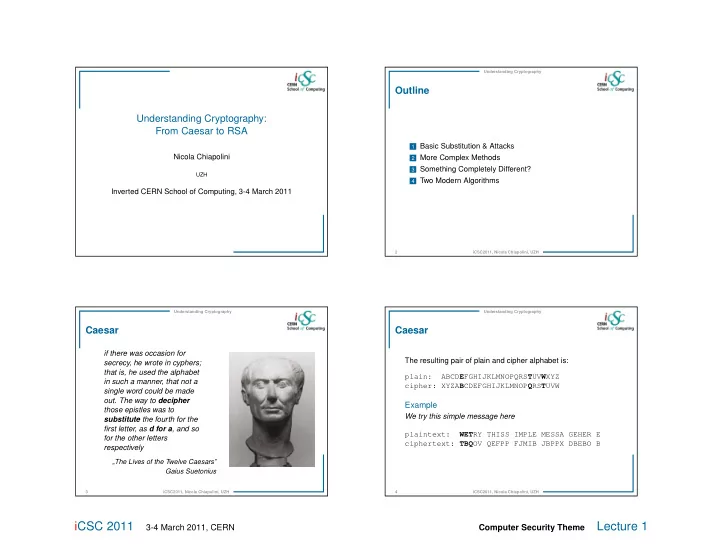
Understanding Cryptography Outline Understanding Cryptography: From Caesar to RSA 1 Basic Substitution & Attacks Nicola Chiapolini 2 More Complex Methods 3 Something Completely Different? UZH 4 Two Modern Algorithms Inverted CERN School of


slide-1
SLIDE 1

Understanding Cryptography: From Caesar to RSA

Nicola Chiapolini

UZH

Inverted CERN School of Computing, 3-4 March 2011

Understanding Cryptography

Outline

1 Basic Substitution & Attacks 2 More Complex Methods 3 Something Completely Different? 4 Two Modern Algorithms

2 iCSC2011, Nicola Chiapolini, UZH Understanding Cryptography

Caesar

if there was occasion for secrecy, he wrote in cyphers; that is, he used the alphabet in such a manner, that not a single word could be made

  • ut. The way to decipher

those epistles was to substitute the fourth for the first letter, as d for a, and so for the other letters respectively

„The Lives of the Twelve Caesars” Gaius Suetonius

3 iCSC2011, Nicola Chiapolini, UZH Understanding Cryptography

Caesar

The resulting pair of plain and cipher alphabet is: plain: ABCDEFGHIJKLMNOPQRSTUVWXYZ cipher: XYZABCDEFGHIJKLMNOPQRSTUVW

Example

We try this simple message here plaintext: WETRY THISS IMPLE MESSA GEHER E ciphertext: TBQOV QEFPP FJMIB JBPPX DBEBO B

4 iCSC2011, Nicola Chiapolini, UZH

iCSC 2011

3-4 March 2011, CERN Computer Security Theme

Lecture 1

slide-2
SLIDE 2

Understanding Cryptography

Caesar - Remarks

Key

shift defines cipher completely (e.g. 3 letters). key space very small (brute force by hand)

Rot13

encryption identical to decryption (A 13 − → N

13

− → A) e.g to prevent spoilers

5 iCSC2011, Nicola Chiapolini, UZH

A B C D E F G H I J K L M N O P Q R S T U V W X Y Z

1 2 3 4 5 6

letter frequency

B E

Understanding Cryptography

Caesar - Attack

Letter Frequency

TBQOV QEFPP FJMIB JBPPX DBEBO B

6 iCSC2011, Nicola Chiapolini, UZH Understanding Cryptography

Caesar - Attack

Plain text

we know/guess that the cipher text contains message there is only one possible position TBQOV QEFPP FJMIB JBPPX DBEBO B MESSA GE Mnbrvcnp Treasure

7 iCSC2011, Nicola Chiapolini, UZH Understanding Cryptography

Randomised Substitution

use permutations big key-space (26!) could use symbols WETRY THISS IMPLE MESSA GEHER E AJ BK CL DM EN FO GP HQ IR SW TX UY VZ

8 iCSC2011, Nicola Chiapolini, UZH

iCSC 2011

3-4 March 2011, CERN Computer Security Theme

Lecture 1

slide-3
SLIDE 3

Understanding Cryptography

Randomised Substitution - Attack

Attacks

plain text attack frequency analysis for letters: ETAON frequency analysis for larger groups use partially decrypted words

„The Gold-Bug” E.A.Poe

9 iCSC2011, Nicola Chiapolini, UZH Understanding Cryptography

Multiple Cipher Equivalents

Goal: flatten the letter distributions

define multiple options for the cipher alphabet need symbols or numbers to extend this idea further plain: ABCDEFGHIJKLMNOPQRSTUVWXYZ cipher: BEINTACWYYQMJPKOGSLXRZDHVU F

10 iCSC2011, Nicola Chiapolini, UZH

GMAZD VACKC ARHPG IYTZW RYKHY OTDEK GWDCS EATJU HEOKA MAHAI GETGR YKSEH ADRKZ AHYCU JXAKH YAKJU HKYGV DTHYU TCGZM DCKYE MYAWA HAKAC RYHYR ZAKPG ARHDT GCKJU HKPDW UHAYB GMDTA ARWAM AWUEZ KYUCG PACUH XYCKD BBYTH CKYTG XYMDG MAZBT YXPAX CDZBE RWBTY XECZE TFGEO ATOZD ECPGO ERARB ZUDRO GERWH PDXYT GPDGV DTOAC GCPAX CDZBA RKPAC WUHAK PGXYT DIACG ZAPDW ATGOH CPACD BBYTK CERWH PGXYT DCUOO GCCBU ZKPDC GDBBY THCET GKPDX YTGPD IAZZS TYJEJ ZAAXS TYMGE RWDVE ZHPAC YIRXA RWERW KPGXY TDOYX SZGHD ZAWYG CPDES SGETK YBUZB AZHPD IAZZY BPACO TGEKY T

Understanding Cryptography

Multiple Cipher Equivalents - Attack

11 iCSC2011, Nicola Chiapolini, UZH Understanding Cryptography

Summary of the Basics

Ideas

1 shift alphabet 2 randomise alphabet 3 use multiple cipher equivalents

Attack Methods

brute force plaintext frequencies (letters, pairs, trigrams) repeated segments

12 iCSC2011, Nicola Chiapolini, UZH

iCSC 2011

3-4 March 2011, CERN Computer Security Theme

Lecture 1

slide-4
SLIDE 4

Understanding Cryptography

Vigenere Cipher - Algorithm

Idea use more than one full cipher alphabet.

plain: ABCDEFGHIJKLMNOPQRSTUVWXYZ cipher C: CDEFGHIJKLMNOPQRSTUVWXYZAB cipher E: EFGHIJKLMNOPQRSTUVWXYZABCD cipher R: RSTUVWXYZABCDEFGHIJKLMNOPQ cipher N: NOPQRSTUVWXYZABCDEFGHIJKLM plaintext: WETRY THISS IMPLE MESSA GEHER E key: CERNC ERNCE RNCER NCERN CERNC E ciphertext: YIKEA XYVUW ZZRPV ZGWJN IIYRT I

13 iCSC2011, Nicola Chiapolini, UZH Understanding Cryptography

Vigenere Cipher - Attack

1 determine key-length n 2 split into n columns 3 use letter frequency for each column separately

Coincidence Counting

ciphertext: YIKEA XYVUW ZZRPV ZGWJN IIYRT I shift 2: YIK EAXYV UWZZR PVZGW JNIIY RT I shift 4: Y IKEAX YVUWZ ZRPVZ GWJNI IYRT I key-length: 4

14 iCSC2011, Nicola Chiapolini, UZH Understanding Cryptography

CSC 2010: HTML riddle

Code

1 Take password and create hash 2 check hash against given value 3 if check passed, decipher secret

message by XOR with password letters

15 iCSC2011, Nicola Chiapolini, UZH Understanding Cryptography

CSC 2010: HTML riddle - Key Length

0x68 0x56 0x42 0x18 0x50 0x4B 0x52 0x18 0x47 0x68 0x56 0x42 0x18 0x50 0x5C 0x45 0x41 0x11 0x5A 0x42 0x4A 0x58 0x56 0x4B 0x52 0x18 0x47 0x5C 0x45 0x41 0x11 0x5A 0x42 0x4B 0x11 0x49 0x52 0x4A 0x42 0x56 0x59 0x42 0x4A 0x58 0x56 0x42 0x4B 0x11 0x49 0x52 0x19 0x11 0x76 0x7C 0x16 0x11 0x70 0x17 0x54 0x4A 0x42 0x56 0x59 0x19 0x11 0x76 0x7C 0x16 0x58 0x4F 0x52 0x18 0x11 0x70 0x17 0x54 0x58 0x4F 0x52 0x18

16 iCSC2011, Nicola Chiapolini, UZH

iCSC 2011

3-4 March 2011, CERN Computer Security Theme

Lecture 1

slide-5
SLIDE 5

Understanding Cryptography

CSC 2010: HTML riddle - Columns

0x68 0x56 0x42 0x18 0x50 0x4B 0x52 0x18 0x47 0x5C 0x45 0x41 0x11 0x5A 0x42 0x4A 0x58 0x56 0x42 0x4B 0x11 0x49 0x52 0x4A 0x42 0x56 0x59 0x19 0x11 0x76 0x7C 0x16 0x11 0x70 0x17 0x54 0x58 0x4F 0x52 0x18 0x58 0x57 0x17 0x5B 0x58 0x4D 0x4E 0x18 0x7A 0x78 0x7A 0x7D 0x7F 0x6A 0x7C 0x15 0x64 0x6B 0x76 0x74 0x62 0x72 0x7E 0x61 0x1D 0x19 0x62 0x4A 0x50 0x55 0x17 0x4A 0x54 0x5E 0x5E 0x57 0x5F 0x17 0x17 0x71 0x11 0x58 0x5A 0x18 0x03 0x0C 0x17 0x41 0x54 0x58 0x45 0x4B 0x11 0x56 0x5B 0x5C 0x1F 0x19 0x7A 0x41 0x11 0x5F 0x56 0x4E 0x5E 0x4B 0x5E 0x4C 0x54 0x19 0x43 0x50

17 iCSC2011, Nicola Chiapolini, UZH Understanding Cryptography

CSC 2010: HTML riddle - Key Letter

0x11 = 0001 0001 0x20 = 0010 0000 0011 0001 = 0x31 = ‘1’ http://www.physik.uzh.ch/~nchiapol/icsc

18 iCSC2011, Nicola Chiapolini, UZH Understanding Cryptography

Extending Vigenere: Wheel Cipher

36 disks key: disk ordering assemble plaintext in one line read off ciphertext in any other line

19 iCSC2011, Nicola Chiapolini, UZH Understanding Cryptography

Extending Vigenere: Plaintext Auto-Key

plaintext: WETRY THISS IMPLE MESSA GEHER E key: CERNW ETRYT HISSI MPLEM ESSAG E ciphertext: YIKEU XAZQL PUHDM YTDWM KWZEX I

Weakness

The key has the properties of plaintext. Strings in key and plaintext at fixed offset.

20 iCSC2011, Nicola Chiapolini, UZH

iCSC 2011

3-4 March 2011, CERN Computer Security Theme

Lecture 1

slide-6
SLIDE 6

Understanding Cryptography

Extending Vigenere: Key Auto-Key

simple rule (sum of last 3 key letters) hard to do manually simple rules are probably weak mechanical devices pseudo random number generator plaintext: WETRY THISS IMPLE MESSA GEHER E key: 24734 41944 75689 30257 46770 4 ciphertext: YIAUC XIRWW PRVTN PEUXH KKOLR I

21 iCSC2011, Nicola Chiapolini, UZH Understanding Cryptography

Extending Vigenere: The Enigma

The Enigma

randomised alphabets generates different alphabet for each letter sequence defined by rotors configuration huge periods: 26nRotors

22 iCSC2011, Nicola Chiapolini, UZH Understanding Cryptography

A provably secure cipher

The One-Time Pad

generate truly random key with same length as message use key only once

23 iCSC2011, Nicola Chiapolini, UZH Understanding Cryptography

Block Ciphers

ciphers worked on one letter at a time could use groups instead

24 iCSC2011, Nicola Chiapolini, UZH

iCSC 2011

3-4 March 2011, CERN Computer Security Theme

Lecture 1

slide-7
SLIDE 7

Understanding Cryptography

Playfair

Playfair

encrypt pairs of letters at a time pair in row: next to right pair in column: next below else: take diagonally opposed C E R N A B D F G H I K L M O P Q S T U V W X Y Z

Example

plaintext: WETRY THISS IMPLE MESSA GEHER E ciphertext: EDSNN YBOXX KOSIN KRQUR DNDAN R

25 iCSC2011, Nicola Chiapolini, UZH Understanding Cryptography

Playfair - Attack

needs a lot of cipher text use statistics of letter pairs hope for plaintext segments algorithm has typical properties e.g. ER → RN C E R N A B D F G H I K L M O P Q S T U V W X Y Z

26 iCSC2011, Nicola Chiapolini, UZH Understanding Cryptography

Summary Complex Methods

Ideas

1 use multiple alphabets 2 generate the key during encryption 3 encrypt groups of letters

Attack Methods

coincidence counting reuse of key knowing the rules

27 iCSC2011, Nicola Chiapolini, UZH Understanding Cryptography

Codes

Instead of letters or groups of letters we could replace whole words. limited possibilities need large code books useful for compression

28 iCSC2011, Nicola Chiapolini, UZH

iCSC 2011

3-4 March 2011, CERN Computer Security Theme

Lecture 1

slide-8
SLIDE 8

Understanding Cryptography

Steganography

mark letters with pinhole invisible ink microdots selected bits in image file

29 iCSC2011, Nicola Chiapolini, UZH Understanding Cryptography

Transposition Methods

Example

plaintext: WE TRY THIS SIMPLE MESSAGE HERE W E T R Y T H I S S I M P L E M E S S A G E H E R E T A O N ciphertext: WTIMG EEHME ETTIP SHARS LSEOY SEARN

30 iCSC2011, Nicola Chiapolini, UZH Understanding Cryptography

Data Encryption Standard

Block Cipher Blocks of 64 Bits Key: 64 Bits (56 used)

Generating Key Stream

use plaintext & key XOR Permutations Substitution

31 iCSC2011, Nicola Chiapolini, UZH Understanding Cryptography

Data Encryption Standard

1 split block in halves 2 prepare subkey 3 combine subkey

and right half

4 xor result and left half 5 switch halves 6 restart at 2 (16x)

right half P+ ⊕ subkey

48

S1 · · · S8

32

P

  • ut

32 48 48 6 4

32 iCSC2011, Nicola Chiapolini, UZH

iCSC 2011

3-4 March 2011, CERN Computer Security Theme

Lecture 1

slide-9
SLIDE 9

Understanding Cryptography

Data Encryption Standard

Result

Each bit in each block depends on every other bit of the block and all the key bits. no statistical properties remain prevents differential cryptanalysis (injecting plaintexts with minimal differences)

33 iCSC2011, Nicola Chiapolini, UZH Understanding Cryptography

Public Key

The Basic Idea

use different keys for encryption and decryption need a problem that is hard to solve but easy with additional information

Example

Factorise: 7031 = 79 · 89

34 iCSC2011, Nicola Chiapolini, UZH Understanding Cryptography

Public Key - RSA

Step by Step: Generate Key

1 choose two prime numbers p, q 2 calculate n = p · q 3 calculate f = (p − 1) · (q − 1) 4 find two numbers e, d such that

e · d = 1 mod f

5 publish e and n, keep d secret

p = 11, q = 7 n = 77 f = 60 e = 23 d = x · f e + 1 e x ∈ N ⇒ d = 47 (x = 18)

35 iCSC2011, Nicola Chiapolini, UZH Understanding Cryptography

Public Key - RSA

Step by Step: Usage

1 encrypt:

c = me mod n

2 decrypt:

m = cd mod n m = 42 (< n) c = 4223 mod 77 = 14 m = 1447 mod 77 = 42

36 iCSC2011, Nicola Chiapolini, UZH

iCSC 2011

3-4 March 2011, CERN Computer Security Theme

Lecture 1

slide-10
SLIDE 10

Understanding Cryptography

Public Key - RSA

me·d = m mod (p · q) e · d = 1 mod (p − 1)(q − 1) a · b mod n = (a mod n) · (b mod n) mod n ma+b mod n =

  • (ma mod n) · mb

mod n ma·b mod n = (ma mod n)b mod n

37 iCSC2011, Nicola Chiapolini, UZH Understanding Cryptography

Side Channel Attacks

The attacker decides what he attacks: Timing Computations need different amount of time Power Computations consume different amount of power Fault Computations can be forced to fail

38 iCSC2011, Nicola Chiapolini, UZH Understanding Cryptography

Thank you for your attention.

39 iCSC2011, Nicola Chiapolini, UZH Understanding Cryptography

References

  • D. Kahn.

The Codebreakers. Scribner, 1996. Dossier: Kryptographie Spektrum der Wissenschaft, 2001 http://www.physik.uzh.ch/~nchiapol/icsc

41 iCSC2011, Nicola Chiapolini, UZH

iCSC 2011

3-4 March 2011, CERN Computer Security Theme

Lecture 1