A novel implantable sensor for long-term continuous glucose - - PowerPoint PPT Presentation

a novel implantable sensor for long term continuous
SMART_READER_LITE
LIVE PREVIEW

A novel implantable sensor for long-term continuous glucose - - PowerPoint PPT Presentation

Sencell Development PRODUCT & TECHNOLOGY A novel implantable sensor for long-term continuous glucose measurement CORPORATE THE READ-OUT OPTIONS TECHNOLOGY 2 The Challenge Miniaturization Project Lifecare AS is developing an implantable


slide-1
SLIDE 1

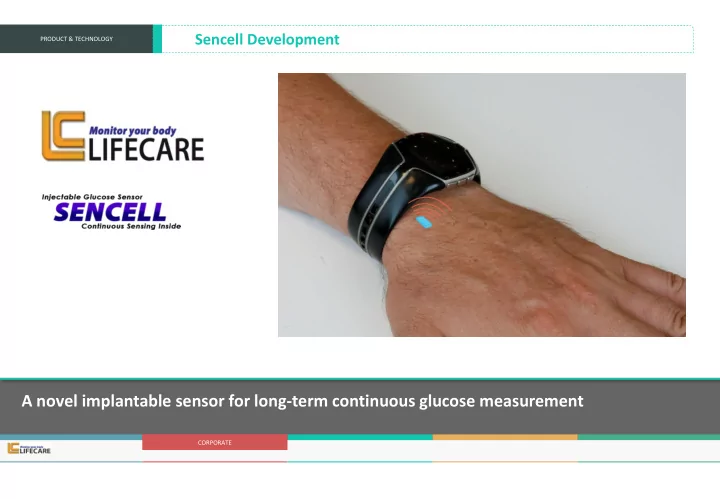
A novel implantable sensor for long-term continuous glucose measurement

PRODUCT & TECHNOLOGY

Sencell Development

CORPORATE
slide-2
SLIDE 2

TECHNOLOGY THE READ-OUT OPTIONS

2

slide-3
SLIDE 3

3

Lifecare AS is developing an implantable glucose sensor named SENCELL for positioning under the skin into the interstitial space. Starting from a laboratory working cell (5 x 3 x 3 cm), the company has achieved significant miniaturization and has performed preclinical proof-of-concept with a small working sensor model (2 x 1 x 0.5 cm) Laboratory Cell Preclinical I Preclinical II Clinical

?

TECHNOLOGY

Miniaturization Project

The Challenge

slide-4
SLIDE 4

No reagent consumption No generation of poisonous by-products High glucose specificity Long term stability Universal calibration No internal power supply

Detecting glucose by the principle of osmotic pressure holds promise of a glucose sensing technology that is suitable for both miniaturization and long term continuous monitoring in vivo without causing patient discomfort or reducing quality of life.

Osmotic pressure measurement offers several major advantages TECHNOLOGICAL ADVANTAGES

No additional start-up time Miniaturization Unobtrusive Implantation by injections/minimal surgery Real time continuous operation Wireless communication

TECHNOLOGY

4

Low cost operation

slide-5
SLIDE 5

TECHNOLOGY MACROCELL IN-VITRO The underlying principle

Factors influencing the performance time have been identified and characterized through a series of experiments with a novel test cell

  • Sensing chamber height
  • Viscosity of sensing fluid
  • Temperature of sensor cell

Performance analysis is measured according to:

  • Response time
  • Sensitivity
  • Reproducibility (stable response)
  • Precipitation
  • Interfering substances
  • Toxicology

5

slide-6
SLIDE 6

TECHNOLOGY

SENCELL RESULTS IN- VITRO

  • Very good active fluid composition with novel recipe
  • Stable measurements / signals

→ Measurements in-macro-cell with reproducible results for at least 3 months at RT → At least stable in-vitro at RT for over 3 months and at 37°C for 11 weeks → ConA stable for at least 3 months at 21°C → This new active fluid recipe stable responses can be obtained for 3 months at 21°C → This is very promising for long-term implantation of ConA- based glucose sensors

  • Concentration measurements at 37°C show no loss of ConA over 3 months
  • Amplitudes acceptable. Similar at 37°C
  • Good understanding of kinetics, and response time

→ The use of fluidics inputs and outputs gives complex sensor responses on the order of 2-3 minutes (in both directions)

  • The evaluation of six potentially interfering molecules revealed no problematic interferences at

physiologically relevant concentrations. Potential Specificity of ConA/dextran chemistry sufficient for measurement of glucose in presence of physiologically relevant levels of α-D-mannose, maltose, xylose, transferrin, & fructose. For L-lactate interference detectable for levels reached by intense sportive activities (e.g. Marathon)

Key components selected and tested in macrocell (wired) in-vitro configuration

6

slide-7
SLIDE 7

7 Commercially Confidential

Sensor Development

TECHNOLOGY

7

Cambridge Consultants - A world leader in technology and product innovation

KEY PARTNERS: IN-VIVO

▪ Each system consists of four similar hand made sensor implants wired to a break-out box that collected measurement data for the duration of the trial, and 1 x Dexcom 4 devices.

Dexcom 4

slide-8
SLIDE 8

8

Pig 3, Day 3, Sensor 1

(after mathematical correction for movement artefacts by using Sencell sensor pattern similarities)

Pilot Animal Experiment

0,60 0,70 0,80 0,90 1,00 1,10 1,20 1,30 7:04 7:29 7:54 8:24 8:49 9:09 9:30 9:54 10:14 10:35 10:59 11:19 11:44 12:04 12:24 12:45 13:09 13:29 SENCELL 1 NORM. Dexcom

TECHNOLOGY

slide-9
SLIDE 9

TECHNOLOGY

  • 2. Pre -clinical

9

Sencell Development

The mechanical design has been completely re-engineered to allow for the dual chamber (sensing and reference) ➢ Active Fluid was prepared using an established recipe except for clarification concerning the protocol for adding Dextran ➢ Reference Fluid was equivalent to the Buffer for the Active Fluid without ConA and Dextran ➢ Fluids were de-gassed and added to the Signal and Reference chambers before closing the device and monitoring pressures as the clamping screws were gradually tightened

slide-10
SLIDE 10

TECHNOLOGY

10

  • 2. Pre -clinical

➢ The pre-clinical pilot study part II was performed from 22/08/-01/09/2016 at the Mfd Facility, Wendelsheim, ➢ Germany Three juvenile German landrace pigs were used for Sencell implantation (two males and one female)

Dexcom 4 Dexcom 6

slide-11
SLIDE 11

KEY PARTNERS IN-VIVO

NOTIFIED BODY COMPETNT AUTHORITIES AUTHORIZED REPRESENTATIVES

MANUFACTURERS & SUBCONTRACTORS

DISTRIBUTORS

VISION

  • 2. Pre -clinical

Glucose signals after one-point calibrations

TECHNOLOGY

slide-12
SLIDE 12

12

Sencell Development

Long term miniaturisation potential using 3D nano-printing technology

TECHNOLOGY

Source: Company information. Note: (1) Technology Readiness Levels (TRL) are a type of measurement system used by NASA to assess the maturity level of a particular technology. Further potential in miniaturisation of Lifecare’s micro-sensor using cantiMED’s 3D-printed nano-senors - target size 100 - 200 µm x 200 - 1000 µm Increased sensitivity allows for pressure measurements in increments

  • f less than 0.01 mbar

Several standardised pressure sensors to be placed at the bottom of the osmotic pressure chamber resulting in increased accuracy and sensitivity in pressure measurements cantiMED’s nano-sensors offer a significant reduction in production cost 3D nano-printing process employed by cantiMED has been implemented by Zeiss in mass production processes and is e.g. considered to be the standard repair tool for high-end photomasks cantiMED technology has been ranked Technology Readiness Level(1) 7 (TRL) Miniaturised pressure chamber using 3D nano-printing

Nano-sensor

100 - 500 µm 50 - 100 µm

3D-printed cantiMED nano-sensors

A nano-sensor is an ultra-small device, measuring pressure, force or other quantities with highest resolution

slide-13
SLIDE 13

13

Sencell Development

Illustration of cantiMED 3D-printing technology

TECHNOLOGY

Membrane

(Material free to choose)

Illustration of 3D-printed sensor

2 µm

na nano3DSe SenseTM

TM

Sensor Tunneling-process («hopping») Substantial change in resistance

Pressure

Deflection (nm) ∆R/R (%)

Miniaturisation through proven cantiMED nano-technology allows for increased sensor sensitivity and lower production costs

slide-14
SLIDE 14

14

Sencell Development

Precise nanoscale 3D-printing

TECHNOLOGY

Resolution 10nm Print on any substrate material Rapid prototyping within minutes

slide-15
SLIDE 15

KEY PARTNERS IN-VIVO

NOTIFIED BODY COMPETNT AUTHORITIES AUTHORIZED REPRESENTATIVES

MANUFACTURERS & SUBCONTRACTORS

DISTRIBUTORS

VISION

Sencell Development

TECHNOLOGY

Wafer-BatCH-Production

slide-16
SLIDE 16

KEY PARTNERS IN-VIVO

NOTIFIED BODY

VISION

Sencell Development

TECHNOLOGY

Biocompatible Outer Membrane Glucose Permeable Membrane Osmotic Pressure Chamber Fluidic Channel Sealed Fluidic Port Pressure Membrane Nanosensors Circuitry Electronics Interstitial Fluid

slide-17
SLIDE 17

KEY PARTNERS IN-VIVO

NOTIFIED BODY COMPETNT AUTHORITIES AUTHORIZED REPRESENTATIVES

MANUFACTURERS & SUBCONTRACTORS

DISTRIBUTORS

VISION

Sencell Development

TECHNOLOGY

Osmotic Pressure Electrodes

Pressure Membrane Stable Frame

  • 1. Generation of

Pressure Membrane

slide-18
SLIDE 18

KEY PARTNERS IN-VIVO

NOTIFIED BODY

VISION

Sencell Development

TECHNOLOGY

Array of Membranes

slide-19
SLIDE 19

21

Sencell Developmentt

21

TECHNOLOGY

Logo on very small scale Overview: Array of sensors, mass produced Blow up image: Sensors with electrode structures Blow up image: A nanosensor 3D-printed electrodes

Electrode Electrode Electrod e Electrode

Nanosensors (3D-printed)

Batch fabrication of nanosensors incorporating 3D nanoprinting (Nano3DSense™)

slide-20
SLIDE 20

KEY PARTNERS IN-VIVO

CORPORATE GLUCOSE

NOTIFIED BODY COMPETNT AUTHORITIES AUTHORIZED REPRESENTATIVES

MANUFACTURERS & SUBCONTRACTORS

DISTRIBUTORS

VISION