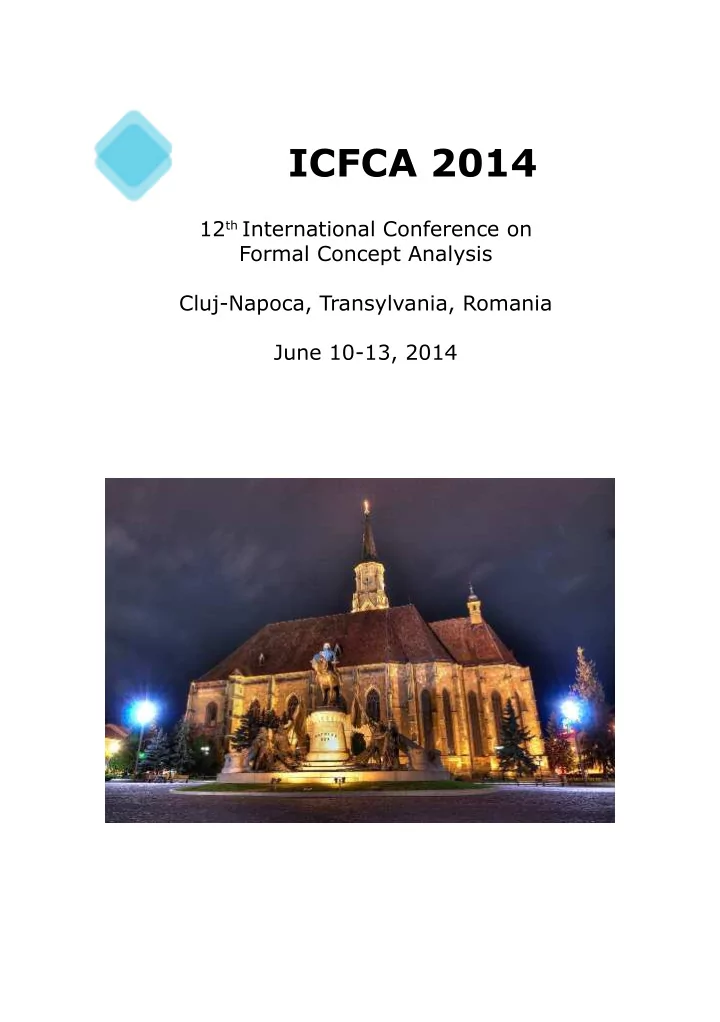
ICFCA 2014 12 th International Conference on Formal Concept Analysis - - PDF document

icfca 2014
SMART_READER_LITE
LIVE PREVIEW

ICFCA 2014 12 th International Conference on Formal Concept Analysis - - PDF document

ICFCA 2014 12 th International Conference on Formal Concept Analysis Cluj-Napoca, Transylvania, Romania June 10-13, 2014 Formal Concept Analysis is a fjeld of applied ma- The International Conference on Formal Concept Analysis thematics with


slide-1
SLIDE 1

ICFCA 2014

12th International Conference on Formal Concept Analysis Cluj-Napoca, Transylvania, Romania June 10-13, 2014

slide-2
SLIDE 2

The International Conference on Formal Concept Analysis series (ICFCA) aims to be the prime forum for the publication

  • f advances in applied lattice and order theory and in partic-

ular scientifjc advances related to Formal Concept Analysis and its applications. ICFCA is a series of annual conferenc- es that started in 2003 in Darmstadt and has been held in several continents: Europe, Australia, America, and Africa. In 2014, ICFCA goes East and meets Transylvania. The ICFCA 2014 will be hosted by the Babes-Bolyai University of Cluj- Napoca, Transylvania, Romania, from June 10 to June 13, 2014. Formal Concept Analysis is a fjeld of applied ma- thematics with its mathematical root in order the-

  • ry,

in particular the theory

  • f

complete lattices. Researchers had long been aware of the fact that these fjelds have many potential applications. Formal Concept Analysis emerged in the 1980s from efforts to restructure lattice theory to promote better communication between lattice theorists and potential users of lattice theory. The key theme was the mathematical formalization of concept and conceptual hierarchy. Since then, the fjeld has developed into a growing research area in its

  • wn

right with a thriving the-

  • retical community and an increasing number of applications.
  • Data and knowledge

processing including data visualization

  • Applications for hierarchi-

cal classifjcation and data

  • rganization
  • Machine learning
  • Information retrieval
  • Data analysis and knowl-

edge management

  • Semantic Web
  • Data mining
  • Software Engineering.

We are looking forward to welcoming you in Cluj- Napoca, the treasure city of Transylvania, and we cor- dially invite you to participate to the ICFCA 2014. cs.ubbcluj.ro/icfca14

slide-3
SLIDE 3

Travel information How to reach Cluj-Napoca: * by plane: There are direct fmights connecting Cluj to Barce- lona, Bari, Bergamo, Bologna, Brussels Charleroi, Dortmund, Eindhoven, London Luton, Madrid, Munich, Paris Beauvais, Rome, Treviso, Valencia, Vienna, Zaragoza. For more infor- mation, please check the Cluj Airport website (airportcluj.ro). * by train: Cluj-Napoca is about 7 hours from Bucharest, 6 hours from Budapest, Hungary, and 9 hours from Vienna, Austria. * by car: If you travel from Western Europe, take motorway M1 from Wien to Budapest, then European Route E60 for Budapest – Szolnok – Püspökladány – Ártánd / Bors (border crossing) – Oradea – Cluj. Accomodation Cluj-Napoca is a modern city, providing a wide range of acco- modation possibilities, from luxury hotels to budget backpack travellers hostels. In walking distance to the conference site, there are several hotels with rates starting from EUR 30. Visit the conference website (cs.ubbcluj.ro/icfca14) for a list

  • f recommended hotels, their websites, locations and rates.