ICD 11 and SNOMED CT common ontology : Circulatory system Jean-Marie - - PowerPoint PPT Presentation

icd 11 and snomed ct common
SMART_READER_LITE
LIVE PREVIEW

ICD 11 and SNOMED CT common ontology : Circulatory system Jean-Marie - - PowerPoint PPT Presentation

ICD 11 and SNOMED CT common ontology : Circulatory system Jean-Marie Rodrigues, Stefan Schulz, Alan Rector, Kent Spackman, Jane Millar, James Campbell, Bedirhan stn, Christopher Chute, Harold Solbrig, Vincenzo Della Mea, Kristina Brand


slide-1
SLIDE 1

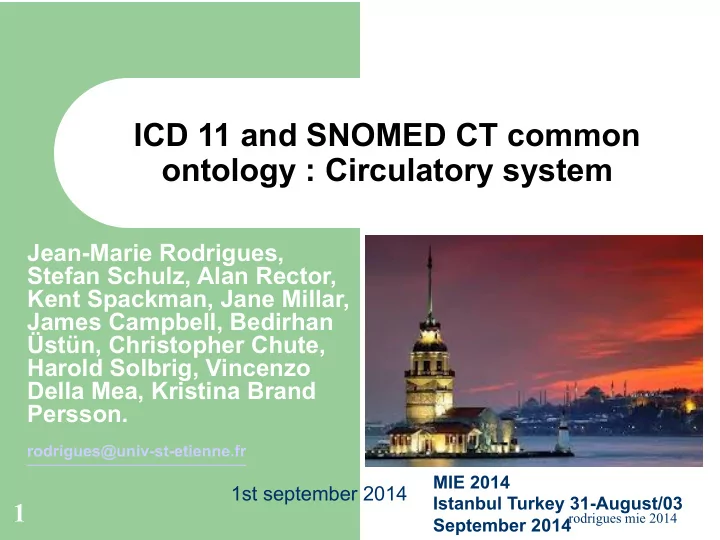
ICD 11 and SNOMED CT common

  • ntology : Circulatory system

Jean-Marie Rodrigues, Stefan Schulz, Alan Rector, Kent Spackman, Jane Millar, James Campbell, Bedirhan Üstün, Christopher Chute, Harold Solbrig, Vincenzo Della Mea, Kristina Brand Persson.

rodrigues@univ-st-etienne.fr

MIE 2014 Istanbul Turkey 31-August/03 September 2014

1st september 2014

1

rodrigues mie 2014

slide-2
SLIDE 2

Plan

Ø SNOMED CT and ICD11 Ø Common Ontology and multilayered

ICD 11

Ø Circulatory system pilot Ø Conclusion

rodrigues mie 2014

2

slide-3
SLIDE 3

SNOMED CT and ICD11

Ø SNOMED CT

Ø standardized health terminology that provides clinical terms

for health records. SNOMED CT concepts provide standardized meaning by logic descriptions

Ø ICD 11 Ø delivering summary high level aggregations Ø a multi-layered disease classification system.

  • Foundation Component, Common ontology plus queries
  • Purpose-specific linearizations (mortality, morbidity, primary

care) with jointly exhaustive and mutually exclusive classes

rodrigues mie 2014

3

slide-4
SLIDE 4

Common Ontology definition

Ø The Common Ontology is a set of ICD

Foundation Component terms harmonised with a subset of SNOMED CT and formulated in SNOMED CT’s description logic.

Ø OWL/DL SubClass/SuperClass Ø Non Is_A Definition relations (axioms)

l Fully defined terms (necessary and sufficient) l Partially defined terms (necessary plus manual

assertion)

l Poly-hierarchy

rodrigues mie 2014

4

slide-5
SLIDE 5

Simplified Architectural Diagram

Foundation Scaffold Common Ontology Subset of SNOMED CT0 Linearization A SNOMED CT

ICD-11 Foundation Component

Linking Query Library Common Ontology Linearizations

Foundation Ontology

slide-6
SLIDE 6

Architectural Diagram

Foundation Scaffold External links Common Ontology (with ICD-11) Subset of SNOMED CT Content Model Contents Content Model Schema Linearization A Linearization B (un-nested) SNOMED CT External sources External sources Additional External sources

ICD-11 Foundation Component

Linking Query Library Common Ontology (with SNOMED CT) Subset of ICD-11 value sets Linearization set A (nested)

ICD11 Foundation

  • ntology

Non-

  • ntological

primitives

slide-7
SLIDE 7

rodrigues mie 2014 7

slide-8
SLIDE 8

FC non in CO

  • Headers that aggregate entities
  • f vocabulary, typically using plurals (“Diseases of…”)
  • Fine-grained parts of ICD, more

specific than SNOMED CT

  • Queries for Exclusion statements for

linearizations

  • Non-ontological content (Icat content model)

(signs, symptoms, diagnostic criteria)

rodrigues mie 2014

8

slide-9
SLIDE 9

Linearizations differences with the common ontology

Ø Mono-hierarchy( different from Co Is_a) Ø Specific preferred term Ø Inclusion/exclusion Ø Residuals Ø Related to Common Ontology by

Ø a disjunction of terms in the Common Ontology Ø Queries

rodrigues mie 2014

9

slide-10
SLIDE 10

the basic structure of most queries

Ø the basic structure of most queries are of

the form “A but not B or C or …”, i.e.

Ø LinearizationClass à

BaseOntologyClassExpression MINUS OntExpression1 MINUS OntExporession2

Ø where “MINUS” can be read as “not

classified under”.

rodrigues mie 2014 10

slide-11
SLIDE 11

Ø ICD:’Hypertensive diseases’ à

FROM sct: Findings SELECT sct: ‘Hypertensive Disease’

Ø

MINUS sct:’Metabolic disorder’ // from Dis of Circ System MINUS sct:’Endocrine disorder’ // from Dis of Circ System MINUS sct:’Infectious and parasitic // as above MINUS sct:’Poisoning’ // as above MINUS sct:’Diseases of Puerperium’ // from self MINUS sct:’Disorders of Pregnancy’ // from self

rodrigues mie 2014 11

slide-12
SLIDE 12

Circulatory system pilot

Ø Workflow Ø Material Ø Method Ø Results

rodrigues mie 2014 12

slide-13
SLIDE 13

Workflow 1

Ø identify candidate SCT concepts for FC

classes.

Ø Construct valid SCT formal expressions for

ICD-11 textual definitions,

Ø Specify the queries for ICD-11 FC classes Ø Assure that all expressions in SCT

representing subchapters in ICD-11 aggregate to the SCT pre-coordinated expression for the ICD-11 chapter concept.

rodrigues mie 2014 13

slide-14
SLIDE 14

Workflow 2

Ø When necessary, submit potential

revisions to the SCT concepts model and expansions of SCT content

Ø Add all SCT editorial expansions into the

common ontology.

rodrigues mie 2014 14

slide-15
SLIDE 15

WHO Material

Ø ICD11 Chapter

Ø Circulatory Ø Ear & mastoid process Ø Respiratory Ø Infectious diseases Ø Dermatology Ø GURM – genitourinary & reproductive medicine

Ø URL:

http://mitel.dimi.uniud.it/whotools/ mappingTools/mappet/

rodrigues mie 2014 15

slide-16
SLIDE 16

Common Ontology data base

Ø SQL database

Ø Lexical matches Ø Automatic input of SCT terms and Short Norms

Form

Ø Import export process via WHO URL

Ø References

Ø e.g. Medscape/OMIM/Orphanet

Ø Internal review approach Ø External review

Ø American College of Cardiology for circulatory

slide-17
SLIDE 17

Identifying SCT candidates to CO

Map Type Description Common Ontology(CO) SCTID ICD11 maps to existing SNOMED CT, synonymous Short Normal Form 0/A pre-coordinated concept without change Definition using SNOMED CT concepts and compositional grammar 0/E post-coordinated expression without change in the model of meaning Definition using SCT attributes only e.g. site, morphology, expression provided in SNOMED CT compositional grammar 0/R residual phrase Not in CO but queries 0/X pre-coordinated concept with changes Change to SCT model of meaning 0/EX post-coordinated expression with changes Change to content – object/value

rodrigues mie 2014 17

slide-18
SLIDE 18

– Exact match examples

Map Type ICD11 Rubric Common Ontology (Short Normal Form) SCTID Cerebral venous thrombosis 95464572001|Disease (disorder)|: {116676008|Associated morphology (attribute)|=396339007|Thrombus (morphologic abnormality)|363698007| Finding site (attribute)|=68351006| Structure of cerebral vein (body structure)|} SCTID Coronary vaso spastic with angina 194828000|Angina (disorder)| +23687008|Coronary artery spasm (disorder)|:{363698007|Finding site (attribute)|=74281007|Myocardium structure (body structure)|}

rodrigues mie 2014 18

slide-19
SLIDE 19

– Pre coordination examples

Map Type ICD11 Rubric Common Ontology 0/A Aldosterone-producing carcinoma 116680003 | Is a |88213004 | Hyperaldosteronism, |42752001 | Due to| 255035007 | Adrenal carcinoma 0/A Acute myocardial infarction, STEMI, anterior wall 401303003 | Acute ST segment elevation myocardial infarction | + 54329005 | Acute anterior myocardial infarction

rodrigues mie 2014 19

slide-20
SLIDE 20

Post coordination – examples

Map Type ICD11 Rubric Common ontology 0/E Asymptomatic stenosis of extracranial carotid artery 116680003 | Is a |230738008 | Asymptomatic cerebrovascular disease, |363698007 | Finding site|17999001 | Structure of cervical portion of internal carotid artery, |116676008 | Associated morphology|415582006 | Stenosis 0/E internal auditory artery

  • cclusion

116680003 | Is a |2929001 | Occlusion of artery, |363698007 | Finding site|89471000 | Structure

  • f labyrinthine artery
slide-21
SLIDE 21

Results

rodrigues mie 2014 21

slide-22
SLIDE 22

Cerebrovascular disease

slide-23
SLIDE 23

Results

Map Type Number Common Ontology SCTID 792 (50.1%) Short Normal Form 0/A 534 (33.8%) To be developped with SCT grammar 0/E 86 (5.4%) To be developped with SCT grammar 0/EX 16 (1.0%) To be developped with changes SCT values 0/X 12 (0.8%) To be developped with changes in SCT model of meaning 0/R 116 (7.3%) Not in CO but queries Unclear definition 26 (1.6%) Definition by domain experts

slide-24
SLIDE 24

Map Circ Ear Resp Inf All % SCTID 792 146 594 1459 2291 58 0/A and 0/E 648 29 391 664 1734 34 Residual 116 27 93 35 269 5 Unclear definition 26 7 47 49 129 3 Total 1582 209 1125 2207 5123 100

Outcomes– ICD11 SCT coordination Mappings -overall

slide-25
SLIDE 25

Conclusion (1)

Ø Around 84 % of circulatory chapter ICD11

codes can be represented by a subset of existing SCT concepts and pre- coordination

Ø 5,4 % can be represented with SCT

attributes (or defining relations or model of meaning)

Ø 1,8 % needs modification of the model of

meaning (attribute or values sets)

Ø 7,3 % and 1,6 % cannot be represented in

CO

rodrigues mie 2014 25

slide-26
SLIDE 26

Conclusion 2

Ø Further steps of the workflow are

Ø Validating the formal SCT representations Ø Adressing the pre-coordination issue Ø Modify the SCT model of meaning when

necessary

Ø Develop the queries Ø Extend the method to other chapters

rodrigues mie 2014 26

slide-27
SLIDE 27

27

Questions?

Tak Vielen Dank für Ihre Aufmerksamkeit

Terima Kashi Thank you Merci rodrigues@univ-st-etienne.fr

Tak

Grazie Gracias Obrigado Efcharisto ARIGATO GOZAIMASU Multumesc.

rodrigues mie 2014