I see it, but because by it I see everything else. C. S. Lewis, Is - - PowerPoint PPT Presentation

i see it but because by it i see
SMART_READER_LITE
LIVE PREVIEW

I see it, but because by it I see everything else. C. S. Lewis, Is - - PowerPoint PPT Presentation

Week 2: The Grand Panorama: C. S. Lewis on the Meaning of Life I believe in Christianity as I believe that the Sun has risen, not only because I see it, but because by it I see everything else. C. S. Lewis, Is Theology Poetry? The


slide-1
SLIDE 1

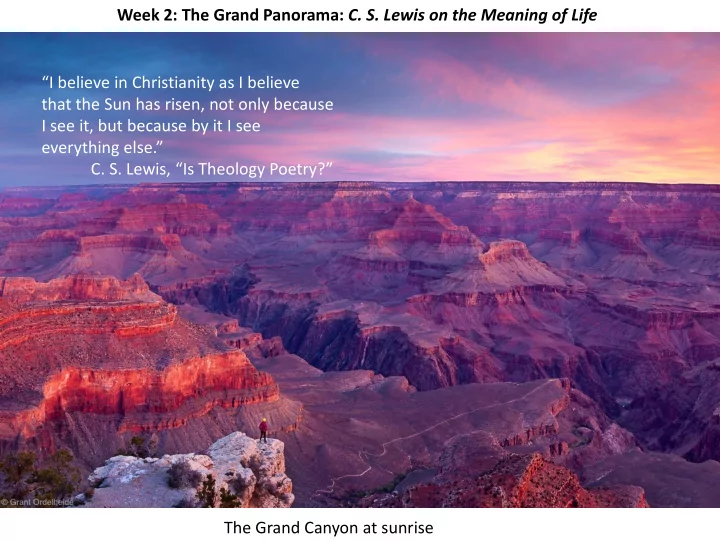
“I believe in Christianity as I believe that the Sun has risen, not only because I see it, but because by it I see everything else.”

  • C. S. Lewis, “Is Theology Poetry?”

The Grand Canyon at sunrise Week 2: The Grand Panorama: C. S. Lewis on the Meaning of Life

slide-2
SLIDE 2

Elevenses with C. S. Lewis The Grand Panorama:

  • C. S. Lewis on the Meaning of Life

Week 2 October 1, 2017

slide-3
SLIDE 3

Plan for the day

  • Introduction regarding meaning
  • Some relevant social science data
  • Some relevant views of writers and philosophers
  • Lewis’ argument from right and wrong
  • Lewis’ argument from longing
slide-4
SLIDE 4

Changing priorities regarding being very well off financially as opposed to developing a meaningful philosophy of life

Pryor, J. H. et al. (2007). The American freshman: Forty year trends, 1966-2006. UCLA: Higher Education Research Institute.

slide-5
SLIDE 5

Over the second half of the 20th century, income rose sharply in the U.S. but the percentage of the population who said they were very happy if anything declined a bit

Myers, David. (2000) The American paradox: Spiritual hunger in an age of plenty. New Haven:Yale U. p. 137.

slide-6
SLIDE 6

Indicators of well being among young adults showed dramatic changes in the second half of the 20th century

  • Teen suicide rates tripled
  • Violent crime rates quadrupled
  • The prison population quintupled
  • Major depression among young adults

increased ten-fold

Myers, David. (2000) The American paradox: Spiritual hunger in an age of plenty. New Haven: Yale University Press, p. 137. Seligman, Martin (2002). Authentic happiness. New York: Free Press, pp. 117-118.

slide-7
SLIDE 7

Ideas have consequences…

  • In the wake of World War II, existentialism

became a stronger cultural force

  • Jean Paul Sartre (Nausea)—Life is pointless:

“Here we sit, all of us, eating and drinking to preserve our precious existence, and really there is nothing, nothing, absolutely no reason for existing.”

  • Albert Camus (Myth of Sisyphus)—Life is absurd:

“The absurd is born of this confrontation between the human need and the unreasonable silence of the world.”

slide-8
SLIDE 8
  • Scientistic materialism also became much more prominent over

the course of the 20th century

  • Carl Sagan (“Cosmos” PBS series)—You’re just matter in motion:

“The universe is all there is, all there ever was, and all there ever will be.”

  • Richard Dawkins (River out of Eden: A Darwinian View of Life)—

The universe has “no design, no purpose, no evil and no good, nothing but blind, pitiless indifference.”

  • In Lewis’ day, there were comparable voices
  • For example, Bertrand Russell (“A Free Man’s Worship”)—

All human labor is “destined to extinction in the vast death of the solar system” resulting henceforth in “the unyielding despair of the soul.’”

  • Or, H. G. Wells, whose “Scientific Outlook” is “one of the finest myths

which human imagination has produced” where life emerges by the “millionth millionth chance” but then “the last scene reverses all” and “All ends in nothingness” (cf. Lewis on Wells in “Is Theology Poetry?”)

  • Lewis embraced this view of reality in the 1910s and 1920s,

arguing it was “right” and had a “wholesome severity” even though it offered a “grim and meaningless” view of life

  • His adolescent pessimism was hardened in the trenches of WWI which

seemed to confirm the pointlessness of life and the nonexistence of God.

slide-9
SLIDE 9

How did Lewis come to reject this materialistic worldview? Along with the influence of his friends, and the impact of his reading authors who believed in the transcendent, certain clues or “signals of transcendence” helped convinced Lewis to believe. Today we consider two important arguments that persuaded Lewis our experiences are “shadows” of greater realities “glimpsed through the veil”

(Chesterton, The Everlasting Man).

  • The Argument from Right and Wrong
  • Presented in Mere Christianity, Book 1: “Right and

Wrong as a Clue to the Meaning of the Universe”

  • The Argument from Longing
  • Included in Lewis’ sermon “The Weight of Glory”
slide-10
SLIDE 10

Before we consider the content of what Lewis had to say, let’s first briefly consider “How did Lewis become a master communicator?”

  • In short, he went to “boot camp”: that is, Lewis

accepted an invitation from the Royal Air Force to give talks at military bases around the country.

  • In early 1941, after a first talk at a training base for

a bomber command that he thought was “a complete failure,” Lewis decided he had to “learn the language of his audience” and how to translate his ideas into their way of speaking.

  • “It’s no use laying down a priori what the plain man

does or does not understand. You have to learn by experience.”

slide-11
SLIDE 11

Lewis went on to give a series of talks on the BBC radio throughout the war years, to an audience of more than a million listeners

  • The title for the very first set of talks was “Right and

Wrong as a Clue to the Meaning of the Universe”

  • The first 4 talks were originally entitled as follows, with

a fifth session was added for Q&A:

  • August 6, 1941: “Common Decency”
  • August 13, 1941: “Scientific Law and Moral Law”
  • August 20, 1941: “Materialism or Religion”
  • August 27, 1941: “What Can We Do about It?”
  • September 3, 1941: Session devoted to responding to

questions from listeners.

  • The talks were scheduled immediately following a

fifteen-minute news broadcast that drew a very large audience, especially during wartime.

  • The talks were so successful that Lewis was asked back

for three more series of talks, one of which on “Christian Behavior” was to be broadcast on the BBC Forces’ Network.

slide-12
SLIDE 12

“Right and Wrong as a Clue to the Meaning of the Universe”

  • Ch. 1: The Law of Human Nature

“Everyone has heard people quarrelling…”

  • 1. What does Lewis think we can learn from such

quarrelling?

  • To quarrel is to try to show the other person is in the

wrong, and so implicitly one is appealing to some standard that they expect the other person to know about.

  • 2. Why does Lewis say that, if the Law of Right and

Wrong were not something all humans knew, “then all the things we said about the war were nonsense”?

  • We condemned the Nazis because we believed that they

had to know, at some level, that what they were doing was wrong.

slide-13
SLIDE 13

“Right and Wrong as a Clue to the Meaning of the Universe”:

  • Ch. 1: The Law of Human Nature (cont.) & Ch. 2: Some

Objections

  • 3. How does Lewis suggest you could cure a

relativist, i.e. someone who says he doesn’t believe in Right and Wrong?

  • Breaking a promise to that person, or treating that

person unfairly is likely to elicit a complaint of “’It’s not fair’ before you can say Jack Robinson” (p. 6).

  • 4. What is Lewis’ analogy of the piano about?
  • He acknowledges we have instincts, like the “herd

instinct” and the instinct of self-preservation, but we need something else to tell us to which we should follow in a given situation. Instincts are neutral like notes on a piano, and the Moral Law tells us which note to play louder.

slide-14
SLIDE 14

“Right and Wrong as a Clue to the Meaning of the Universe”:

  • Ch. 2: Some Objections (cont.)
  • 5. If you learned something from parents and

teachers, must it be merely a social convention?

  • Some things learned from parents or society are mere

conventions (like driving on the left side of road), but

  • ther things are not (like the multiplication table).
  • 6. If your ideas about morality can be truer and

those of the Nazis less true, must there be something—some Real Morality—that is the standard by which they could be measured?

  • Lewis’ example: my idea about New York might be truer

than yours. When differences in moralities exists, the things we are bound to think about the differences (that

  • ne is inferior to the other) suggest that there is a

standard, not that there is no real natural law of behavior.

slide-15
SLIDE 15

“Right and Wrong as a Clue to the Meaning of the Universe”:

  • Ch. 3: The Reality of the Law & Ch. 4: What Lies Behind the

Law

  • 7*. Physical laws like the law of gravity might just be

describing what, say, stones do. Does the Law of Human Nature simply say what people do? Is it saying what is simply convenient, or what is good for society?

  • No, the Law of Human Nature says what people ought to do, but

(often) don’t. And, the fact that it is not about what is simply convenient is made clear by how important is the intent behind an action, e.g. tripping. Further, saying you should do what is good for society only makes sense if there is some fundamental principle that says why that should be done, e.g. being unselfish.

  • 8. Why does Lewis say science cannot determine whether

the materialist or religious view is correct?

  • Science answers questions like “What happens if…?”,

not “Why is there anything there?” or “Is there anything behind the things science observes?” Science has inherent limitations in the kinds of questions it can answer. Even if all scientific questions were answered, the question remains of “Does it have any meaning?”

slide-16
SLIDE 16

“Right and Wrong as a Clue to the Meaning of the Universe”:

  • Ch. 4: What Lies Behind the Law (cont.)
  • 9. What is the one case where we can do more

than just observe facts, where we have “inside information” about the universe?

  • We have inside information about “Man” or about

human nature (e.g. the mailman example—the only packet I’m allowed to open is Man).

  • 10. What does Lewis mean when he says he’s not
  • ffering “soft soap” about God?
  • Lewis wants to separate himself from those who have

suggested God is simply a providential principle, or all kindness, or whatever you wish were true (i.e., he wants to avoid “wishful thinking”.)”

slide-17
SLIDE 17

“Right and Wrong as a Clue to the Meaning of the Universe”:

  • Ch. 5: We Have Cause to be Uneasy
  • 11. Why do we have cause to be uneasy?
  • We have concluded that there seems to be Something or

Somebody behind the Moral Law.

  • The two bits of evidence we have about this Somebody:
  • The Universe He made suggests He is a great artist but merciless.
  • The Moral Law within suggests this Somebody is very interested in

right behavior, but we generally fail to live up to the Moral Law.

  • Christianity doesn’t make sense until you face these facts.
  • If you look for truth you might find comfort in the end. But if you

look for comfort, you will not find either comfort or truth, only wishful thinking.

  • Most of us got over the pre-war wishful thinking about

international politics.

  • It’s time we did the same regarding religion.
slide-18
SLIDE 18

“Arrows of Joy”: The Argument fr from Longing or r Desir ire

  • Lewis says that “Joy” is the “the central story of my life”

(Surprised by Joy, p. 17).

  • But “joy” is used by Lewis in the sense of Sehnsucht,

the wistful, soft, tearful longing of the German romantic writers.

  • Lewis’ thinking about this is not a deductive argument,

but a reflection about what is the best explanation of

  • ur experience.
  • He portrays this longing in various ways in different

books:

  • In the Chronicles of Narnia, as the longing for Narnia or Aslan.
  • In Pilgrim’s Regress, as the sweet desire for one’s true home.
  • In “The Weight of Glory” as, in part, a quest for beauty.
  • In Surprised by Joy, as his “earliest aesthetic experiences.”
slide-19
SLIDE 19

Examples of Lewis’ experiences of “joy”

  • r “longing”
  • As a child, the fragrance of a flowering currant bush at Little

Lea, which evoked…

  • … “there arose in me without warning, and as if from a

depth not of years but of centuries, the memory of that earlier morning at the Old House when my brother brought his toy garden into the nursery” (Surprised by Joy, p. 16)

  • Later, reading poetry, e.g. Henry Wadsworth Longfellow’s

lines about a Norse god:

  • “I heard a voice that cried,
  • Balder the beautiful
  • Is dead, is dead—”
  • As a young teenager at Cherbourg school, Wagner’s four-

cycle opera The Ring of the Nibelungs, including Siegfried and The Twilight of the Gods There are parallels of Lewis’ experiences of joy and the mystical experience studied by William James, which he characterized as “privileged moments” that carry an “enormous sense of inner authority and illumination” (The Varieties of Religious Experience, 1902).

slide-20
SLIDE 20

“The Weight of Glory”

Lewis’ sermon at the Church of St. Mary the Virgin, Oxford, June 8, 1942.

  • “We remain conscious of a desire which no natural

happiness will satisfy. A man’s hunger does not prove that he will get any bread. But surely a man’s hunger does prove that man comes of a race that repairs its body by eating and inhabits a world where eatable substances exist. Here, then, is the desire, still wandering and uncertain of its object and still largely unable to see that object in the direction where it really lies” (p. 4)

  • 12. Why does Lewis say Our Lord finds our desires, not

too strong, but too weak?

  • We should “desire our own good” and “the enjoyment of it”.
  • “We are half-hearted creatures, fooling around with drink and

sex and ambition, when infinite joy is offered us.”

slide-21
SLIDE 21

“The Weight of Glory” (cont.)

  • 13. How is a Christian, in relation to heaven, like a

school boy studying Greek grammar?

  • We haven’t yet attained the satisfaction of the ultimate goal

(e.g. enjoying reading classics in the original language). It’s a gradual process to grow through obedience in increasing power to desire the ultimate reward.

  • “In speaking of this desire for our own far-off country…

I am trying to rip open the inconsolable secret in each

  • ne of you…the secret we cannot hide and cannot tell”

(p. 3).

  • 14. Why is it we cannot tell the secret? Why is it we

cannot hide the secret?

  • We cannot tell the secret because we have never actually had

the longing fulfilled. But we cannot hide the secret because we intuitively long for something more.

  • 15. If a book or music led to our experience of this

desire or longing, was the beauty in the book or music?

  • The beauty was not in the books or music. “It only came

through them.”

slide-22
SLIDE 22

“The Weight of Glory” (cont.)

  • “Almost all our modern philosophies have been

devised to convince us that the good of man is to be found on this earth” (p 4).

  • These philosophies include ideas like a philosophy of

inevitable progress or “Creative Evolution.”

  • 16. What is the second law of thermodynamics and

why does Lewis refer to it?”

  • All closed energy systems tend to disorder. The universe

as a whole not progressively improving, but winding down.

slide-23
SLIDE 23

“The Weight of Glory” (cont.)

  • ““Heaven is, by definition, outside our experience, but all

intelligible descriptions must be of things within our

  • experience. The scriptural picture of heaven is therefore…

symbolical… There is no getting away from the fact that this idea [of glory] is very prominent in the New Testament and in early Christian writings… Glory suggests two ideas to me,

  • f which one seems wicked and the other ridiculous. Either

glory means to me fame, or it means luminosity” (p. 4-5)

  • “When I began to look into this matter I was shocked to find

such different Christians as Milton, Johnson, and Thomas Aquinas taking heavenly glory quite frankly in the sense of fame or good report.” (p. 5)

  • “Well done, thou good and faithful servant.” (Matt. 25:21)
  • 17. Does Lewis think the fundamental thing is how we think
  • f God?
  • “By God Himself, it is not! How God thinks of us is not only more

important, but infinitely more important.”

slide-24
SLIDE 24

“The Weight of Glory” (cont.)

  • “Having followed up what seemed puzzling and repellant in the

sacred books, I find, to my great surprise, looking back, that Glory…turns out to satisfy my original desire and indeed to reveal an element which I had not noticed.” (p. 6-7)

  • “In this universe we are treated as strangers, the longing to be

acknowledged, to meet with some response, to bridge some chasm that yawns between us and reality, is part of our inconsolable secret.” (p. 7)

  • Glory means “good report with God, acceptance by God,

response, acknowledgment, and welcome into the heart of

  • things. The door on which we have been knocking all our lives

will open at last.” (p. 7)

  • “St. Paul promises to those who love God not, as we should

expect, that they will know Him, but that they will be known by Him (I Co. 8:3)” but “it may happen to any one of us to appear at last before the face of God and hear only the appalling words: ‘I never knew you. Depart from me.’” [Matt. 7. 21ff. ‘Lord, Lord’].

  • “We walk everyday on the razor edge of these two possibilities.”

(p. 7)
slide-25
SLIDE 25

“The Weight of Glory” (cont.)

  • “And this brings me to the other sense of glory—

glory as brightness, splendor, luminosity. We are to shine as the sun [I Cor. 15:41ff], we are to be given the Morning Star [Rev. 2:8].” (p. 8)

  • “When human souls have become as perfect in

voluntary obedience as the inanimate creation is in its lifeless obedience, then they will put on… that greater glory of which Nature is the first sketch. Nature is mortal; we shall outlive her. When all the suns and nebulae have passed away, each one of you will still be alive.” (p. 8)

slide-26
SLIDE 26

“The Weight of Glory” (cont.)

  • “Meanwhile the cross comes before the crown and

tomorrow is a Monday morning… It may be possible for each to think too much of his own potential glory hereafter; it is hardly possible for him to think too often or too deeply about that of his neighbour. The load, or weight, or burden

  • f my neighbour’s glory should be laid daily on my back, a

load so heavy that only humility can carry it, and the backs

  • f the proud will be broken.” (p. 9)
  • “The dullest and most uninteresting person you talk to may
  • ne day be a creature which, if you saw it now, you would

be strongly tempted to worship, or else a horror and a corruption such as you now meet, if at all only in a

  • nightmare. All day long we are, in some degree, helping

each other to one or other of these destinations.” (p. 9)

  • 18. “What would it be to taste at the fountain-head that

stream of which even these lower reaches prove so intoxicating?” (p. 8-9)

  • Lewis writes after his conversion that he was “now approaching the

source from which those arrows of Joy had been shot at me ever since childhood” (Surprised by Joy, p 230).

  • He ends A Grief Observed with a quote from Dante’s Paradise which

may be translated “Then she turned back to the eternal fountain.”

slide-27
SLIDE 27

Conclusion from “Is Theology Poetry?”

  • “This is how I distinguish dreaming and waking.

The waking world is judged more real because it can contain the dreaming world; the dreaming world is judged less real because it cannot contain the waking one.”

  • “For the same reason I am certain that in passing

from the scientific point of view to the theological, I have passed from dream to waking. Christian theology can fit in science, art, morality, and the sub-Christian religions. The scientific point of view cannot fit in any of these things, not even science itself.”

  • “I believe in Christianity as I believe that the Sun

has risen, not only because I see it, but because by it I see everything else.”

slide-28
SLIDE 28

“I believe in Christianity as I believe that the Sun has risen, not only because I see it, but because by it I see everything else.”

  • C. S. Lewis, “Is Theology Poetry?”

The Grand Canyon at sunrise Week 2: The Grand Panorama: C. S. Lewis on the Meaning of Life