
SLIDE 1
CSCE 471/871 Lecture 4: Profile Hidden Markov Models
Stephen D. Scott
1
Introduction
- Designed to model (profile) a multiple alignment of a protein family
(e.g. p. 102)
- Gives a probabilistic model of the proteins in the family
- Useful for searching databases for more homologues and for aligning
strings to the family
2
Outline
- Organization of a profile HMM
– Ungapped regions – Insert and delete states
- Building a model
- Searching with HMMs
3
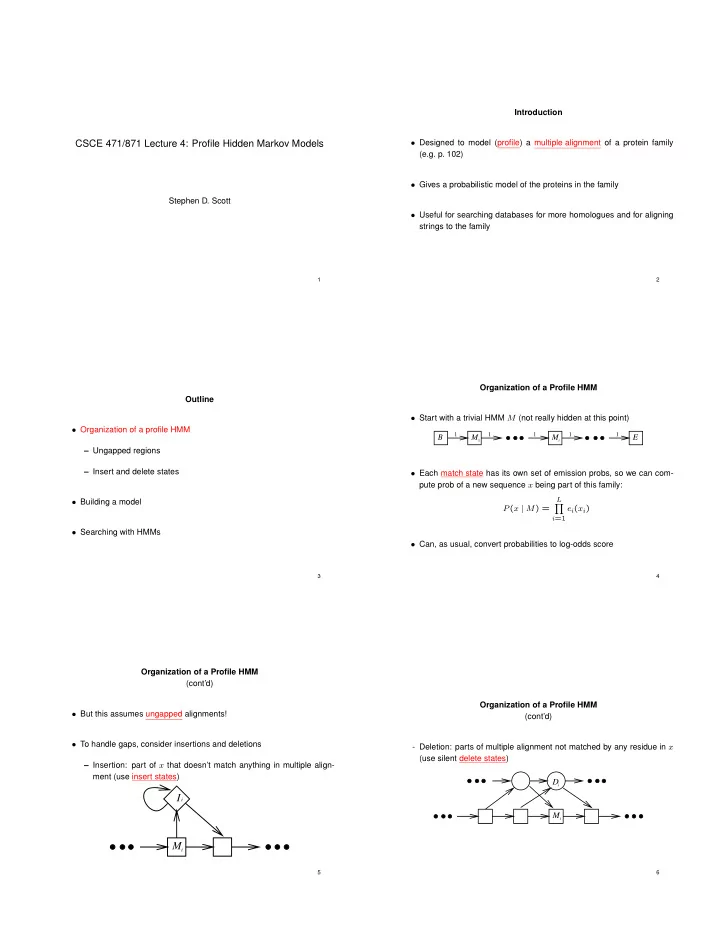
Organization of a Profile HMM
- Start with a trivial HMM M (not really hidden at this point)
B
1
M1
1
M E
i
1 1 1
- Each match state has its own set of emission probs, so we can com-
pute prob of a new sequence x being part of this family: P(x | M) =
L Y i=1
ei(xi)
- Can, as usual, convert probabilities to log-odds score
4
Organization of a Profile HMM (cont’d)
- But this assumes ungapped alignments!
- To handle gaps, consider insertions and deletions
– Insertion: part of x that doesn’t match anything in multiple align- ment (use insert states)
Mi
i
I
5
Organization of a Profile HMM (cont’d)
- Deletion: parts of multiple alignment not matched by any residue in x
(use silent delete states) Mi D
i
6