I ntroduction / Standard digital control loop Actuator Physical - - PowerPoint PPT Presentation

i ntroduction
SMART_READER_LITE
LIVE PREVIEW

I ntroduction / Standard digital control loop Actuator Physical - - PowerPoint PPT Presentation

I ntroduction / Standard digital control loop Actuator Physical System Sensor Resource-aware control Maurice Heemels Controller ! All control tasks executed periodically and triggered by time th oCPS PhD School on CPS,


slide-1
SLIDE 1

Where innovation starts

Resource-aware control

Maurice Heemels

th oCPS PhD School on CPS, June

/

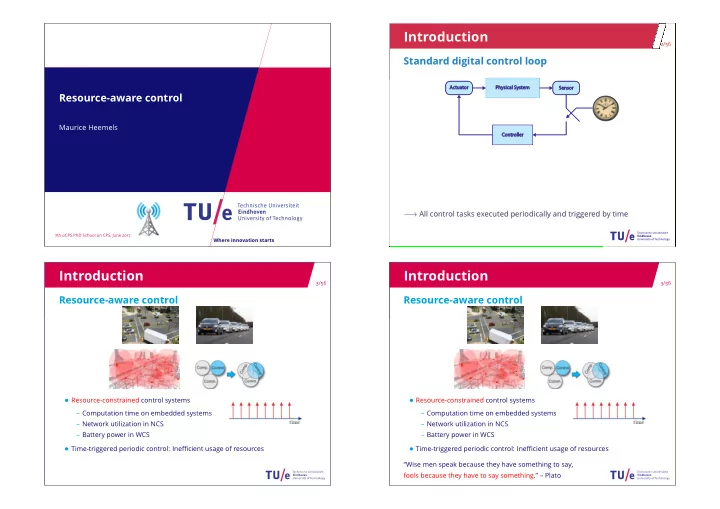
Standard digital control loop

Actuator Sensor Physical System Controller

  • ! All control tasks executed periodically and triggered by time

Introduction

/

Resource-aware control

  • Resource-constrained control systems

– Computation time on embedded systems – Network utilization in NCS – Battery power in WCS

  • Time-triggered periodic control: Inecient usage of resources

Introduction

/

Resource-aware control

  • Resource-constrained control systems

– Computation time on embedded systems – Network utilization in NCS – Battery power in WCS

  • Time-triggered periodic control: Inecient usage of resources

“Wise men speak because they have something to say, fools because they have to say something.” – Plato

Introduction

slide-2
SLIDE 2

/

Resource-aware control

  • Paradigm shift: Periodic control

! Aperiodic control

  • Only act when needed: bringing feedback in resource utilization

Actuator Sensor Physical System Controller

  • !

Actuator Sensor Physical System Controller

Introduction

/

Resource-aware control

  • Paradigm shift: Periodic control

! Aperiodic control

  • Only act when needed: bringing feedback in resource utilization

Actuator Sensor Physical System Controller

  • !

Actuator Sensor Physical System Controller

“Wise men speak because they have something to say, fools because they have to say something.” – Plato

Introduction

/

Paradigm shift: Periodic control

! Aperiodic control

  • Event-triggered control:

u(t) = K(x(tk)), when t 2 [tk, tk+1) tk+1 = inf{t > tk | C(x(t), x(tk)) > 0}

Actuator Sensor Physical System Controller

[] Arzen, IFAC WC’ [] Astrom & Bernhardsson, IFAC WC’ [] Heemels et al, CEP’

Introduction

/

Paradigm shift: Periodic control

! Aperiodic control

  • Event-triggered control:

u(t) = K(x(tk)), when t 2 [tk, tk+1) tk+1 = inf{t > tk | C(x(t), x(tk)) > 0}

Actuator Sensor Physical System Controller

  • Example event-triggering condition

C(x(t), x(tk)) > 0 , kx(t) x(tk) |{z}

ˆ x(t)

k >

Introduction

slide-3
SLIDE 3

/

Paradigm shift: Periodic control

! Aperiodic control

  • Event-triggered control: reactive

u(t) = K(x(tk)), when t 2 [tk, tk+1) tk+1 = inf{t > tk | C(x(t), x(tk)) > 0}

  • Self-triggered control: proactive

u(t) = K(x(tk)), when t 2 [tk, tk+1) tk+1 = tk + M(x(tk))

Introduction

/

  • Basic setup state-feedback ETC: kx(t) x(tk)k > kx(t)k
  • Hybrid systems
  • Challenges

– Performance/Robustness w.r.t. disturbances & Zeno-freeness – Output-based (& Decentralized)

  • Alternative event-triggered controllers

– Relative, absolute and mixed event generators – Periodic event-triggered control – Time regularisation – Dynamic event generators

  • Application to vehicle platooning
  • Conclusions & What’s next?

(Dessert?)

Outline

/

  • Linear system

˙ x(t) = Ax(t) + Bu(t)

  • Linear state feedback

u(t) = Kx(t), t 2 R>0

Actuator Sensor Physical System Controller

Basic ETC setup

/

  • Linear system

˙ x(t) = Ax(t) + Bu(t)

  • Linear state feedback

u(t) = Kx(t), t 2 R>0

Actuator Sensor Physical System Controller

  • Ideal loop: ˙

x(t) = (A + BK)x(t) A + BK Hurwitz

Basic ETC setup

slide-4
SLIDE 4

/

  • Linear system

˙ x(t) = Ax(t) + Bu(t)

  • Linear state feedback

u(t) = Kx(t), t 2 R>0

Actuator Sensor Physical System Controller

  • Ideal loop: ˙

x(t) = (A + BK)x(t)

  • Sampled-data control with execution times tk, k 2 N (ZOH)

u(t) = Kˆ x(t) = Kx(tk), t 2 [tk, tk+1)

[] Tabuada, Event-triggered real-time scheduling of stabilizing control tasks, TAC

Basic ETC setup

/

  • Linear system

˙ x(t) = Ax(t) + Bu(t)

  • Linear state feedback

u(t) = Kx(t), t 2 R>0

Actuator Sensor Physical System Controller

  • Ideal loop: ˙

x(t) = (A + BK)x(t)

  • Sampled-data control with execution times tk, k 2 N (ZOH)

u(t) = Kˆ x(t) = Kx(tk), t 2 [tk, tk+1)

  • Perturbation perspective: implementation-induced error

e(t) = x(tk) x(t) for t 2 [tk, tk+1) ˙ x(t) = Ax(t) + BKx(tk) = (A + BK)x(t) + BKe(t)

[] Tabuada, Event-triggered real-time scheduling of stabilizing control tasks, TAC

Basic ETC setup

/

  • Perturbation perspective:

˙ x(t) = Ax(t) + BKx(tk) = (A + BK)x(t) + BKe(t)

  • Since A + BK Hurwitz, quadratic Lyapunov function V (x) = x>Px s.t.

d dtV 6 a2kx(t)k2 + ke(t)k2

Basic ETC setup

/

  • Perturbation perspective:

˙ x(t) = Ax(t) + BKx(tk) = (A + BK)x(t) + BKe(t)

  • Since A + BK Hurwitz, quadratic Lyapunov function V (x) = x>Px s.t.

d dtV 6 a2kx(t)k2 + ke(t)k2

  • Crux: Guarantee ke(t)k 6 ⇢a · kx(t)k with 0 < ⇢ < 1 s.t.

d dtV 6 a2kx(t)k2 + ke(t)k2 6 (1 ⇢2)a2kx(t)k2

  • Guarantee for Global Exponential Stability

tk+1 = inf{t > tk | k x(tk) x(t)

| {z }

=e(t)

k > ⇢a · kx(t)k}

Basic ETC setup

slide-5
SLIDE 5

/

  • Summary of event-triggered setup:

– Linear system

˙ x(t) = Ax(t) + Bu(t)

– Execution times tk, k 2 N

tk+1 = inf{t > tk | kx(tk) x(t)k > ⇢a · kx(t)k}

– Control law:

u(t) = Kx(tk), t 2 [tk, tk+1)

  • Global exponential stability (GES)

Event-triggered control

/

  • Summary of event-triggered setup:

– Linear system

˙ x(t) = Ax(t) + Bu(t)

– Execution times tk, k 2 N

tk+1 = inf{t > tk | kx(tk) x(t)k > ⇢a · kx(t)k}

– Control law:

u(t) = Kx(tk), t 2 [tk, tk+1)

  • Global exponential stability (GES)
  • Question: Which important issue should we still verify?

Event-triggered control

/

  • Linear system

˙ x(t) = Ax(t) + Bu(t)

  • Linear state feedback (ZOH)

u(t) = Kx(tk), t 2 [tk, tk+1)

Actuator Sensor Physical System Controller

  • Execution times: tk+1 = inf{t > tk | k x(tk) x(t)

| {z }

=e(t)

k > kx(t)k}

  • Properties established in []:

– Global exponential stability (GES) when su. small – Zeno-free: Global positive lower bound on minimal inter-event time (MIET)

inf{tk+1 tk | k 2 N} > ⌧min > 0

[] Tabuada, Event-triggered real-time scheduling of stabilizing control tasks, TAC

Basic ETC setup

/

  • Linear system

˙ x(t) = Ax(t) + Bu(t)

  • Linear state feedback (ZOH)

u(t) = Kx(tk), t 2 [tk, tk+1)

Actuator Sensor Physical System Controller

  • Execution times: tk+1 = inf{t > tk | k x(tk) x(t)

| {z }

=e(t)

k > kx(t)k}

  • Properties established in []:

– Global exponential stability (GES) when su. small – Global positive lower bound on minimal inter-event time (MIET)

inf{tk+1 tk | k 2 N} > ⌧min > 0

  • Improved designs for GES/L1-gain via hybrid system analysis []

[] Tabuada, Event-triggered real-time scheduling of stabilizing control tasks, TAC [] Donkers, Heemels, Output-Based Event-Triggered Control with Guaranteed L∞-gain ..., TAC

Basic ETC setup

slide-6
SLIDE 6

/

  • Perturbation perspective:

˙ x(t) = Ax(t) + BKx(tk) = (A + BK)x(t) + BKe(t)

  • Execution times tk, k 2 N

tk+1 = inf{t > tk | k x(tk) x(t)

| {z }

=e(t)

k > kx(t)k}

Hybrid systems (side trip)

/

  • Perturbation perspective:

˙ x(t) = Ax(t) + BKx(tk) = (A + BK)x(t) + BKe(t)

  • Execution times tk, k 2 N

tk+1 = inf{t > tk | k x(tk) x(t)

| {z }

=e(t)

k > kx(t)k}

  • Hybrid system perspective [,] based on jump-ow models []:

d dt

x

e

  • =

 (A + BK)x + BKe

(A + BK)x BKe

  • ,

when kek2 6 2kxk2

x+

e+

  • =

x

  • ,

when kek2 > 2kxk2

[] Donkers, Heemels, Output-Based Event-Triggered Control ..., TAC & CDC [] Postoyan, Anta, Nesic, Tabuada, A unifying Lyapunov-based framework ..., CDC-ECC [] Goebel, Sanfelice, Teel, Hybrid Dynamical Systems, Princeton, .

Hybrid systems (side trip)

/

Hybrid system perspective (side trip)

d dt

x

e

  • =

 (A + BK)x + BKe

(A + BK)x BKe

  • when kek2 6 2kxk2

x+

e+

  • =

x

  • when kek2 > 2kxk2
  • r compactly with ⇠ =

x

e

  • (

˙ ⇠ = Φ⇠, when ⇠>Q⇠ 6 0 ⇠+ = J⇠, when ⇠>Q⇠ > 0

ETC based on feedback

/

Hybrid system perspective (side trip)

˙ ⇠ = Φ⇠ when ⇠>Q⇠ 6 0 ⇠+ = J⇠

when ⇠>Q⇠ > 0

[] Donkers, Heemels, Output-based event-triggered control with guaranteed L∞-gain, TAC & CDC [] Goebel, Sanfelice, Teel, Hybrid Dynamical Systems: Modeling, Stability and Robustness, Princeton, .

ETC based on feedback

slide-7
SLIDE 7

/

Hybrid system perspective (side trip)

˙ ⇠ = Φ⇠ when ⇠>Q⇠ 6 0 ⇠+ = J⇠

when ⇠>Q⇠ > 0

  • Stability analysis using hybrid tools [,]: V (⇠) = ⇠>P⇠

– d

dtV (⇠) < 0 when ⇠>Q⇠ 6 0

– V (J⇠) 6 V (⇠) when ⇠>Q⇠ > 0

[] Donkers, Heemels, Output-based event-triggered control with guaranteed L∞-gain, TAC & CDC [] Goebel, Sanfelice, Teel, Hybrid Dynamical Systems: Modeling, Stability and Robustness, Princeton, .

ETC based on feedback

/

Hybrid system perspective (side trip)

˙ ⇠ = Φ⇠ when ⇠>Q⇠ 6 0 ⇠+ = J⇠

when ⇠>Q⇠ > 0

  • Stability analysis using hybrid tools [,]: V (⇠) = ⇠>P⇠

– d

dtV (⇠) < 0 when ⇠>Q⇠ 6 0

– V (J⇠) 6 V (⇠) when ⇠>Q⇠ > 0

  • Linear matrix inequalities: if there are ↵, > 0 s.t.

– Φ>P + PΦ ↵Q 0 – J>PJ P + Q 0

  • Guarantee for GES (extended ideas apply for L1-gains)
  • Never more conservative than perturbation approach []

[] Donkers, Heemels, Output-based event-triggered control with guaranteed L∞-gain, TAC & CDC [] Goebel, Sanfelice, Teel, Hybrid Dynamical Systems: Modeling, Stability and Robustness, Princeton, .

ETC based on feedback

/

Example : State feedback control

  • Consider ˙

x = h

1 2 3

i x + h

1

i u and u(t) = [1

4]x(tk)

  • TTC:

tk = k · 0.025

  • ETC:

tk = t ( ) ke(t)k > 0.05kx(t)k

Illustrative Example

/

Example : State feedback control

  • Consider ˙

x = h

1 2 3

i x + h

1

i u and u(t) = [1

4]x(tk)

  • TTC:

tk = k · 0.025

  • ETC:

tk = t ( ) ke(t)k > 0.05kx(t)k

MIET = .

2 4 6 8 10 12 14 0.5 1 1.5 time t kx(t)k TTC 2 4 6 8 10 12 14 10−4 10−3 10−2 10−1 100 time t inter-event time τi TTC

Illustrative Example

slide-8
SLIDE 8

/

Example : State feedback control

  • Consider ˙

x = h

1 2 3

i x + h

1

i u and u(t) = [1

4]x(tk)

  • TTC:

tk = k · 0.025

  • ETC:

tk = t ( ) ke(t)k > 0.05kx(t)k

MIET = .

2 4 6 8 10 12 14 0.5 1 1.5 time t kx(t)k TTC ETC 2 4 6 8 10 12 14 10−4 10−3 10−2 10−1 100 time t inter-event time τi TTC

Illustrative Example

/

Example : State feedback control

  • Consider ˙

x = h

1 2 3

i x + h

1

i u and u(t) = [1

4]x(tk)

  • TTC:

tk = k · 0.025

  • ETC:

tk = t ( ) ke(t)k > 0.05kx(t)k

MIET = .

2 4 6 8 10 12 14 0.5 1 1.5 time t kx(t)k TTC ETC 2 4 6 8 10 12 14 10−4 10−3 10−2 10−1 100 time t inter-event time τi TTC ETC

Illustrative Example

/

Example : State feedback control

  • Consider ˙

x = h

1 2 3

i x + h

1

i u and u(t) = [1

4]x(tk)

  • TTC:

tk = k · 0.025

  • ETC:

tk = t ( ) ke(t)k > 0.05kx(t)k

MIET = .

2 4 6 8 10 12 14 0.5 1 1.5 time t kx(t)k TTC ETC 2 4 6 8 10 12 14 200 400 600 time t number of events TTC ETC

Illustrative Example

/

Example : Comparison P and HS approach

  • Consider ˙

x =

h 0

1 2 3

i

x +

h0

1

i

u and u(t) = [1

4]x(tk)

  • Example taken from []
  • We look for largest 2 giving GES: kek2 6 2kxk2

[]

2

MIET P: Results from [] . . P: By minimising the L2-gain . . Hybrid System . .

[] Tabuada, TAC ’ [] Donkers, Heemels, CDC & TAC

Illustrative Examples

slide-9
SLIDE 9

/

Example : Comparison P and HS approach

  • Consider ˙

x =

h 0

1 2 3

i

x +

h0

1

i

u and u(t) = [1

4]x(tk)

  • Example taken from []
  • We look for largest 2 giving GES: kek2 6 2kxk2

[]

2

MIET P: Results from [] . . P: By minimising the L2-gain . . Hybrid System . .

  • PS: via minimising L2-gain: maximise a (note = ⇢a)

˙ V 6 a2kx(t)k2 + ke(t)k2

for ˙

x = (A + BK)x + BKe

  • ETM:

tk+1 = inf{t > tk | k x(tk) x(t)

| {z }

=e(t)

k > ⇢a · kx(t)k}

[] Tabuada, TAC ’ [] Donkers, Heemels, CDC & TAC

Illustrative Examples

/

  • Linear system

˙ x(t) = Ax(t) + Bu(t)

  • Linear state feedback (ZOH)

u(t) = Kx(tk), t 2 [tk, tk+1)

Actuator Sensor Physical System Controller

  • Execution times: tk+1 = inf{t > tk | k x(tk) x(t)

| {z }

=e(t)

k > kx(t)k}

  • Properties established in []:

– Global exponential stability (GES) when su. small – Global positive lower bound on minimal inter-event time (MIET)

inf{tk+1 tk | k 2 N} > ⌧min > 0

  • Improved designs for GES/L1-gain via hybrid system analysis []

[] Tabuada, Event-triggered real-time scheduling of stabilizing control tasks, TAC [] Donkers, Heemels, Output-Based Event-Triggered Control with Guaranteed L∞-gain ..., TAC

Summary

/

  • Performance/Robustness w.r.t. disturbances
  • Output-based (& Decentralized)

Challenges

/

Illustrative example

  • Consider ˙

x = h

1 2 3

i x + h

1

i u and u(t) = [1

4]x(tk)

  • TTC:

tk = k · 0.025

  • ETC:

tk = t ( ) ke(t)k > 0.05kx(t)k

2 4 6 8 10 12 14 0.5 1 1.5 time t kx(t)k TTC ETC 2 4 6 8 10 12 14 10−4 10−3 10−2 10−1 100 time t inter-event time τi TTC ETC

Borgers, Heemels, Event-Separation Properties of Event-Triggered Control Systems, TAC

Disturbances in ETC

slide-10
SLIDE 10

/

Illustrative example

  • Consider ˙

x = h

1 2 3

i x + h

1

i u + w and u(t) = [1

4]x(tk)

  • TTC:

tk = k · 0.025

  • ETC:

tk = t ( ) ke(t)k > 0.05kx(t)k

2 4 6 8 10 12 14 0.5 1 1.5 time t kx(t)k TTC ETC 2 4 6 8 10 12 14 10−4 10−3 10−2 10−1 100 time t inter-event time τi TTC ETC

Borgers, Heemels, Event-Separation Properties of Event-Triggered Control Systems, TAC

Disturbances in ETC

/

Illustrative example

  • Consider ˙

x = h

1 2 3

i x + h

1

i u + w and u(t) = [1

4]x(tk)

  • TTC:

tk = k · 0.025

  • ETC:

tk = t ( ) ke(t)k > 0.05kx(t)k

2 4 6 8 10 12 14 0.5 1 1.5 time t kx(t)k TTC ETC 2 4 6 8 10 12 14 10−4 10−3 10−2 10−1 100 time t inter-event time τi TTC ETC

Borgers, Heemels, Event-Separation Properties of Event-Triggered Control Systems, TAC

Disturbances in ETC

/

Illustrative example

  • Consider ˙

x = h

1 2 3

i x + h

1

i u + w and u(t) = [1

4]x(tk)

  • TTC:

tk = k · 0.025

  • ETC:

tk = t ( ) ke(t)k > 0.05kx(t)k

2 4 6 8 10 12 14 0.5 1 1.5 time t kx(t)k TTC ETC 2 4 6 8 10 12 14 10−4 10−3 10−2 10−1 100 time t inter-event time τi TTC ETC

Borgers, Heemels, Event-Separation Properties of Event-Triggered Control Systems, TAC

Disturbances in ETC

/

Illustrative example

Actuator Sensor Physical System Controller

  • Consider

( ˙ xp = h

1 1 10 1

i xp + h

1 1

i u y = [1

0 ]xp

u(t) = 2y(tk)

  • ETM: ky(t) y(tk)k2 > 2ky(t)k2
  • Parameter: 2 = 0.5

Output-based ETC

slide-11
SLIDE 11

/

Illustrative example

  • Minimal inter-event time (MIET) is zero! (Zeno behavior)

Donkers, Heemels, Output-Based Event-Triggered Control with Guaranteed L∞-gain and Improved and Decentralised Event-Triggering, TAC

Output-based ETC

/

  • Relative: ky ˆ

yk > kyk

[]

  • Absolute: ky ˆ

yk >

[-]

  • Mixed: ky ˆ

yk > kyk +

[]

[] Tabuada, Event-triggered real-time scheduling of stabilizing control tasks, TAC [] Yook, Tilbury, Soparkar, Trading computation for bandwidth: Reducing communication in distributed control systems using state estimators, TCST [] Miskowicz, Send-on-delta concept: An event-based data-reporting strategy, Sensors, [] Lunze and Lehmann, A state-feedback approach to event-based control, Automatica, [] Donkers, Heemels, Output-Based Event-Triggered Control with Guaranteed L∞-gain ..., TAC

Event-triggered control schemes

/

Inverted pendulum

Movie ETC in action

/

Event-separation properties / Zeno-freeness

  • Consider ˙

x = Ax + Bu + w and u(t) = Kx(tk) = K(x(t) + e(t))

  • Execution times:

tk+1 = inf{t > tk | k x(tk) x(t) | {z }

=e(t)

k > kx(t)k + } ! MIET ⌧(x0, w) dependent on x0 and w: ⌧(x0, w) = infk2N (tk+1 tk)

Disturbances in ETC

slide-12
SLIDE 12

/

Event-separation properties / Zeno-freeness

  • Consider ˙

x = Ax + Bu + w and u(t) = Kx(tk) = K(x(t) + e(t))

  • Execution times:

tk+1 = inf{t > tk | k x(tk) x(t) | {z }

=e(t)

k > kx(t)k + } ! MIET ⌧(x0, w) dependent on x0 and w: ⌧(x0, w) = infk2N (tk+1 tk)

  • Event-separation properties (nominal)

– Global ESP:

infx02Rn ⌧(x0, 0) > 0

– Semi-global ESP: for compact X0 ⇢ Rn: infx02X0 ⌧(x0, 0) > 0 – Local ESP: for each x0 2 Rn: ⌧(x0, 0) > 0

Borgers, Heemels, Event-Separation Properties of Event-Triggered Control Systems, TAC

Disturbances in ETC

/

Event-separation properties / Zeno-freeness

  • Consider ˙

x = Ax + Bu + w and u(t) = Kx(tk) = K(x(t) + e(t))

  • Execution times:

tk+1 = inf{t > tk | k x(tk) x(t) | {z }

=e(t)

k > kx(t)k + } ! MIET ⌧(x0, w) dependent on x0 and w: ⌧(x0, w) = infk2N (tk+1 tk)

  • Event-separation properties (robust): there is " > 0

– Robust global:

infx02Rn, kwk∞<" ⌧(x0, w) > 0

– Robust semi-global: compact X0: infx02X0, kwk∞<" ⌧(x0, w)> 0 – Robust local: for each x0 2 Rn and kwk1 < ": ⌧(x0, w) > 0

Borgers, Heemels, Event-Separation Properties of Event-Triggered Control Systems, TAC

Disturbances in ETC

/

State-feedback case

ETM robust global global robust semi-global semi-global robust local local relative

⇥ X ⇥ X ⇥ X

absolute

⇥ ⇥ X X X X

mixed

X X X X X X

Overview

/

State-feedback case

ETM robust global global robust semi-global semi-global robust local local relative

⇥ X ⇥ X ⇥ X

absolute

⇥ ⇥ X X X X

mixed

X X X X X X

Output-feedback case

ETM robust global global robust semi-global semi-global robust local local relative

⇥ ⇥ ⇥ ⇥ ⇥ ⇥

absolute

⇥ ⇥ X X X X

mixed

⇥ ⇥ X X X X

  • Relative triggering fragile. Zero robustness
  • Mixed or absolute eective (semi-global)
  • However, only practical stability / ultimate boundedness (no GAS)

Borgers, Heemels, Event-Separation Properties of Event-Triggered Control Systems, TAC

Overview

slide-13
SLIDE 13

/

State-feedback case

ETM robust global global robust semi-global semi-global robust local local relative

⇥ X ⇥ X ⇥ X

absolute

⇥ ⇥ X X X X

mixed

X X X X X X

Output-feedback case

ETM robust global global robust semi-global semi-global robust local local relative

⇥ ⇥ ⇥ ⇥ ⇥ ⇥

absolute

⇥ ⇥ X X X X

mixed

⇥ ⇥ X X X X

  • Relative triggering fragile. Zero robustness
  • Mixed or absolute eective (semi-global)
  • However, only practical stability / ultimate boundedness (no GAS)
  • Challenge: What about robust global ESP and GAS/L2-gains?

Borgers, Heemels, Event-Separation Properties of Event-Triggered Control Systems, TAC

Overview

/

P ETM C ZOH u w z x ˆ x

  • Guaranteed control performance (L2gain) from disturbance w to
  • utput z = q(x, w):

kzkL2 6 (|⇠0|) + kwkL2 with kzkL2 = sZ 1 kz(t)k2dt

  • Global asymptotic stability (GAS) in absence of disturbances
  • Robust positive “minimal inter-event time” (⌧miet)
  • Reduced communication w.r.t. time-triggered control

Objectives

/

Cooperative Adaptive Cruise Control

WiFi-p: Feedforward Radar: Feedback

  • String stability: disturbance attenuation along the vehicle string 6 1

kzkL2 6 (|⇠0|) + kwkL2 with kzkL2 = sZ 1 kz(t)k2dt

  • Communication resources limited ! event-triggered communication

Motivation

/

String unstable (no communication)

5 10 15 20 25 30 35 40 20 25 30 35 Time [s] Velocity [m/s] 5 10 15 20 25 30 35 40 −1 1 2 Time [s] Desired acceleration [m/s2]

String stable (with communication)

5 10 15 20 25 30 35 40 20 25 30 35 Time [s] Velocity [m/s] 5 10 15 20 25 30 35 40 −1 1 2 Time [s] Desired acceleration [m/s2]

String (in)stability

slide-14
SLIDE 14

/

Time regularisation:

  • Periodic Event-Triggered Control (PETC) [-,]

tk+1 = inf{t > tk | ky(t) ˆ y(t)k > ky(t)k ^ t = kh, k 2 N}

  • Enforcing minimal inter-event time [,-]

tk+1 = inf{t > tk+T | ky(t) ˆ y(t)k > ky(t)k}

[] Arzen, A simple event-based PID controller, IFAC [] Heemels, Sandee, van den Bosch, Analysis of event-driven controllers for linear systems, IJC [] Heemels, Donkers, Teel, Periodic Event-Triggered Control for Linear Systems, TAC [] Henningsson, Johannesson, Cervin, Sporadic event-based control of rst-order linear stochastic .., Aut. [] Tallapragada, Chopra, Event-triggered dynamic output feedback control for LTI systems, CDC [] Tallapragada, Chopra, Event-triggered decentralized dynamic output .. LTI systems, NECSYS [] Borgers, Dolk, Heemels, Riccati-based design of ETCs for Linear Systems ... , HSCC + TAC [] Dolk, Borgers, Heemels, Output-based and Decentralized Dynamic ETC ... , TAC

Event-triggered control schemes

/

  • Periodic Event-Triggered Control (PETC)

tk+1 = inf{t > tk | ky ˆ yk > kyk ^ t = kh, k 2 N}

  • Enforcing minimal inter-event time

tk+1 = inf{t > tk+T | ky ˆ yk > kyk}

Output-feedback case

ETM robust global global robust semi-global semi-global robust local local relative

⇥ ⇥ ⇥ ⇥ ⇥ ⇥

absolute

⇥ ⇥ X X X X

mixed

⇥ ⇥ X X X X

time-regu

X X X X X X

Time regularized ETC

/

  • Periodic Event-Triggered Control (PETC)

tk+1 = inf{t > tk | ky ˆ yk > kyk ^ t = kh, k 2 N}

  • Hybrid system analysis: GAS & nite L2-gains [,]
  • Implementation advantages:

– Guaranteed (reasonable) minimal inter-event time – Only time-periodic verication of event-triggering conditions – More in line with time-sliced architectures

[] Heemels, Donkers, Teel, Periodic Event-Triggered Control for Linear Systems, TAC [] Heemels, Donkers, Model-based Periodic Event-Triggered Control for Linear Systems, Automatica

PETC

/

Hybrid systems formulation

d dt  ⇠ ⌧

  • =

 A⇠ + Bw 1

  • , when ⌧ 2 [0, h],

 ⇠+ ⌧+

  • =

8 > > > < > > > :  J1⇠

  • ,

when ⇠>Q⇠ > 0, ⌧ = h

 J2⇠

  • ,

when ⇠>Q⇠ 6 0, ⌧ = h

z = C⇠ + Dw

PETC

slide-15
SLIDE 15

/

Hybrid systems formulation

d dt  ⇠ ⌧

  • =

 A⇠ + Bw 1

  • , when ⌧ 2 [0, h],

 ⇠+ ⌧+

  • =

8 > > > < > > > :  J1⇠

  • ,

when ⇠>Q⇠ > 0, ⌧ = h

 J2⇠

  • ,

when ⇠>Q⇠ 6 0, ⌧ = h

z = C⇠ + Dw

  • In case w = 0 and interested in stability only
  • Discretize at kh, k 2 N (just before jump) leading to discrete-time PWL system [,,]

⇠k+1 = ⇢ eAhJ1⇠k,

when ⇠>

k Q⇠k > 0

eAhJ2⇠k,

when ⇠>

k Q⇠k 6 0

[] Heemels, Donkers, Teel, Periodic Event-Triggered Control for Linear Systems, TAC [] Heemels, Donkers, Model-based Periodic Event-Triggered Control for Linear Systems, Automatica [] Heemels, Sandee, van den Bosch, Analysis of event-driven controllers for linear systems, IJC

PETC

/

Hybrid systems formulation

  • Including intersample-behavior, e.g., for L2-gain analysis

d dt  ⇠ ⌧

  • =

 A⇠ + Bw 1

  • , when ⌧ 2 [0, h],

 ⇠+ ⌧ +

  • =

8 > > > > > < > > > > > : " J1⇠ # ,

when ⇠>Q⇠ > 0, ⌧ = h

" J2⇠ # ,

when ⇠>Q⇠ 6 0, ⌧ = h

z = C⇠ + Dw

PETC

/

Hybrid systems formulation

d dt  ⇠ ⌧

  • =

 A⇠ + Bw 1

  • , when ⌧ 2 [0, h]

 ⇠+ ⌧ +

  • =

 (⇠)

  • ,

when ⌧ = h

z = C⇠ + Dw

PETC

/

Hybrid systems formulation

d dt  ⇠ ⌧

  • =

 A⇠ + Bw 1

  • , when ⌧ 2 [0, h]

 ⇠+ ⌧ +

  • =

 (⇠)

  • ,

when ⌧ = h

z = C⇠ + Dw

Other applications for this framework:

  • Reset controllers with testing for reset only at kh, k 2 N []
  • Linear systems/controllers with one sensor/actuator node transmitting at kh,

k 2 N determined by quadratic protocol []

  • Linear systems controlled by arbitrarily switching sampled-data controllers (in

this case setvalued) []

  • Linear systems controlled by saturating sampled-data controllers []

[] Heemels, Dullerud, Teel, L2-gain Analysis for a Class of Hybrid Systems with Applications to Reset and Event-triggered Control: A Lifting Approach, TAC’ [] CDC’ version of above

PETC

slide-16
SLIDE 16

/

Hybrid systems formulation

d dt  ⇠ ⌧

  • =

 A⇠ + Bw 1

  • , when ⌧ 2 [0, h]

 ⇠+ ⌧ +

  • =

 (⇠)

  • ,

when ⌧ = h

z = C⇠ + Dw

PETC

/

Hybrid systems formulation

d dt  ⇠ ⌧

  • =

 A⇠ + Bw 1

  • , when ⌧ 2 [0, h]

 ⇠+ ⌧ +

  • =

 (⇠)

  • ,

when ⌧ = h

z = C⇠ + Dw

  • L2-contractive: There are 0 2 [0, 1) and a K-function s.t.

kzkL2 6 (|⇠0|) + 0kwkL2 with kzkL2 = sZ 1 kz(t)k2dt

PETC

/

d dt  ⇠ ⌧

  • =

 A⇠ + Bw 1

  • , when ⌧ 2 [0, h]

 ⇠+ ⌧ +

  • =

 (⇠)

  • ,

when ⌧ = h

z = C⇠ + Dw ¯ ⇠k+1 = Ad(¯ ⇠k) + Bdvk rk = Cd(¯ ⇠k)

Main result: The hybrid system is internally stable and L2-contractive i the discrete-time nonlinear system is internally stable and `2-contractive.

[] Heemels, Dullerud, Teel, L2-gain Analysis for a Class of Hybrid Systems with Applications to Reset and Event-triggered Control: A Lifting Approach, TAC’

Lifting-based approach

/

d dt  ⇠ ⌧

  • =

 A⇠ + Bw 1

  • , when ⌧ 2 [0, h]

 ⇠+ ⌧ +

  • =

 (⇠)

  • ,

when ⌧ = h

z = C⇠ + Dw ¯ ⇠k+1 = Ad(¯ ⇠k) + Bdvk rk = Cd(¯ ⇠k)

Main result: The hybrid system is internally stable and L2-contractive i the discrete-time nonlinear system is internally stable and `2-contractive.

  • `2-contractive: there is 0 2 [0, 1) s.t.

krk`2 6 (|¯ ⇠0|) + 0kvk`2 with krk2

`2 = 1

X

k=0

|rk|2

[] Heemels, Dullerud, Teel, L2-gain Analysis for a Class of Hybrid Systems with Applications to Reset and Event-triggered Control: A Lifting Approach, TAC’

Lifting-based approach

slide-17
SLIDE 17

/

d dt  ⇠ ⌧

  • =

 A⇠ + Bw 1

  • , when ⌧ 2 [0, h]

 ⇠+ ⌧ +

  • =

 (⇠)

  • ,

when ⌧ = h

z = C⇠ + Dw ¯ ⇠k+1 = Ad(¯ ⇠k) + Bdvk rk = Cd(¯ ⇠k)

Main result: The hybrid system is internally stable and L2-contractive i the discrete-time nonlinear system is internally stable and `2-contractive.

  • Lifting with veriable conditions without linearity
  • For PETC piecewise linear system

! contractivity/stability analysis via

LMIs using piecewise quadratic Lyapunov functions

[] Heemels, Dullerud, Teel, L2-gain Analysis for a Class of Hybrid Systems with Applications to Reset and Event-triggered Control: A Lifting Approach, TAC’

Lifting-based approach

/

  • Linear system

˙ x(t) = Ax(t) + Bu(t)

  • When? Execution times tk, k 2 N

tk+1 = tk + M(xk)

with M : Rn ! {h1, h2, . . . , hN} ⇢ R>0

  • What? Control law:

u(t) = Kx(tk), t 2 [tk, tk+1)

Self-triggered control (Side trip)

/

d dt 2 4 ⇠ ⌧ ` 3 5 = 2 4 A⇠ + Bw 1 3 5 ,

when ⌧ 2 [0, h`]

2 4 ⇠+ ⌧ + `+ 3 5 2 (⇠) ⇥ {0} ⇥ L(`, ⇠),

when ⌧ = h`

z = C⇠ + Dw

  • Self-triggered control: Select on event time tk the next event time in a

state-dependent fashion:

tk+1 = tk + h`+ with `+ 2 L(`, ⇠)

Strijbosch, Dullerud, Teel, Heemels, CDC ??

Extensions

/

P ETM C ZOH ua = u w x xc

P : ˙ x =  0 1 2 3

  • x +

 1

  • u + w

C : u = ⇥ 1 4 ⇤ x(tk)

  • Periodic Event-Triggered Control (PETC)

tk+1 = inf{t > tk | kx(tk) x(t)k > kx(t)k ^ t = kh, k 2 N}

  • Enforcing minimal inter-event time

tk+1 = inf{t > tk+T | kx(tk) x(t)k > kx(t)k}

2 4 6 8 10 12 14 16 18 20 0.5 1 1.5 time t kx(t)k time reg. PETC 2 4 6 8 10 12 14 16 18 20 10−2 10−1 100 time t inter-event time τ k time reg. PETC

Time regularisation: Example

slide-18
SLIDE 18

/

  • Static event generator: tk+1 := inf{t > tk + T | C(x(t), e(t)) > 0}

Dynamic event generator [,,]

˙ ⌘ = Ψ(x, e, ⌘) tk+1 := inf{t > tk + T | ⌘(t) < 0}

[] Postoyan et al., “Event-triggered and self-triggered stabilization ...,” CDC [] Girard, “Dynamic triggering mechanisms for event-triggered control,” TAC [] Dolk, Borgers, Heemels, Output-based and Decentralized Dynamic ETC ... , CDC+ TAC [] Borgers, Dolk, Heemels, Riccati-based design of ETCs for Linear Systems ... , HSCC + TAC

Dynamic event-triggered control

/

  • Static event generator: tk+1 := inf{t > tk + T | C(x(t), e(t)) > 0}

Dynamic event generator [,,]

˙ ⌘ = Ψ(x, e, ⌘) tk+1 := inf{t > tk + T | ⌘(t) < 0}

  • How to nd Ψ and T ?

[] Postoyan et al., “Event-triggered and self-triggered stabilization ...,” CDC [] Girard, “Dynamic triggering mechanisms for event-triggered control,” TAC [] Dolk, Borgers, Heemels, Output-based and Decentralized Dynamic ETC ... , CDC+ TAC [] Borgers, Dolk, Heemels, Riccati-based design of ETCs for Linear Systems ... , HSCC + TAC

Dynamic event-triggered control

/

  • Perturbation perspective:

˙ x(t) = Ax(t) + BKx(tk) = (A + BK)x(t) + BKe(t)

  • Since A + BK Hurwitz, quadratic Lyapunov function V (x) = x>Px

d dtV 6 a2kx(t)k2 + ke(t)k2

  • Crux: Guarantee ke(t)k 6 ⇢a · kx(t)k with 0 < ⇢ < 1 s.t.

d dtV 6 a2kx(t)k2 + ke(t)k2 6 (1 ⇢2)a2kx(t)k2

  • Guarantee for Global Exponential Stability

tk+1 = inf{t > tk | k x(tk) x(t)

| {z }

=e(t)

k > ⇢a · kx(t)k}

  • Zeno-free: There is T > 0 such that tk+1 tk > T for all k 2 N.

Recap: Design relative triggering

/

  • Since A + BK Hurwitz, quadratic Lyapunov function V (x) = x>Px

d dtV 6 a2kx(t)k2 + ke(t)k2

Basic design dETM

slide-19
SLIDE 19

/

  • Since A + BK Hurwitz, quadratic Lyapunov function V (x) = x>Px

d dtV 6 a2kx(t)k2 + ke(t)k2

  • Now consider ˙

⌘ = Ψ(x, e, ⌘) and LF U(x, ⌘) = V (x) + ⌘ [] : d dtU 6 a2kxk2 + kek2 + Ψ

Basic design dETM

/

  • Since A + BK Hurwitz, quadratic Lyapunov function V (x) = x>Px

d dtV 6 a2kx(t)k2 + ke(t)k2

  • Now consider ˙

⌘ = Ψ(x, e, ⌘) and LF U(x, ⌘) = V (x) + ⌘ [] : d dtU 6 a2kxk2 + kek2 + Ψ

  • To get d

dtU 6 (1 ⇢2)a2kxk2 "⌘ for some " > 0 we require

a2kxk2 + kek2 + Ψ = (1 ⇢2)a2kxk2 "⌘

and thus ˙

⌘ = Ψ(x, e, ⌘) = ⇢2a2kxk2 "⌘ kek2

Basic design dETM

/

  • Since A + BK Hurwitz, quadratic Lyapunov function V (x) = x>Px

d dtV 6 a2kx(t)k2 + ke(t)k2

  • Now consider ˙

⌘ = Ψ(x, e, ⌘) and LF U(x, ⌘) = V (x) + ⌘ [] : d dtU 6 a2kxk2 + kek2 + Ψ

  • To get d

dtU 6 (1 ⇢2)a2kxk2 "⌘ for some " > 0 we require

a2kxk2 + kek2 + Ψ = (1 ⇢2)a2kxk2 "⌘

and thus ˙

⌘ = Ψ(x, e, ⌘) = ⇢2a2kxk2 "⌘ kek2

  • Now tk+1 := inf{t > tk + T | ⌘(t) < 0}, ⌘(0) = 0 and t0 = 0 :

– ⌘(t) > 0 for t 2 R>0 and thus U positive denite – d

dtU 6 (1 ⇢2)a2kxk2 "⌘ and thus GES

Basic design dETM

/

  • Since A + BK Hurwitz, quadratic Lyapunov function V (x) = x>Px

d dtV 6 a2kx(t)k2 + ke(t)k2

  • Now consider ˙

⌘ = Ψ(x, e, ⌘) and LF U(x, ⌘) = V (x) + ⌘ [] : d dtU 6 a2kxk2 + kek2 + Ψ

  • To get d

dtU 6 (1 ⇢2)a2kxk2 "⌘ for some " > 0 we require

a2kxk2 + kek2 + Ψ = (1 ⇢2)a2kxk2 "⌘

and thus ˙

⌘ = Ψ(x, e, ⌘) = ⇢2a2kxk2 "⌘ kek2

  • Now tk+1 := inf{t > tk + T | ⌘(t) < 0}, ⌘(0) = 0 and t0 = 0 :

– ⌘(t) > 0 for t 2 R>0 and thus U positive denite – d

dtU 6 (1 ⇢2)a2kxk2 "⌘ and thus GES

  • Never triggers before the static version!!

Basic design dETM

slide-20
SLIDE 20

/

  • Static event generator: tk+1 := inf{t > tk + T|C(x(t), e(t)) > 0}

Dynamic event generator [,,]

˙ ⌘ = Ψ(x, e, ⌘) tk+1 := inf{t > tk + T | ⌘(t) < 0}

  • [,] design for w = 0 (no disturbances)
  • Recently, [] new design methodology for output-based decentralized

triggering under disturbances (Lp-gain)

  • New “non-conservative” designs tailored for linear systems using Riccati-

based designs (output-based / disturbances (L2-gain)) []

[] Postoyan et al., “Event-triggered and self-triggered stabilization ...,” CDC [] Girard, “Dynamic triggering mechanisms for event-triggered control,” TAC [] Dolk, Borgers, Heemels, “Dynamic Event-triggered Control...,” CDC and TAC [] Borgers, Dolk, Heemels, Riccati-based design of ETCs for Linear Systems ... , HSCC + TAC

Dynamic event-triggered control

/

P ETM C ZOH u w z x ˆ x

P : ˙ x =  0 1 2 3

  • x +

 1

  • u + w

C : u = ⇥ 1 4 ⇤ x(tk)

Case study: L2-gain ✓ = 4 from input w to state x: T = 9.1 · 103

Dynamic ETC: Example

/

P ETM C ZOH u w z x ˆ x

P : ˙ x =  0 1 2 3

  • x +

 1

  • u + w

C : u = ⇥ 1 4 ⇤ x(tk)

Case study: L2-gain ✓ = 4 from input w to state x: T = 9.1 · 103

  • Dynamic event generator tk+1 := inf{t > tk + T | ⌘(t) < 0}
  • Static event generator: tk+1 := inf{t > tk + T | Ψ(x, e, ⌧, ⌘) < 0}

Dynamic ETC: Example

/

P ETM C ZOH u w z x ˆ x

P : ˙ x =  0 1 2 3

  • x +

 1

  • u + w

C : u = ⇥ 1 4 ⇤ x(tk)

Case study: L2-gain ✓ = 4 from input w to state x: T = 9.1 · 103

  • Dynamic event generator tk+1 := inf{t > tk + T | ⌘(t) < 0}
  • Static event generator: tk+1 := inf{t > tk + T | Ψ(x, e, ⌧, ⌘) < 0}

2 4 6 8 10 12 14 16 18 20 0.5 1 1.5 time t |x(t)| static ETM dynamic ETM 2 4 6 8 10 12 14 16 18 20 10−2 10−1 100 time t inter-event time τ k static dynamic

Dynamic ETC: Example

slide-21
SLIDE 21

/

1 2 3 4 5 6 7 8 ·10−2 2 4 6 8 10 τ mati / τ miet / τ avg L2-gain θ τmati τmiet τavg,static τavg,dynamic

Dynamic ETC: Example

/

Cooperative Adaptive Cruise Control

WiFi-p: Feedforward Radar: Feedback

  • String stability: disturbance attenuation along the vehicle string

– Lp-gain6 1

  • Communication resources limited ! event-triggered communication

Real-life application

/ /

  • Headway time: . seconds
  • MIET: . seconds
  • ! MOVIE

CACC

slide-22
SLIDE 22

/

CACC

/

CACC

/

−4 −2 2 ui(t) 10 20 velocity vi(t) 10 15 20 25 30 35 40 45 50 10−1 100 101 time t tk − tk−1 , car 1 , car 2 10 15 20 25 30 35 40 45 50 −1 1 time t d2(t) − dr,2(t) Time-triggered Control, Event-triggered Control

  • Similar behaviour as time-triggered communication
  • -% less communication

[] Dolk, Ploeg, Heemels, Event-triggered Control for String-Stable Vehicle Platooning, submitted IEEE Trans. ITS [HSCC’]

Event-triggered CACC

/

  • Event-triggered control: A new resource-aware control paradigm
  • Several ETC algorithms discussed with their own tools (hybrid)
  • Challenges

– Performance / Robustness w.r.t. disturbances – Output-based & decentralized event generators – Constrained systems (MPC) – Implementation and Applications – Better than periodic time-triggered control – Improved analysis and design tools: MIET, average inter-execution times,

Lp-gain, etc.

  • Many interesting practical and theoretical issues open in this appealing re-

search eld

“Wise men speak because they have something to say, fools because they have to say something.” – Plato

  • More info: http://www.heemels.tue.nl

Conclusions

slide-23
SLIDE 23

/

  • Collaborators

– Duarte Antunes, Mahmoud Abdelrahim, Behnam Asadi, Hadi Bal- aghi, Niek Borgers, Florian Brunner, Victor Dolk, Tijs Donkers, Tom Gommans, Stefan Heijmans, Heico Sandee, Nard Strijbosch, ... – Frank Allgöwer, Adolfo Anta, Jamal Daafouz, Geir Dullerud, Kalle Johansson, Dragan Nesic, Romain Postoyan, Paulo Tabuada, Andy Teel, Paul van den Bosch, ...

  • Financial support
  • More info: http://www.heemels.tue.nl

Acknowledgements

/

  • M. Abdelrahim, R. Postoyan, J. Daafouz and D. Nesic, Stabilization of nonlinear systems using event-triggered output

feedback controllers, IEEE Transactions on Automatic Control, (), -, .

  • Arzen, A simple event-based PID controller, IFAC World Congress, .
  • Astrom, Bernhardsson Comparison of periodic and event based sampling for rst order stochastic systems, IFAC World

Congress

  • D.P. Borgers and W.P.M.H. Heemels, Event-separation properties of event-triggered control systems, IEEE Transactions
  • n Automatic Control, (), p. -, .
  • D.P. Borgers, V.S. Dolk, W.P.M.H. Heemels, Riccati-based design of ETCs for Linear Systems ... , CDC, HSCC +

TAC.

  • V.S. Dolk, D.P. Borgers, W.P.M.H. Heemels, Dynamic Event-triggered Control: Tradeos Between Transmission Intervals

and Performance, IEEE Conference on Decision and Control (CDC), pp. -, .

  • V.S. Dolk, D.P. Borgers, W.P.M.H. Heemels, Output-based and Decentralized Dynamic Event-triggered Control with Guar-

anteed Lp-gain Performance and Zeno-freeness, IEEE Transactions on Automatic Control, .

  • M.C.F. Donkers and W.P.M.H. Heemels, Output-Based Event-Triggered Control with Guaranteed L∞-gain and Improved

and Decentralised Event-Triggering, IEEE Transactions on Automatic Control, (), p. -, .

  • M.C.F. Donkers and W.P.M.H. Heemels, Output-Based Event-Triggered Control with Guaranteed L∞-gain and Improved

Event-Triggering, IEEE Conference on Decision and Control (CDC) , Atlanta, USA, p. -.

  • A. Girard, Dynamic triggering mechanisms for event-triggered control, IEEE Transactions on Automatic Control, To ap-

pear, .

  • R. Goebel, R. Sanfelice, A. Teel, Hybrid Dynamical Systems, Princeton, .

Literature

/

  • W.P.M.H. Heemels, M.C.F. Donkers, Model-based periodic event-triggered control for linear systems, Automatica (),
  • pp. -, .
  • W.P.M.H. Heemels, M.C.F. Donkers, and A.R. Teel, Periodic Event-Triggered Control for Linear Systems, IEEE Transac-

tions on Automatic Control , (), p. -, .

  • W.P.M.H. Heemels, G. Dullerud, A.R. Teel, L-gain Analysis for a Class of Hybrid Systems with Applications to Reset and

Event-triggered Control: A Lifting Approach, IEEE Transactions on Automatic Control, (), p. -, ()

  • W.P.M.H. Heemels, R.J.A. Gorter, A. van Zijl, P.P.J. v.d. Bosch, S. Weiland, W.H.A. Hendrix, M.R. Vonder, Asynchronous

measurement and control: a case study on motor synchronisation, Control Engineering Practice, (), -, ()

  • W.P.M.H. Heemels, J.H. Sandee, P.P.J. van den Bosch, Analysis of event-driven controllers for linear systems, Interna-

tional Journal of Control, (), pp. - ().

  • Henningsson T, Johannesson E, Cervin A, Sporadic event-based control of rst-order linear stochastic systems, Automat-

ica , pp. -, .

  • M. Miskowicz, Send-on-delta concept: An event-based data-reporting strategy, Sensors , pp. -, .
  • J. Lunze and D. Lehmann, A state-feedback approach to event-based control, Automatica , pp. -, .
  • R. Postoyan, A. Anta, D. Nesic and P. Tabuada, A unifying Lyapunov-based framework for the event-triggered control of

nonlinear systems, CDC (IEEE Conference on Decision and Control), pp -, .

  • R. Postoyan, P. Tabuada, D. Nesic and A. Anta, Event-triggered and self-triggered stabilization of distributed networked

control systems, CDC (IEEE Conference on Decision and Control), .

  • R. Postoyan, P. Tabuada, D. Nesic and A. Anta, A framework for the event-triggered stabilization of nonlinear systems,

IEEE Transactions on Automatic Control, (), -, .

Literature

/

  • P. Tabuada, Event-triggered real-time scheduling of stabilizing control tasks, IEEE Trans. Autom. Control, vol. , no. ,
  • pp. -, .
  • Tallapragada P, Chopra N, Event-triggered decentralized dynamic output feedback control for LTI systems, IFAC workshop
  • n distributed estimation and control in networked systems, pp -, .
  • Tallapragada P, Chopra N, Event-triggered dynamic output feedback control for LTI systems, IEEE st annual conference
  • n decision and control (CDC), Maui, pp -, .
  • J.K. Yook and D.M. Tilbury and N.R. Soparkar, Trading Computation for Bandwidth: Reducing Communication in Dis-

tributed Control Systems Using State Estimators, IEEE Trans. Control Systems Technology, (), pp. -, . Recent overviews:

  • W.P.M.H. Heemels, K.H. Johansson, and P. Tabuada, An introduction to event-triggered and self-triggered control, st

IEEE Conference on Decision and Control , Hawaii, USA, p. -

  • W.P.M.H. Heemels, K.H. Johansson, and P. Tabuada, Event-Triggered and Self-Triggered Control, Encyclopedia of Sys-

tems and Control, Springer-Verlag London . Pointers for “better than periodic time-triggered control:”

  • D. Antunes and W.P.M.H. Heemels, Rollout Event-Triggered Control: Beyond Periodic Control Performance, IEEE Trans-

actions on Automatic Control (), p. -, .

  • Astrom, Bernhardsson Comparison of periodic and event based sampling for rst order stochastic systems, IFAC World

Congress

  • T.M.P. Gommans, D. Antunes, M.C.F. Donkers, P. Tabuada, W.P.M.H. Heemels, Self-Triggered Linear Quadratic Con-

trol, Automatica (), p. -, .

  • ! More info: http://www.heemels.tue.nl

Literature
slide-24
SLIDE 24

/

Dessert:

Approximate dynamic programming approach to resource-aware control

  • ! Connection to lecture/work by Prof. Dimitri Bertsekas

/

  • Linear system:

xt+1 = Axt + But

  • Control costs:

Jcont =

1

X

t=0

x>

t Qxt + u> t Rut

  • Communication costs:

Jcomm ⇠ fave = 1 have

Three variants (A)

min Jcont + ⇢Jcomm

(B)

min Jcomm s.t. Jcont 6 ccont

(C)

min Jcont s.t. Jcomm 6 ccomm

[,]

[] D. Antunes, W. P. M. H. Heemels, P. Tabuada, CDC [] D. Antunes, W. P. M. H. Heemels, Rollout Event-Triggered Control: Beyond Periodic Control Performance, TAC

Roll-out LQR

/

  • Control costs:

Jcont =

1

X

t=0

x>

t Qxt + u> t Rut

  • Communication costs:

Jcomm ⇠ fave =

1 have

xt+1 = ( Axt + But,

when ut transmitted at time t (t = 1)

Axt + But1

when ut not transmitted at time t (t = 0) Problem: Design control/scheduling policy ⇡ = {(µ

t , µu t )}t2N with

(t, ut) = (µ

t (xt), µu t (xt))

minimizing Jcont s.t. Jcomm 6 ccomm = 1

q (i.e., have > q)

Roll-out LQR

/

  • Receding horizon: Scheduling times tk = kh with h sched. period
  • Optimal control problem: based on state xtk = x minimize Jcont over

admissible schedules {j

t}t2N, j = 1, 2, . . . , J, and inputs {ut}t2N

Roll-out LQR: The main idea

slide-25
SLIDE 25

/

  • Receding horizon: Scheduling times tk = kh with h sched. period
  • Optimal control problem: based on state xtk = x minimize Jcont over

admissible schedules {j

t}t2N, j = 1, 2, . . . , J, and inputs {ut}t2N

– Free choice: m = h

q transmissions at 0, 1, 2, . . . , h 1

– Roll-out algorithm: after time h periodic transmission with period

q = h

m

Roll-out LQR: The main idea

/

  • Resulting scheduling/control policy: At scheduling time tk = kh and

state xtk = x

j⇤ = arg min{x>Pjx | j = 1, 2, . . . , J}

with x>Pjx the optimal costs corresponding to schedule {j

t}t2N

t = j∗

t

ut = Kt,j∗xt, t 2 N[kh,(k+1)h)

Roll-out LQR

/

  • Resulting scheduling/control policy: At scheduling time tk = kh and

state xtk = x

j⇤ = arg min{x>Pjx | j = 1, 2, . . . , J}

with x>Pjx the optimal costs corresponding to schedule {j

t}t2N

t = j∗

t

ut = Kt,j∗xt, t 2 N[kh,(k+1)h)

  • This policy results in have = q and thus Jcomm = 1

q

  • Outperforms periodic schedule with period q!

Roll-out LQR

/

˙ x = ACx + BCu

with

AC = 2 6 6 4 1 0 0 1 m m 0 0 m m 0 0 3 7 7 5 , BC = 2 6 6 4 1 3 7 7 5 , m = 2⇡2

  • Control costs: R 1

0 (x2 1 + x2 2 + 0.1u2 C)dt

Roll-out LQR: Numerical example

slide-26
SLIDE 26

/

˙ x = ACx + BCu

with

AC = 2 6 6 4 1 0 0 1 m m 0 0 m m 0 0 3 7 7 5 , BC = 2 6 6 4 1 3 7 7 5 , m = 2⇡2

  • Control costs: R 1

0 (x2 1 + x2 2 + 0.1u2 C)dt

Roll-out LQR: Numerical example