
SLIDE 1
INTERPRETING NEWSPAPER COVERAGE
OF THE 1918 INFLUENZA EPIDEMIC
Tom Ewing Virginia Tech National Library of Medicine April 30, 2013
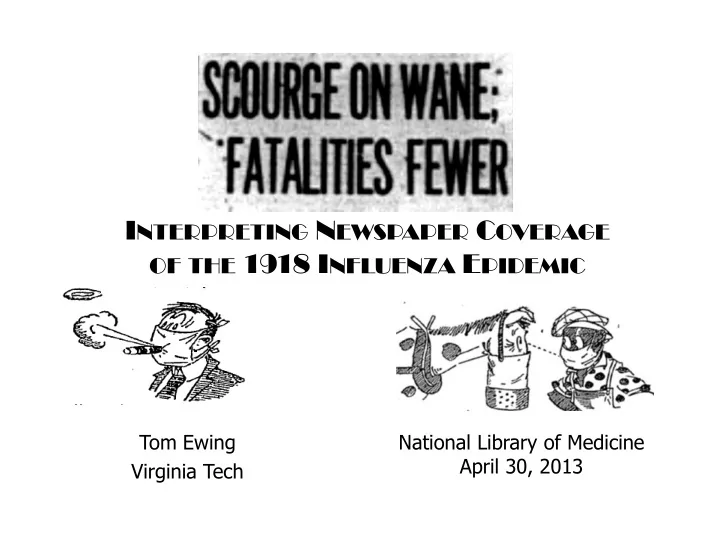
I NTERPRETING N EWSPAPER C OVERAGE OF THE 1918 I NFLUENZA E PIDEMIC - - PowerPoint PPT Presentation
I NTERPRETING N EWSPAPER C OVERAGE OF THE 1918 I NFLUENZA E PIDEMIC Tom Ewing National Library of Medicine April 30, 2013 Virginia Tech The Evening Star [Washington] October 19, 1918, p. 1 The Evening Star [Washington] October 19, 1918, p.
Tom Ewing Virginia Tech National Library of Medicine April 30, 2013
The Evening Star [Washington] October 19, 1918, p. 1
The Evening Star [Washington] October 19, 1918, p. 1
The Evening Star [Washington] October 19, 1918, p. 1
“Scourge on Wane; Fatalities Fewer,” Evening Star (Washington) October 19, 1918, p. 1. Decrease of Fourteen Deaths and 190 New Cases for Twenty-Four Hours. Officials are Optimistic Hope of health officials that the influenza is on the wane here seemed borne out today by a decrease in fourteen deaths for the twenty-four hours ended at noon today as compared with the increase of eight deaths for a similar period yesterday. A decrease is noted of 190 cases of new patients for the twenty-four hours ended at noon today. Seventy-seven deaths from influenza were reported to the health department for the period ended at noon. Yesterday’s report at the similar hour totaled ninety-one deaths, an increase of eight over Thursday. Great hope is derived from the report of but 744 cases reported for the twenty-four hour period ended at noon today, as compared with the previous day’s record of 934 cases. Justification for Optimism Health Officer W. C. Fowler this morning said that the optimistic view taken by him of the influenza situation as expressed in the Evening Star yesterday afternoon held good today, he maintaining the belief, with all the lights before him of the conditions of the city and the operation of the disease; that the contagion was on the decrease and that in a short time this would be evident. ’There is no doubt in my mind,’ said Dr. Fowler, ‘that we are holding our own, and with the splendid co-operation of the public health service, that of the Red Cross activities, the trained nurses’ organization, the physicians and the army of volunteer helpers we have every encouragement that we are slowly but surely mastering the disease’. He cited the decrease of fourteen deaths today and the decrease of 190 in the new cases reported for the day as basis for his views.
“Scourge on Wane; Fatalities Fewer,” Evening Star (Washington) October 19, 1918,
Officials are Optimistic Hope of health officials that the influenza is on the wane here seemed borne out today by a decrease in fourteen deaths for the twenty-four hours ended at noon today as compared with the increase of eight deaths for a similar period yesterday. A decrease is noted of 190 cases of new patients for the twenty-four hours ended at noon today. Seventy-seven deaths from influenza were reported to the health department for the period ended at noon. Yesterday’s report at the similar hour totaled ninety-one deaths, an increase of eight over Thursday. Great hope is derived from the report of but 744 cases reported for the twenty-four hour period ended at noon today, as compared with the previous day’s record of 934 cases. Justification for Optimism Health Officer W. C. Fowler this morning said that the optimistic view taken by him of the influenza situation as expressed in the Evening Star yesterday afternoon held good today, he maintaining the belief, with all the lights before him of the conditions of the city and the
time this would be evident. ’There is no doubt in my mind,’ said Dr. Fowler, ‘that we are holding our own, and with the splendid co-operation of the public health service, that of the Red Cross activities, the trained nurses’ organization, the physicians and the army of volunteer helpers we have every encouragement that we are slowly but surely mastering the disease’. He cited the decrease of fourteen deaths today and the decrease of 190 in the new cases reported for the day as basis for his views.
The Evening Star [Washington] October 19, 1918, p. 1
The Evening Star [Washington] October 19, 1918, p. 1
Principal Investigators:
– Tom Ewing, Department of History (VT) – Bernice Hausman, Department of English (VT) – Bruce Pencek, University Libraries (VT) – Naren Ramakrishnan, Dept of Computer Science (VT) – Gunther Eysenbach, Centre for Global eHealth Innovation (UT)
Graduate Research Assistants:
– Samah Gad, Dept of Computer Science (VT) – Kathleen Kerr, Department of English (VT) – Michelle Seref, Department of English (VT) – Laura West, Department of History (VT)
Database (Titles) 1917-1919 Just 1918 Chronicling America (pages) 12,365 6,389 Peel’s Prairie Provinces 2,147 1,212 Newsbank America’s Historical Newspapers (articles) 51,929 31,717 Proquest: New York Times 9,304 3,518 Washington Post 1,545 1,069 San Francisco Chronicle 1,366 914 Los Angeles Times 13,033 1,970 Chicago Tribune 3,430 1,455 Atlanta Constitution 1,772 931 Baltimore Sun 3,586 1,639 Boston Globe 1,440 843 Colorado Historical Newspaper Project 3,358 1,899 Georgia Newspaper Project 669 517 Totals 105,944 54,073
Title Format / Database OCR? VT Evening Star Microfilm (MF) No N Washington Bee Readex America’s Historical Newspapers No Y Washington Herald Library of Congress Chronicling America Yes Y Washington Post MF / Proquest Historical Newspapers No Y/N Washington Times Library of Congress Chronicling America Yes Y
Timelines: Influenza across space and time Washington DC Population, as of July 1918: 401,681 Estimated deaths due to influenza, Sept 1918 to Jan 1919: 2,892 Source: “Deaths from Influenza and Pneumonia in Cities of the United States, 1918-19,” Public Health Reports, Vol. 34, No. 6, February 7, 1919, p. 226-227.
Week ending Sept 14 Sept 21 Sept 28 Oct 5 Deaths 34 173 Week ending Oct 12 Oct 19 Oct 26 Nov 2 Deaths 488 622 389 181 Week ending Nov 9 Nov 16 Nov 23 Nov 30 Deaths 55 42 37 42 Week ending Dec 7 Dec 14 Dec 21 Dec 28 Deaths 41 86 120 154
William H. Davis, “The Influenza Epidemic as Shown in the Weekly Health Index,” The American Journal of Public Health 1919
34 173 488 622 389 181 55 42 37 42 41 86 120 154 139 109 107 73
100 200 300 400 500 600 700 Sept 14 Sept 21 Sept 28 Oct 5 Oct 12 Oct 19 Oct 26 Nov 2 Nov 9 Nov 16 Nov 23 Nov 30 Dec 7 Dec 14 Dec 21 Dec 28 Jan 4 Jan 11 Jan 18 Jan 25
Deaths from Influenza in Washington DC
34 173 488 622 389 181 55 42 37 42 41 86 120 154 139 109 107 73 100 200 300 400 500 600 700 Sept 14 Sept 21 Sept 28 Oct 5 Oct 12 Oct 19 Oct 26 Nov 2 Nov 9 Nov 16 Nov 23 Nov 30 Dec 7 Dec 14 Dec 21 Dec 28 Jan 4 Jan 11 Jan 18 Jan 25
Deaths from Influenza "Influenza" "Influenza" +" death"
Search in Chronicling America for Washington Times for terms: 1) “influenza” (613 total); 2) “influenza” and “death” (328 total)
1 10 20 30 40 50 60 70 80
Sept 14 Sept 21 Sept 28 Oct 5 Oct 12 Oct 19 Oct 26 Nov 2 Nov 9 Nov 16 Nov 23 Nov 30 Dec 7 Dec 14 Dec 21 Dec 28 Jan 4 Jan 11 Jan 18 Jan 25
"Influenza" "Influenza" +" death"
Newspapers reported on the disease with the same mixture of truth and half-truth, truth and distortion, truth and lies with which they reported everything else…As terrifying as the disease was, the press made it more
said bore no relationship to what people saw and touched and smelled and endured. People could not trust what they read. Uncertainty follows distrust, fear follows distrust, and, under conditions such as these, terror follows fear…Over and over in hundreds of newspapers, day after day, repeated in one form or another people read [Surgeon General] Rupert Blue’s reassurance as well: ‘There is no cause for alarm if precautions are
newspaper in the country, in large, blocked-off parts of pages labeled ‘Advice on How to Avoid Influenza.’…How could one not get panicky? Even before people’s neighbors began to die, before bodies began to pile up in each new community, every piece of information except the newspapers told the truth…Fear drove the people, an the government and the press could not control it. They could not control it because every true report had been diluted with lies. And the more the officials and newspapers reassured,…the more people believed themselves cast adrift, adrift with no one to trust, adrift on an ocean of death.” (John Barry, The Great Influenza, pp. 334-340)
10/4/1918 a a A A A4 The Spanish influenza situation at the near-by camps is reaching alarming proportions. 10/5/1918 a a A A A4 New cases of influenza today leaped to 1,695, as against 999 reported yesterday. 10/5/1918 a a A A A4 Five More Grip victims Succumb--City Closed Tight. 10/19/1918 r R R r R4 Racing at the Maryland plant will be resumed sometime next week as the Maryland Health Board is now confident that the epidemic is waning and conditions are gratifying. 10/9/1918 R r R r R4 The number of new influenza cases and of deaths in the army camps is showing a slight decrease, according to a statement issued by the military authorities yesterday. 10/8/1918 R r R r R4 The Spanish influenza is on the wane here according to Dr. W. L. Wood, a special state health officer, and also of the United States Public Health Service. 10/19/1918 e E E e E4 Middies Game with Princeton Pay Station Put Off Because of "Flu." 10/19/1918 e E E e E4
has postponed her trip on account of the influenza epidemic. 10/19/1918 e E E a E3 These children, he stated, are suffering with the influenza and it is impossible for the two nurses who have been caring for them during the past week to give each the individual treatment they need. 10/7/1918 A w W a W4 The Spanish influenza situation here continues serious. 10/8/1918 W w W w W4 Friends and relatives of Washingtonians and war workers in the city are requested by the health department to remain out of the city until the epidemic is under control. 10/8/1918 W w W w W4 Relatives of even those who are ill with the disease are warned that their presence in the city can do no good, and that they are running an unnecessary risk.
Washington Herald: ≈700 sentences manually coded, Sept 12-Oct 22, 1918
Week Alarmist Warning Explanatory Reassuring All Sept 8-14 3 3 0.6% Sept 15-21 2 9 5 16 3.0% Sept 22-29 5 3 14 4 26 4.8% Sept 29-Oct 5 10 18 37 11 76 14.2% Oct 6-Oct 12 19 39 69 38 165 30.7% Oct 13-19 18 28 99 50 195 36.3% Oct 20-26 1 4 31 20 56 10.4% Totals 53 94 262 128 537 9.2% 14.4% 50.8% 25.6% Washington Herald: 537 sentences manually coded, 75% or more agreement
Washington Herald: 537 sentences manually coded, Sept 12-Oct 22, 1918 “Expert” Coders: Kathleen Kerr, GRA, English Bernice Hausman, Professor, Department of English Bruce Pencek: Social sciences librarian, University ibrarian Tom Ewing: professor, Department of History 9.9% 17.5% 48.8% 23.8% Alarmist Warning Explanatory Reassuring
50 100 150 200 250 Week Sept 8-14 Sept 15-21 Sept 22-29 Sept 29-Oct 5 Oct 6-Oct 12 Oct 13-19 All Tones Alarmist Warning Explanatory Reassuring
Washington Herald: ≈700 sentences manually coded, Sept 12-Oct 22, 1918
50 100 150 200 250
Sept 8-14 Sept 15-21 Sept 22-29 Sept 29-Oct 5 Oct 6-Oct 12 Oct 13-19 Negative Neutral Positive All
Washington Herald: ≈700 sentences manually coded, Sept 12-Oct 22, 1918
Washington Herald, ≈700 sentences, Sept 12-Oct 6, 1918
Washington Herald, ≈700 sentences, Sept 12-Oct 6, 1918
Washington Herald, ≈700 sentences, Oct 6-22, 1918
Sept 12-Oct 6, 1918 Oct 6-22, 1918
10/16/1918 e W R a 1 Help of all kinds is needed and needed at once if Washington is to fight a successful battle against the greatest epidemic that has ever swept the nation. 9/21/1918 e r W E 2 To prevent the spread of Spanish influenza in Washington,
to the doctors throughout the city to report all cases of acute grip, which they suspect to be the dreaded disease. 9/21/1918 e r W E 2 The physician, however, took no changes but immediately reported his patient's condition to Dr. Fowler in order to prevent the spread of the disease if Lieut. and Mrs. Henne's case should be a mild form of "Spanish influenza." 9/25/1918 e e A A 2 Because of the alarming spread of influenza, the schools of this city were ordered closed today until the epidemic has abated. 9/25/1918 a e E A 2 The Public Health Service last night announced that 2,943 new cases of Spanish influenza in the United States had been reported during the past twenty-four hours. 9/25/1918 e e R R 2 Secretary Daniels said there was nothing at the Department to verify any alarming statements either as to the number sick or the number dead if any had died.
To prevent the spread of Spanish influenza in Washington, Dr. Fowler, District health officer, yesterday made an appeal to the doctors throughout the city to report all cases of acute grip, which they suspect to be the dreaded disease.
To prevent the spread of 6pet.laa ii.fluensa In Washington. Dr Fowler District health officer, a-eaterd?- mad? in appassii to the rksetor? throughout the dty to report alt camma of acute grip, which the? susvpert to be Ot. drssaded dlaeaaa. This waa made to the privatela???
the list which dolor? are i*equla*eal ?af? report to th? health office and the neglect of thl? pr?caution may ac count for the rapidity with which IM ha? spread in other ciUe?. ??..,>..... . ..a......, Aa the majority of the doctor? ??a?' Washington readily admit ther ?lo not know the exact .ytnptons of "Sptuiiah influenaa.?? it has been in? work of the Di?trt<rt health office ?a ferret oui the suespected caaee. Tbe caae of L'eut. Arthur Hearers?? and his wife, of Ziti Eightsjeeth auwaK north .?t. waa reportes?; ' to ttr. Fowler yeatayrday. Lient and atra" Henne returned from New York oa Monday and since their return tkmy both have basen Buffering from what they con?Wered "the eff'P?** In speaking of hi? symptom? to hi? attending phyeician? Lieut Heran? - described them a? altanar to a i?e*?er?? attack of hay fever or an. "?yid fashioned" cold. The physiciaui. however took ne j chances but immediately reported hai patient'? storaditlon to Dr. Fowler in
the dlaaa?. If Lieut, and Mrs. Henne? caae ?hould be a mild form of 'Span i?h influenza." ,
Coconin Sun Mohave County Miner Bemidji Daily Pioneer Evening Missourian Evening Herald Watchman & Southron El Paso Herald Ogden Standard Big Stone Gap Post
Pullman Herald Colville Examiner
Chronicling America Newspapers covering the 1918 Influenza Epidemic
Washington Times
New York Tribune Evening World Evening Public Ledger
Chronicling America Newspapers: 1918 Influenza Epidemic
Washington Herald
Washington Post, October 20, 1918, p. 2
Washington Post, October 20, 1918, p. 2
Contact Information: Tom Ewing (etewing@vt.edu)
“When you’ve been holding in a big sneeze for a long time and you have to let it go just as your
about to putt. Also the influenza suspicion is aroused.” “Well for thuh luva mike— this is a swell place for me to be—we’ll all be catchin’ the influenza I can see that.”
Hun bullets, poison gas, liquid fire and shrapnel have not succeeded in killing as many Americans since the beginning of the war as the Spanish influenza germ has since September 14. Men killed in action and those who have died of wounds total 13,645. For the week ending October 12 there have been 17,735 deaths from Spanish influenza and resultant pneumonia in the United States. In several cities the percentage of deaths in proportion to the population has risen to heights never before recorded. Washington has had a death rate for the past week of 86.7 per cent per thousand population. It ranks sixth among the cities scourged by influenza in its death rate. Fall River, Mass., in the center of the district where the disease raged first, records a death rate of 100.4. Philadelphia comes next with a percentage of 97.2. The number of deaths in Philadelphia were 3,234, compared with 470 for the same week in the previous year. Two thousand six hundred and thirty-five deaths were caused by influenza and pneumonia alone.