I Can See Clearer Now The Blur is Gone Per Christian Hansen - - PowerPoint PPT Presentation

i can see clearer now the blur is gone
SMART_READER_LITE
LIVE PREVIEW

I Can See Clearer Now The Blur is Gone Per Christian Hansen - - PowerPoint PPT Presentation

I Can See Clearer Now The Blur is Gone Per Christian Hansen deblurring GAMM 2008 1 The Speaker Per Christian Hansen Professor of Scientific Computing at DTU MSc EE 1982 PhD Num. Anal. 1985 Dr Techn 1996 Key


slide-1
SLIDE 1

GAMM 2008

1

I Can See Clearer Now – The Blur is Gone

Per Christian Hansen

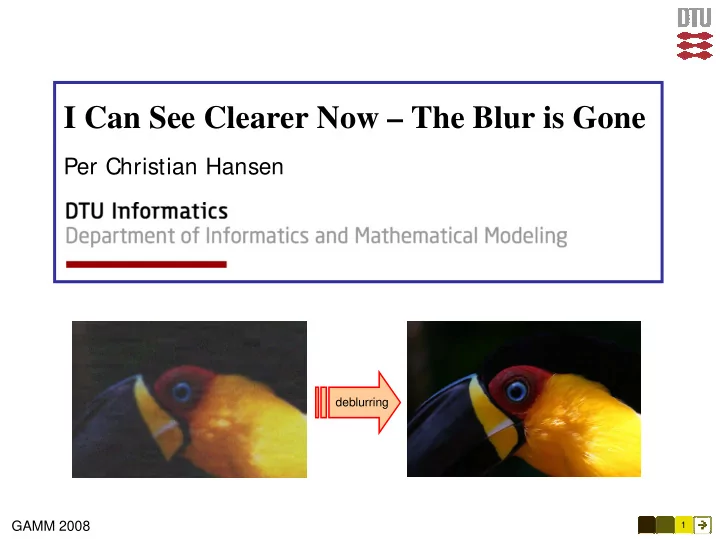
deblurring
slide-2
SLIDE 2

GAMM 2008

2

The Speaker

Per Christian Hansen

  • Professor of Scientific Computing at DTU
  • MSc EE 1982 – PhD Num. Anal. 1985 – Dr Techn 1996
  • Key interests: large-scale computing & inverse problems

Author of two books on inverse problems:

slide-3
SLIDE 3

GAMM 2008

3

Sources of Blurred Images

slide-4
SLIDE 4

GAMM 2008

4

Some Types of Blur and Distortion

From the camera:

  • the lens is out of focus,
  • imperfections in the lens, and
  • noise in the CCD and the analog/digital converter.

From the environments:

  • motion of the object (or camera),
  • fluctuations in the light’s path (turbulence), and
  • false light, cosmic radiation (in astronomical images).

Given a mathematical/statistical model of the blur and distortion, we can deblur the image and compute a sharper reconstruction.

slide-5
SLIDE 5

GAMM 2008

5

Some Applications of Deblurring

Astronomical imaging Biometrics and surveillance Image deblurring Fingerprint restoration Image in-painting

slide-6
SLIDE 6

GAMM 2008

6

Mathematics of Image Deblurring

blurring deblurring

Io (moon of Jupiter) You cannot depend on your eyes when your imagination is out of focus

– Mark Twain

slide-7
SLIDE 7

GAMM 2008

7

Same Problem: Inverse Acoustics

slide-8
SLIDE 8

GAMM 2008

8

Same Problem: Inverse Geomagnetism

slide-9
SLIDE 9

GAMM 2008

9

Same Problem: Seismic Tomography

Seismographs Surface Colors represent slowness (recip.

  • f sound speed).

Incoming seismic waves Reconstruction

slide-10
SLIDE 10

GAMM 2008

10

The Point Spread Function

slide-11
SLIDE 11

GAMM 2008

11

Discretization: Equations → Numbers

slide-12
SLIDE 12

GAMM 2008

12

Discretization: Equations → Numbers

Examples of point spread functions

slide-13
SLIDE 13

GAMM 2008

13

The Difficult Task of Image Deblurring

slide-14
SLIDE 14

GAMM 2008

14

Inverse Problems

Inverse problems are examples of ill-posed problems:

  • the solution may not exist,
  • the solution may not be unique, or
  • the solution may not depend continuously on data.

Example: the world’s simplest ill-posed problem: x1 + x2 = 1. The linear systems of equations associated with discretizations of linear inverse problems are effectively underdetermined – even if the system A x = b is square or overdetermined.

slide-15
SLIDE 15

GAMM 2008

15

Structured Matrices

The matrix A in image deblurring problems is often structured. Typically, it is BTTB = block Toeplitz with Toeplitz blocks.

slide-16
SLIDE 16

GAMM 2008

16

Professor Toeplitz and his Matrix

Otto Toeplitz, 1881 – 1940. Worked on linear and quadratic forms. Given a stationary time series x1, x2, x3, x4, ... the autocorrelation matrix, with elements cij = ai-j = cov(xi , xj ) , is a Toeplitz matrix.

slide-17
SLIDE 17

GAMM 2008

17

Utilization of Matrix Structure

Ordinary matrix-vector multiplication flop count. Toeplitz matrix-vector multiplication flop count.

slide-18
SLIDE 18

GAMM 2008

18

The FFT Algorithm

The ”fathers” – published 1965. The definition The algorithm

function y = fft(x) % FFT algorithm, n = power-of-2 n = length(x);

  • mega = exp(-2*pi*i/n);

if n > 2 % Recursive divide and conquer. k = (0:n/2-1)'; w = omega.^k; u = fft(x(1:2:n-1)); v = w.*fft(x(2:2:n)); y = [u+v; u-v]; else % The Fourier matrix. j = 0:n-1; k = j'; F = omega.^(k*j); y = F*x; end

The principle – O(n log(n) ) complexity

slide-19
SLIDE 19

GAMM 2008

19

FFT-Based Methods

We can immediately reconstruct the image via FFT computations:

  • Periodic boundary conditions:

F = ifft2( fft2(G) ./ fft2(P) );

  • with Wiener filtering

S = fft2(P); % Eigenvalues. F = ifft2( (S./(S.^2 + lambda) .* fft2(G) )

  • Reflexive boundary conditions (and symmetric PSF):

S = dct2(P) ./ dct2(e1); % Eigenvalues. F = idct2( dct2(G) ./ S )

  • with filtering

Q = dct2(P) ./ dct2(e1); % Eigenvalues. F = idct2( (S./(S.^2 + lambda) .* dct2(G) )

For details, see the book

slide-20
SLIDE 20

GAMM 2008

20

Regularizing Iterations

slide-21
SLIDE 21

GAMM 2008

21

Krylov Signal Subspaces

Smiley Crater, Mars

slide-22
SLIDE 22

GAMM 2008

22

Top 10 Algorithms

J.J. Dongarra, F. Sullivan et al., The Top 10 Algorithms, IEEE Computing in Science and Engineering, 2 (2000), pp. 22-79. 1946: The Monte Carlo method (Metropolis Algorithm). 1947: The Simplex Method for Linear Programming. 1950: Krylov Subspace Methods (CG, CGLS, Arnoldi, etc.). 1951: Decomposition Approach to matrix computations. 1957: The Fortran Optimizing Compiler. 1961: The QR Algorithm for computing eigenvalues and –vectors. 1962: The Quicksort Algorithm. 1965: The Fast Fourier Transform algorithm. 1977: The Integer Relation Detection Algorithm. 1987: The Fast Multipole Algorithm for N-body simulations. 1946: The Monte Carlo method (Metropolis Algorithm). 1947: The Simplex Method for Linear Programming. 1950: Krylov Subspace Methods (CG, CGLS, Arnoldi, etc.). 1951: Decomposition Approach to matrix computations. 1957: The Fortran Optimizing Compiler. 1961: The QR Algorithm for computing eigenvalues and –vectors. 1962: The Quicksort Algorithm. 1965: The Fast Fourier Transform algorithm. 1977: The Integer Relation Detection Algorithm. 1987: The Fast Multipole Algorithm for N-body simulations. Key algorithms in image deblurring.

slide-23
SLIDE 23

GAMM 2008

23

Semi-Convergence of CGLS

slide-24
SLIDE 24

GAMM 2008

24

Progress of the Iterations

Initially, the image gets sharper – then ”freckles” start to appear.

DCT spectrum spatial domain

The ”freckles” are band-pass filtered noise.

slide-25
SLIDE 25

GAMM 2008

25

Away From 2-Norms

Io (moon of Saturn) q = 1.1 q = 2

slide-26
SLIDE 26

GAMM 2008

26

Total Variation In-Painting

C S I : C o m p u t a t i o n a l S c i e n c e i n I m a g i n g

Matlab and C software (working title: TV box) is almost finished.

slide-27
SLIDE 27

GAMM 2008

27

3D Tomography in Crystallography

Data:

X-ray diffraction

Reconstruction:

  • rientation distribution function

Smoothing norm:

|| ∇2f ||2 Solution shows the distribution of

  • rientations in an imperfect crystal.

Joint work with Metals in 4D, Risø DTU