
SLIDE 1
Spring 2015 www.i26ALT.org
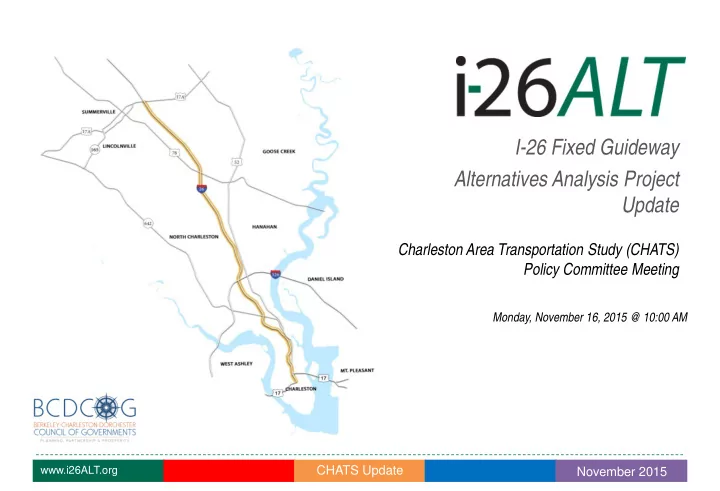
I-26 Fixed Guideway Alternatives Analysis Project Update
Charleston Area Transportation Study (CHATS) Policy Committee Meeting
Monday, November 16, 2015 @ 10:00 AM November 2015 CHATS Update
I-26 Fixed Guideway Alternatives Analysis Project Update - - PowerPoint PPT Presentation
I-26 Fixed Guideway Alternatives Analysis Project Update Charleston Area Transportation Study (CHATS) Policy Committee Meeting Monday, November 16, 2015 @ 10:00 AM Spring 2015 www.i26ALT.org CHATS Update November 2015 Agenda Project
Spring 2015 www.i26ALT.org
Charleston Area Transportation Study (CHATS) Policy Committee Meeting
Monday, November 16, 2015 @ 10:00 AM November 2015 CHATS Update
www.i26ALT.org
Project Update Screen Two Alternatives Analysis FTA Project Readiness Next Steps
CHATS Update November 2015
www.i26ALT.org
CHATS Update November 2015
www.i26ALT.org
CHATS Update
The purpose of the I-26 Alternatives Analysis is to
improve transit service and enhance regional mobility along the 22-mile I-26 Corridor connecting
Summerville, North Charleston, and Charleston.
Goal 1: Improve Mobility, Safety, Accessibility and Connectivity of the Transit System and Region Goal 2: Provide a Cost Effective and Financially Feasible Transit Alternative Goal 3: Support Local Land Use Objectives Goal 4: Plan for Projected Growth in an Environmentally Sustainable Manner Goal 5: Respond to Community Needs and Support Goal 6: Support a Diverse Regional Economy
November 2015
www.i26ALT.org
CHATS Update
Comprehensive Operational Analysis In Depth Analysis of Current Transit Network over Next 20 Years Locally Preferred Alternative + 20-Year Transit Plan for I-26 Corridor Federal Transit Administration Capital Investment Program (Federal Process) 6-10 – Years (Typical) Fixed Guideway Alternatives Analysis of I-26 Corridor Alternatives Analysis for I-26 Corridor for Commuter Bus or Fixed Guideway Transit (BRT, LRT, Commuter Rail, etc.)
Pre-Project Development (Local Planning Process) October 2014 – December 2015
Public Involvement Surveys, Public Outreach, Public Meetings, Project Website, Quarterly Newsletter, Facebook & Twitter Federal Transit Administration (FTA) Coordination Following Guidelines for Fixed Guideway Capital Investment Grant Program
November 2015
www.i26ALT.org
CHATS Update November 2015
www.i26ALT.org
CHATS Update November 2015
Bus Rapid Transit
conventional rail in reserved guideways or mixed traffic.
Light Rail Transit
mixed with traffic, powered electrically from an
Hybrid Rail
rail or commuter rail service using electric or diesel self-propelled passenger cars. (EMU/DMU)
Commuter Rail
local, short distance travel between a central city and adjacent suburbs using electric or diesel locomotive hauled passenger cars.
www.i26ALT.org
CHATS Update
Alternatives Recommended to Move Forward to Screen Two
Alternative A: No Build – Commuter Bus on I-26
Alternative B-1/B-2: US 78/US 52/Meeting– BRTLRT
Alternative B-3/B-4: US 78/US 52/East Bay – BRT/LRT
Alternative C-1/C-2: US 176/US 52/Meeting – BRT/LRT
Alternative C-3/C-4: US 176/US 52/East Bay – BRT/LRT
Alternative D-1/D-2: Dorchester Rd/US 52/Meeting – BRT/LRT
Alternative D-3/D-4: Dorchester Rd /US 52/East Bay – BRT/LRT
November 2015
www.i26ALT.org
CHATS Update
Refining the Alternatives
Ridership Forecasting
Using FTA’s Simplified Simplified-Trips-on-
Projects Software (STOPS)
Guideway Analysis
Mixed Traffic versus Dedicated Guideway Center Median or Side Lanes Neck Area Constraints – King, Meeting,
Other ROW
Peak Hour Bus Lanes to MUSC
Station Location Analysis
Downtown Summerville or Azalea Square North Charleston Transit Hub DT Charleston Transit Hub November 2015
Healthline BRT Cleveland, OH METRO LRT, Phoenix, AZ
www.i26ALT.org
CHATS Update
Refining the Alternatives
Short-Term Phasing Options
Identify 1st Phase – Core “Trunkline” for
“Transitway” enhancements
Peak Hour Bus Lanes Limited Stop Service Transit Signal Priority & Technology to
improve Transit Travel Time
Bus on Shoulder Lanes
Capital and Operating Cost Estimates Develop Transit Feeder Service
November 2015
www.i26ALT.org
CHATS Update
Total Project Cost: Greater
CIG Program Funds:
3 Phase Process
Project Development Engineering Construction
New Fixed guideway BRT in separated ROW Total Project Capital Cost:
CIG Program Funds: $75M
2-Phase Process
Project Development Construction
Simplified financial
New fixed guideway Corridor Based BRT (Not
November 2015
www.i26ALT.org
CHATS Update
Complete NEPA and related environmental laws
Select Locally Preferred Alternative
Adopt LPA in Fiscally Constrained LRTP
Obtain Medium Project Rating under Project Justification Evaluation
Obtain commitment of 30% of matching funds*
Complete 30% design and engineering
Must complete these steps within 2-years
Commitment of 50% of matching funds
Significant progress with engineering within 3-Years
Evaluation Rating
Availability of CIG program funds
Project readiness
November 2015
* Small Starts have 3-Years in Project Development to gain 50% of funding commitment, there is no “Engineering” phase.
www.i26ALT.org
CHATS Update
Screening Criteria Based on FTA Project Justification
Local Financial Commitment during Project Development
Reasonableness of assumptions (50%) Commitment of Capital and Operating Funds (25%) Current Transit Capital and Operating Conditions (25%)
Average Fleet Age (Under 8 Years for Medium Rating) Bond Ratings over last 2 Years/Current Ratio (Assets to Liabilities) Recent Service History for Medium Ranking
Historical Positive Cash Flow/No Cash Flow Shortfalls Only Minor Service Adjustments in Recent Years
November 2015
www.i26ALT.org
Screen Two Alternatives Analysis using Funding & Project Readiness
Select Locally Preferred Alternative: December 2015
Technical Advisory Committee/Steering Committee Meeting
Complete CARTA Comprehensive Operational Analysis: December 2015 Final Project Plan: January 2016 Upcoming Meetings
Stakeholder Meetings: Ongoing Technical Advisory/Steering Committee Meeting: Mid-December 2015 Public Meetings: January 2016 CHATS Update November 2015
Spring 2015 www.i26ALT.org
CHATS Update November 2015
Spring 2015 www.i26ALT.org
Charleston Area Transportation Study (CHATS) Policy Committee Meeting
Monday, November 16, 2015 @ 10:00 AM November 2015 CHATS Update
www.i26ALT.org
CHATS Update
System and route evaluation to
CARTA Transit System
16 Fixed Routes & Neighborhood
Circulators
4 Express Routes to North
Charleston, Summerville, West Ashley, Mt. Pleasant, & James Island
3 Downtown Area Shuttle (DASH)
Trolley Routes
Operates 62 vehicles during peak
service
November 2015
www.i26ALT.org
CHATS Update November 2015
CARTA fixed route service caries
In 2014, CARTA reached 5 million
52% of all trips occur on one of 4
Route 10 Rivers Ave. (24%) Route 211 Meeting/King Trolley
(12%)
Route 12 Upper Dorchester (8%) Route 11 Airport/Dorchester (8%)
Most Active Stops:
North Charleston SuperStop (Rivers
& Cosgrove)
Mary Street Parking Garage
(Meeting & Mary)
www.i26ALT.org
CHATS Update
Transit Dependent Ridership
54% Female 65% Black/African American 58% annual income $30,000 or
48% under Age 35 75% did not have a car
42% travel between home and
50% pay cash fare
November 2015
Service Area Households with No Vehicle
www.i26ALT.org
CHATS Update
2013 Population Served by CARTA
¾ Mile CARTA Service Area:
236,649
2013 Urbanized Area: 567,077
(41.7%)
Transit Supportive Areas
3 Households and/or 4 Jobs per Acre
November 2015
Land Area (Acres) % of Area Served Households Jobs Tri-County Region 1,361,976 249,569 307,809 CARTA Service Coverage Area (1/4 Mile Walk Radius) 31,468 2% 51,360 125,030 Total Tri-County Area Transit Supportive Area 19,243 1.4% 38,162 142,835 Transit Supportive Area Served by CARTA (1/4 Mile Walk Radius) 11,370 59% 27,622 98,367 Transit Supportive Area Served by CARTA (1/4 Mile Walk Radius) 2010
www.i26ALT.org
How can CARTA optimize the current system to focus existing resources on improving service to current transit markets and set aside revenues for future vehicle and technology investment?
CHATS Update
Short-Range Challenges &
Average vehicle fleet age is 13 Years Increased traffic congestion =
longer headways and travel times inconvenient transfer times poor on-time performance
Ridership is flat Limited Capacity at Major Transfer
November 2015
www.i26ALT.org
CHATS Update
How should the system be
Better serve existing and
Improve transit
Incorporate i-26ALT
November 2015
www.i26ALT.org
Meet with CARTA Route Advisory Committee/Board on Short Range
Develop Mid-Range Recommendations as part of i-26ALT Locally Preferred
Present recommendations for public input (January 2016) Implement short range plan (Beginning Summer 2016)
CHATS Update November 2015
Spring 2015 www.i26ALT.org
CHATS Update November 2015