
SLIDE 1
www.spencerfane.com Kansas City Omaha Overland Park St. Louis Jefferson City Denver
Hydraulic Fracturing
Source: Anadarko Petroleum Corporation
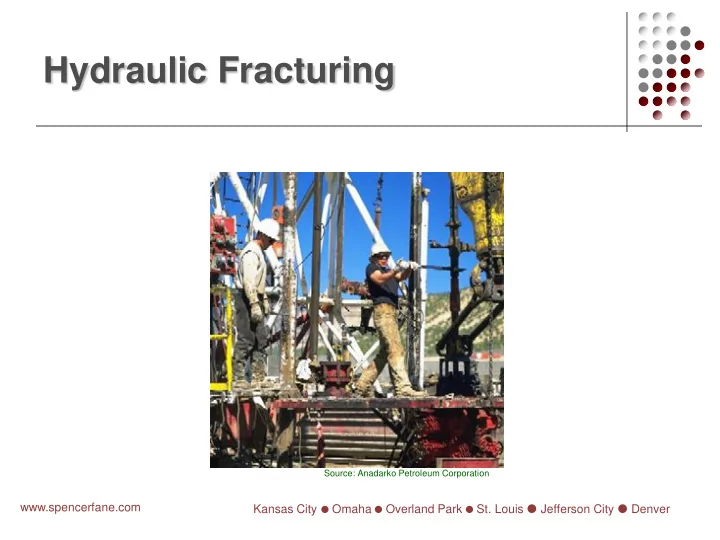
Hydraulic Fracturing Source: Anadarko Petroleum Corporation - - PowerPoint PPT Presentation
Hydraulic Fracturing Source: Anadarko Petroleum Corporation www.spencerfane.com Kansas City Omaha Overland Park St. Louis Jefferson City Denver What is hydraulic fracturing? A process in which a fluid is injected at high
www.spencerfane.com Kansas City Omaha Overland Park St. Louis Jefferson City Denver
Source: Anadarko Petroleum Corporation
www.spencerfane.com Kansas City Omaha Overland Park St. Louis Jefferson City Denver
USGS 2010
Northwest Colorado, Northeast Utah, Southwest Wyoming
www.spencerfane.com Kansas City Omaha Overland Park St. Louis Jefferson City Denver
www.spencerfane.com Kansas City Omaha Overland Park St. Louis Jefferson City Denver
Pros
Responsible operators in compliance with government regulations eliminate dependence on foreign energy sources
More gas and oil can be produced cheaply until sufficient renewable energy resources are developed
Job creation for production companies
Job creation for communities and related industries Cons
Improper well construction or overly aggressive “frack” threatening groundwater, destabilizing substrate and impacting soils
Potential for vast amounts of water diverted from beneficial uses (in Colorado, 78% of all water is used for agriculture)
In the semi-arid Western US, water supplies are limited and costly
Potential for spills and leaching of waste into surface/groundwater
Potential for communication with groundwater aquifers
Potential emissions of methane from gas wells or leaking pipes
Well site sizes are large, sometimes close to residential homes
Increased heavy truck traffic on roads and noise
www.spencerfane.com Kansas City Omaha Overland Park St. Louis Jefferson City Denver
Water sources may come from ground or surface water;
Millions of gallons of water used per production well Storage of water on-site in 20,000 gallon tanks, on-site
Recycling “flowback” water produced in fracturing
Flowback may contain both naturally occurring
www.spencerfane.com Kansas City Omaha Overland Park St. Louis Jefferson City Denver
Production water and flowback water are stored in tanks
Impoundments may be temporary or long-term. In some states, underground injection is preferred method
Concerns re injection capacity, transportation cost, hauling
Potential for use of publicly owned treatment works
POTWs not designed to treat fracking wastewaters,
Releases, leaks and/or spills involving storage and
www.spencerfane.com Kansas City Omaha Overland Park St. Louis Jefferson City Denver
www.spencerfane.com Kansas City Omaha Overland Park St. Louis Jefferson City Denver
Federal: environmental regulation, 40 CFR Code of
State: laws governing oil and gas extraction activities
County: environmental protection (primarily public
Municipal: local governments regulate environmental
www.spencerfane.com Kansas City Omaha Overland Park St. Louis Jefferson City Denver
Rules are expected following further study of “fracking”
New regulations are in place on air emissions from “fracking” EPA plans to issue guidance on the use of diesel fuels in
www.spencerfane.com Kansas City Omaha Overland Park St. Louis Jefferson City Denver
The oil and gas industry, including hydraulic fracturing
Part C SDWA permits regulations for State Underground
www.spencerfane.com Kansas City Omaha Overland Park St. Louis Jefferson City Denver
Congress amended the SDWA in 2005 when it passed the
Thus, regardless of whether the underground injection of
www.spencerfane.com Kansas City Omaha Overland Park St. Louis Jefferson City Denver
Generally, states are free to regulate hydraulic fracturing as they see fit, so long as minimum requirements of federal regulations are met. Many, like New York, are still engaged in extensive and protracted studies
Colorado Oil and Gas Conservation Commission http://cogcc.state.co.us/Announcements/Hot_Topics/Hydraulic_Fracturing/COGCC%20Hydraulic%20F racturing%20Rules.htm Air pollution regulation: Division of Air Pollution Control www.epa.ohio.gov/dapc/regs/regs.aspx Drinking and Ground Water Regulations: Division of Drinking and Ground Waters www.epa.ohio.gov/ddagw/rules.aspx Hazardous Waste Regulations: Division of Hazardous Waste www.epa.ohio.gov/dhwm/laws_regs.aspx Solid and Infectious Waste Regulations: Division of Solid and Infectious Waste Management www.epa.state.oh.us/dsiwm/pages/rules.aspx Wastewater Regulations: Division of Surface Water www.epa.ohio.gov/dsw/rules/index.aspx
www.spencerfane.com Kansas City Omaha Overland Park St. Louis Jefferson City Denver
Permit indicating proposed well location Location of other water sources within 400 feet “Enhanced recovery” operations must be approved Injection of fluids require description of casing, the type of
Well casings must prevent migration of oil, gas, water Pits must meet public health and safety standards and an
Spills must be controlled and contained upon discovery and
Waste from drilling operations may be injected, or disposed
www.spencerfane.com Kansas City Omaha Overland Park St. Louis Jefferson City Denver
In April of 2012, the revised Rules of the COGCC became
Operators are required to: complete a public record chemical disclosure
landowners within 500 feet of a proposed well must receive
provide the COGCC written notice of intended operations at
www.spencerfane.com Kansas City Omaha Overland Park St. Louis Jefferson City Denver
Little to no evidence of direct impact to groundwater. Of 1000 incidents investigated in Ohio, none were found to have been caused by “fracking”.
Potential for contamination of groundwater if mechanical integrity
An issue is the lowering of aquifer water levels by water withdrawal for “fracking” which may:
Affect water quality by exposing minerals to oxygen-rich environment;
Increased salination and risk for potential chemical contamination;
Cause upswelling of lower quality water from deeper within aquifers.
OEPA 2010
www.spencerfane.com Kansas City Omaha Overland Park St. Louis Jefferson City Denver
USGS: www.usgs.gov
Colorado Oil and Gas Conservation Commission http://cogcc.state.co.us/
Ohio Department of Natural Resources: www.ohiodnr.com
Ohio EPA: www.epa.ohio.gov
Penn State Marcellus Center: www.marcellus.psu.edu
Frac Focus: www.fracfocus.org
Other websites with information:
www.TheMarcellusShale.com www.TheUticaShale.com www.GoMarcellusShale.com www.MarcellusCoalition.org http://oilshalegas.com/piceancebasin.html
www.spencerfane.com Kansas City Omaha Overland Park St. Louis Jefferson City Denver
Hydraulic Fracturing Regulation In The United States: The Laissez- Faire Approach Of The Federal Government And Varying State Regulations
Vermont J. Env. Law: http://www.vjel.org/journal/pdf/VJEL10203.pdf
Professor William J. Brady & James P. Crannell
EPA Releases Progress Report on Impacts of Hydraulic Fracturing on Drinking Water Resources
http://www.spencerfane.com/environmental_law_solutions/blog.aspx?entry=250
Recently Enacted Fracking Ban in Colorado Challenged, Highlighting Divide Between State and Local Governments on Energy Production
http://www.spencerfane.com/environmental_law_solutions/blog.aspx?entry=249
Groundbreaking EPA Enforcement at Hydraulic Fracturing Sites
http://www.spencerfane.com/environmental_law_solutions/blog.aspx?entry=39
www.spencerfane.com Kansas City Omaha Overland Park St. Louis Jefferson City Denver