Human Factors in Coercion-Resistant Internet Voting Oksana Kulyk I - - PowerPoint PPT Presentation

human factors in coercion resistant internet voting
SMART_READER_LITE
LIVE PREVIEW

Human Factors in Coercion-Resistant Internet Voting Oksana Kulyk I - - PowerPoint PPT Presentation

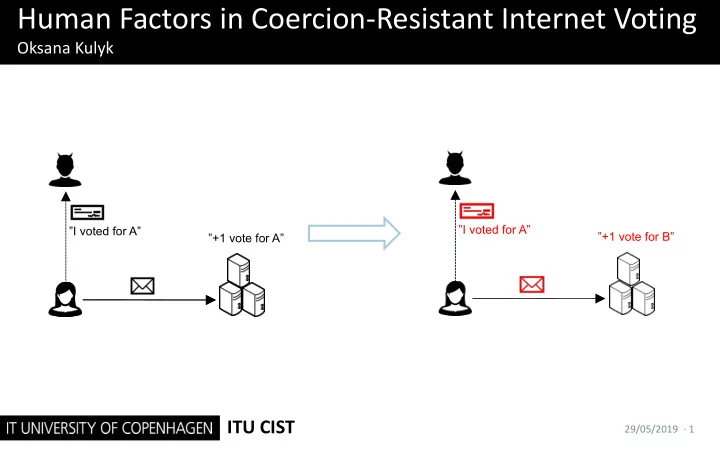
Human Factors in Coercion-Resistant Internet Voting Oksana Kulyk I voted for A I voted for A +1 vote for B +1 vote for A ITU CIST 29/05/2019 1 Coercion in Internet Voting Internet voting is an unsupervised channel


slide-1
SLIDE 1

Human Factors in Coercion-Resistant Internet Voting

Oksana Kulyk

”+1 vote for A” ”I voted for A” ”+1 vote for B” ”I voted for A”

ITU CIST

29/05/2019 · 1
slide-2
SLIDE 2

Coercion in Internet Voting

29/05/2019 · 2

  • Internet voting is an unsupervised channel
  • Hard to restrict voter actions (e.g. recording the

voting procedure)

  • Hard to monitor the voting environment (e.g. over-

the-shoulder adversary)

à Voter coercion and/or vote buying a real possibility

”+1 vote for A” ”I voted for A”

ITU CIST

slide-3
SLIDE 3

Coercion in Internet Voting

29/05/2019 · 3

  • Solution: schemes with different levels of coercion-

resistance incl. receipt-freeness

  • Counter-strategy
  • A procedure different from normal vote casting
  • The voter either obeys the coercer or applies a

counter-strategy

  • Goal: adversary should not be able to tell whether

the voter obeyed or not

”+1 vote for B” ”I voted for A”

ITU CIST

slide-4
SLIDE 4

29/05/2019 · 4

Types of Counter-Strategies

ITU CIST

slide-5
SLIDE 5

Fake Credentials

29/05/2019 · 5

  • While coerced, the voter authenticates themselves

with fake credential

  • The votes cast with the fake credential are not

tallied

  • When left alone, the voter can cast another vote

using their real credential

  • Adversary cannot distinguish between fake and real

credentials

”+1 invalid vote” ”I voted for A”

ITU CIST

slide-6
SLIDE 6

Fake Credentials

29/05/2019 · 6

  • Different level of credential complexity
  • Cryptographic secret keys (256-bit long) [JCJ05]
  • Passwords/passphrases [CH11]
  • 4-character PINs [PS17, NV12]
  • Issues
  • Voters must be able to enter the credentials without

mistakes

  • Possible mitigations: panic passwords, entering the

credential twice à further complication of the procedure

  • Voters must understand how to fake a credential
  • No adversarial observation during credential

distribution

”+1 invalid vote” ”I voted for A”

ITU CIST

slide-7
SLIDE 7

Deniable Vote Updating

29/05/2019 · 7

  • The voter votes as instructed by the adversary
  • When left alone, the voter casts another vote
  • verwriting the previous one
  • The adversary cannot tell whether a vote has been
  • verwritten

”+1 vote for A” ”-1 vote for A” ”+1 vote for B” ”I voted for A”

ITU CIST

slide-8
SLIDE 8

Deniable Vote Updating

29/05/2019 · 8

  • Types of vote updating
  • After coercion: ”Simple” vote updating [LHK11]
  • Either before or after coercion: ”Preliminary” vote

updating [KTV15, BKV17]

  • Issues
  • Simple vote updating: last-minute coercion works
  • Preliminary vote updating: the voter has to keep track
  • f all the votes they cast or plan to cast in the election
  • Additional voter involvement needed to undo the

coercion

”+1 vote for A” ”-1 vote for A” ”+1 vote for B” ”I voted for A”

ITU CIST

slide-9
SLIDE 9

Code Voting

29/05/2019 · 9

  • The voter has a secret unique code assigned to each

candidate

  • The voter casts a code as their choice
  • The adversary does not detect which voting option

has been chosen

”8388 is the code for A” ”+1 vote for B”

A 1590 B 8388 C 5165 8388

ITU CIST

slide-10
SLIDE 10

Code Voting

29/05/2019 · 10

  • Types of codes
  • Mobile app with codes [BGS13]
  • Code sheets [RT09]
  • Issues
  • No adversarial observation of the app/code sheet
  • Faking code sheets/app output might be needed
  • More codes to fake/remember
  • Voter has to input the code without mistakes

”8388 is the code for A” ”+1 vote for B”

A 1590 B 8388 C 5165

ITU CIST

8388

slide-11
SLIDE 11

Summary

29/05/2019 · 11

  • Capabilities assumed for the voters
  • Being free from coercion/observation at some point
  • Remembering codes/credentials
  • Faking code/credential for the adversary
  • Being able to input codes/credentials correctly
  • Being able to remember and follow the procedure

steps

  • Are these assumptions realistic?
  • Can the voters apply the counter-strategy, also under

stressful conditions?

  • Will they apply the counter-strategy?

à Insights from related studies might be helpful

”+1 vote for B” ”I voted for A”

ITU CIST

slide-12
SLIDE 12

29/05/2019 · 12

Human Factors Preventing Coercion-Resistance

ITU CIST

slide-13
SLIDE 13

General Reasons for Insecure Behaviour [VRKE15]

29/05/2019 · 13

Lack of awareness Lack of concern Lack of self-efficacy Lack of compulsion Lack of perseverance ”There is no danger to protect myself from” ”I have nothing to hide” ”There is nothing I can do” ”It is too much effort” ”No one else does it anyway”

ITU CIST

slide-14
SLIDE 14

Related Field: Cast-as-Intended Verifiability

29/05/2019 · 14

  • Methods for the voters to verify the correctness of

their cast vote

  • Issues revealed by existing research
  • Procedure is too complex
  • Voter are not motivated to follow the procedure
  • Voters have misconceptions regarding the procedure
  • Mapped into model from [VRKE15] in [KV18]
  • Similarity to counter-strategies
  • Voter involvement necessary
  • Complicated procedure
  • No familiarity with the concept

“vote for A” “vote for A” ≡ ?

ITU CIST

slide-15
SLIDE 15

Lack of Awareness & Concern

29/05/2019 · 15

  • Verifability
  • Lack of awareness: voters do not know about the risks
  • Lack of concern: hardly applicable
  • Coercion resistance
  • Lack of awareness: hardly applicable
  • Lack of concern: hardly applicable

Lack of awareness Lack of concern Lack of self-efficacy Lack of compulsion Lack of perseverance

ITU CIST

slide-16
SLIDE 16

Lack of Self-Efficacy

29/05/2019 · 16

  • Verifability
  • Voters don’t know that they can verify
  • Verification procedure is too complicated
  • Voters don’t believe that the verification is actually helpful
  • Coercion resistance
  • Voters might not know about the counter-strategies
  • Counter-strategies are complicated
  • Voters might not trust that the counter-strategies help
  • Issues specific to coercion resistance
  • Active coercer discouraging from disobeying
  • Risks of applying the counter-strategy incorrectly are higher
  • No system feedback for the voters that could hint the coercer

Lack of awareness Lack of concern Lack of self-efficacy Lack of compulsion Lack of perseverance

ITU CIST

slide-17
SLIDE 17

Lack of Compulsion

29/05/2019 · 17

  • Verifiability
  • Verification requiring too much time
  • Verification process seeming too complicated
  • Coercion resistance
  • Counter-strategy requiring too much time and effort
  • Might seem more rational to just obey the coercer/vote buyer

Lack of awareness Lack of concern Lack of self-efficacy Lack of compulsion Lack of perseverance

ITU CIST

slide-18
SLIDE 18

Lack of Perseverance

29/05/2019 · 18

  • Verifiability
  • ”Verification is only for experts”
  • ”Only paranoid ones verify”
  • Coercion resistance
  • Being actively pressured by the adversary

Lack of awareness Lack of concern Lack of self-efficacy Lack of compulsion Lack of perseverance

ITU CIST

slide-19
SLIDE 19

Open Questions

29/05/2019 · 19

  • Are these issues actually relevant? à empirical

studies

  • How can these issues be mitigated?
  • Usable implementations of existing schemes
  • Development of new counter-strategies
  • Other measures, e.g. voter education
  • Are there other issues?
  • Empirical studies
  • Research into related fields (e.g. privacy protection)
  • Which counter-strategy is the most successful?

Thank you!

”+1 vote for B” ”I voted for A”

ITU CIST

slide-20
SLIDE 20

References (1)

29/05/2019 · 20

  • [BGS13] Backes, M., Gagné, M., & Skoruppa, M. (2013, November). Using mobile device communication to

strengthen e-Voting protocols. In Proceedings of the 12th ACM workshop on Workshop on privacy in the electronic society (pp. 237-242). ACM.

  • [BKV17] Bernhard, D., Kulyk, O., & Volkamer, M. (2017, August). Security proofs for participation privacy,

receipt-freeness and ballot privacy for the Helios voting scheme. In Proceedings of the 12th International Conference on Availability, Reliability and Security(p. 1). ACM.

  • [CH11] Clark, J., & Hengartner, U. (2011, February). Selections: Internet voting with over-the-shoulder

coercion-resistance. In International Conference on Financial Cryptography and Data Security (pp. 47-61). Springer, Berlin, Heidelberg.

  • [JCJ05] Juels, A., Catalano, D., & Jakobsson, M. (2005, November). Coercion-resistant electronic elections.

In Proceedings of the 2005 ACM workshop on Privacy in the electronic society (pp. 61-70). ACM

ITU CIST

slide-21
SLIDE 21

References (2)

29/05/2019 · 21

  • [KTV15] Kulyk, O., Teague, V., & Volkamer, M. (2015, September). Extending helios towards private eligibility
  • verifiability. In International Conference on E-Voting and Identity (pp. 57-73). Springer, Cham.
  • [KV18] Kulyk, O., & Volkamer, M. (2018). Usability is not Enough: Lessons Learned from’Human Factors in

Security’Research for Verifiability. E-Vote-ID 2018, 66.

  • [LHK11] Locher, P., Haenni, R., & Koenig, R. E. (2016, February). Coercion-resistant internet voting with

everlasting privacy. In International Conference on Financial Cryptography and Data Security (pp. 161-175). Springer, Berlin, Heidelberg.

  • [NV12] Neumann, S., & Volkamer, M. (2012, August). Civitas and the real world: problems and solutions from

a practical point of view. In 2012 Seventh International Conference on Availability, Reliability and Security (pp. 180-185). IEEE.

  • [RT09] Ryan, P. Y., & Teague, V. (2009, April). Pretty good democracy. In International Workshop on Security

Protocols (pp. 111-130). Springer, Berlin, Heidelberg.

ITU CIST

slide-22
SLIDE 22

References (3)

29/05/2019 · 22

  • [PS17] Patachi, Ş., & Schürmann, C. (2017, October). Eos a Universal Verifiable and Coercion Resistant Voting
  • Protocol. In International Joint Conference on Electronic Voting (pp. 210-227). Springer, Cham.
  • [VRKE15] Volkamer, M., Renaud, K., Kulyk, O., & Emeröz, S. (2015, September). A socio-technical investigation

into smartphone security. In International Workshop on Security and Trust Management (pp. 265-273). Springer, Cham.

ITU CIST