{ Hulbert Houses Historic District Why is historic district - - PowerPoint PPT Presentation
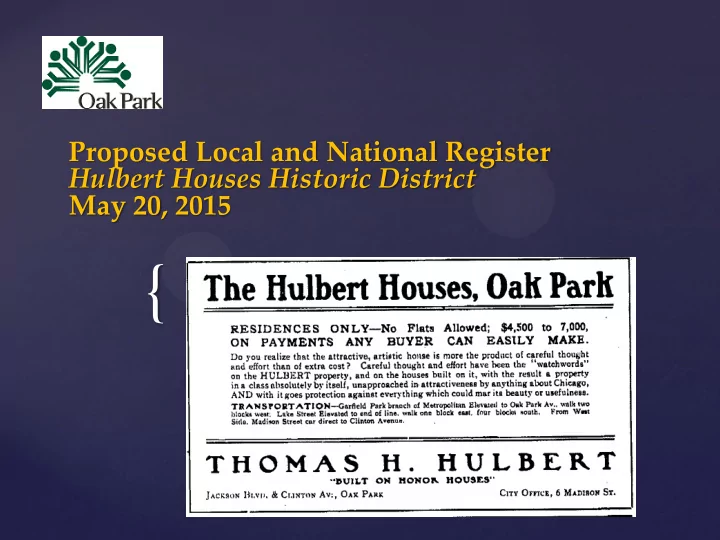
Proposed Local and National Register Hulbert Houses Historic District May 20, 2015 { Hulbert Houses Historic District Why is historic district designation being sought for the neighborhood? Official National and Local recognition
Why is historic district designation being sought for the neighborhood?
Official National and Local recognition
Long-term protection of historic neighborhood character through thoughtful management of alterations and demolition
Historic significance and architectural character of the Hulbert Houses
High level of integrity (97%)
Long-term planning is proactive rather than reactive
Hulbert Houses Historic District
What is the National Register and What Does it Mean for You?
Nation’s official list of historic buildings, districts and sites
Honorary recognition of historic places
No local restrictions on alterations or demolition
Limited protection from Federally funded undertakings
Eligible for the Property Tax Assessment Freeze program
Eligible for a Preservation Easement
Hulbert Houses Historic District
What is Local Designation and What Does it Mean for You?
Oak Park’s official list of Historic Landmarks and Districts
Oak Park Historic Preservation Ordinance
Historic Preservation Commission review of Demolition* through a Certificate of Appropriateness application
Review of Village-funded projects
Does not impact how you use the property, nor does it require you to make improvements to your property.
Eligible for the Property Tax Assessment Freeze program (www.illinois.gov/ihpa/Preserve/Pages/taxfreeze.aspx)
Eligible for the Preservation Easement Program
*Demolition = The razing or destruction, whether entirely or in significant part
- f a building, structure, site or object.
Demolition includes the removal of a building, structure or object from its site or the removal or destruction
- f its façade or surface.
Hulbert Houses Historic District
Why Designate Both National and Local Historic Districts?
A Historic District includes a specific boundary around a special group of properties that are labeled as Contributing or Non-Contributing Resources. There are no restrictions on Non-Contributing properties as they do not contribute to the historic and architectural character of the historic district.
National Recognition brings Honor, Prestige and Pride in property and neighborhood.
Local Recognition allows changes to the long-term historic character of the neighborhood to be thoughtfully managed through the review of demolition* proposed for Contributing Resources by the Historic Preservation Commission or its Staff.
Contributing Properties are eligible for the Property Tax Assessment Freeze Program and the Preservation Easement Program under both National and Local Districts
Hulbert Houses Historic District
What is a Contributing Resource?
A property that represents the historic and architectural characteristics that qualify the area as an historic district, retains a significant amount of historic integrity, and was constructed between 1905-1928. What is a Non-Contributing Resource?
A property that does not represent the historic and architectural characteristics that qualify the area as an historic district, does not retain a significant amount of historic integrity, or was constructed after 1928.
Hulbert Houses Historic District
What is a Certificate of Appropriateness?
A ‘COA’ is a separate application you submit to Commission Staff at no additional fee when demolition* is involved in a project on a Contributing Resource.
All COA applications are reviewed based on the Architectural Review Guidelines.
A COA application may be approved by Commission Staff or by the Historic Preservation Commission at a monthly meeting.
A Building Permit may be issued for a project
- nce the COA has been approved.
Hulbert Houses Historic District
*Demolition = The razing or destruction, whether entirely or in significant part of a Building, structure, site or object. Demolition includes the removal of a building, structure or object from its site or the removal or destruction of its façade or surface.
What is a Certificate of Advisory Review?
Advisory Review is a review process for any project that does not require a COA. Commission Staff generally reviews and signs off on minor projects.
All Advisory Review applications are reviewed based on the Architectural Review Guidelines.
the Historic Preservation Commission may provide recommendations to you on an Advisory Review project if it will have a significant impact on the neighborhood.
You may choose to follow the Historic Preservation Commission’s Advisory comments, or you may proceed with the project as submitted.
Hulbert Houses Historic District
Tell me more about the review process.
Comparison with existing historic districts
Existing Historic District buildings = 4,000 buildings
2014 Total Historic Permits Reviewed = 1,169
Number of Projects Requiring a COA in 2014 = 74
Number of COA’s reviewed by Historic Preservation Commission = 30
Number of COA’s approved by Commission Staff = 44
Number of building permit applications approved by Commission Staff = 1,069
Comparison with the Gunderson Historic District (Second Subdivision)
Number of Buildings = 230 buildings
2014 Total Historic Permits Reviewed = 42
2014 Certificate of Appropriateness reviews = None
2014 Certificate of Advisory reviews = 5 (vinyl siding, vinyl windows, addition)
Staff approvals = 37 (fences, driveways, sidewalks, chimneys, work in rear, garage)
Hulbert Houses Historic District
What are the costs to me for living in a Historic District?
Architecture/Design Plans for larger projects: If your architect or contractor is familiar with the process, or you consult with the Historic Preservation Commission or Staff early in the design phase, you may eliminate future costs for changes to architectural drawings.
Building Materials: You may incur some additional costs if proposing to use some materials, such as vinyl or aluminum, as many of these materials do not meet the Architectural Review
- Guidelines. Upgrading to more traditional materials like stucco, brick, or wood siding may be
more expensive in the short-term, but should last much longer.
Potential delay in permit review process to accommodate Historic Review: By consulting with Commission Staff early in the design phase of any project, and meeting with the Historic Preservation Commission prior to submitting your building permit application, you may eliminate additional delays within the Permit Processing Division.
Hulbert Houses Historic District
Will living in a Historic District Affect my Property Taxes?
There is no basis for connecting property tax assessments with historic district designation. Normal assessment procedures by Cook County will not change. Property taxes are assessed based on numerous factors, such as comparable sales, land, location, square footage and construction type.
Will living in a Historic District Affect my Property Values?
Numerous studies have shown that over time, property values within a historic district either stabilize or may increase. This is partly due to the knowledge that the historic district will not drastically change in the future, and that no major projects will be constructed which will negatively impact the character of the neighborhood. This stability comes from the fact that all properties are reviewed based on the Architectural Review Guidelines.
Hulbert Houses Historic District
Common Terms and Definitions:
CONTRIBUTING RESOURCE: A building constructed between 1905-1928 that has not been significantly altered and therefore contributes to the historic character of the district.
NON-CONTRIBUTING RESOURCE: A building constructed after 1928 or one which has been significantly altered and therefore does not contribute to the historic character of the district.
CERTIFICATE OF APPROPRIATENESS: An application for a project which involves full or partial demolition of a Contributing Resource or is using a local government funding sources.
CERTIFICATE OF ADVISORY REVIEW: An application for a project that does not meet the criteria for a Certificate of Appropriateness.
HISTORIC PRESERVATION ORDINANCE: An ordinance adopted by the Village of Oak Park which
- utlines the roles and duties of the Historic Preservation Commission, designation procedures and
criteria, and work that requires a Certificate of Appropriateness.
ARCHITECTURAL REVEW GUIDELINES: Design review guidelines adopted by the Village of Oak Park which outlines the principles by which the Historic Preservation Commission will review submittals for proposed work within Oak Park Historic Districts or work on Oak Park Landmarks
Hulbert Houses Historic District
Process Moving Forward:
Analyze the results of the two public meetings.
Prepare a “Frequently Asked Questions” flyer.
Prepare a Survey/Poll to mail to property owners to gauge support.
Scenario 1: Hire a consultant to prepare Nomination Report to be used for both National Register and Local historic district designation
Hold a public hearing
Forward to village Board for local approval
Meet with Illinois Historic Sites Advisory Council
Scenario 2: Hire a consultant to prepare Nomination Report to be used for either a Local or National Register historic district designation
Either Village or State process