
SLIDE 1
Huffman Coding
- David A. Huffman (1951)
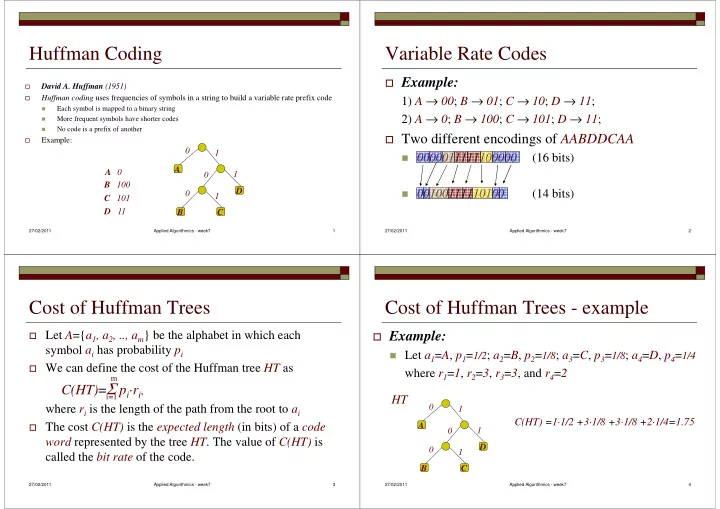
- Huffman coding uses frequencies of symbols in a string to build a variable rate prefix code
- Each symbol is mapped to a binary string
- More frequent symbols have shorter codes
- No code is a prefix of another
27/02/2011 Applied Algorithmics - week7 1
- No code is a prefix of another
- Example:
A 0 B 100 C 101 D 11 D C B A 1 1 1
Variable Rate Codes
Example:
1) A → 00; B → 01; C → 10; D → 11; 2) A → 0; B → 100; C → 101; D → 11;
27/02/2011 Applied Algorithmics - week7 2
Two different encodings of AABDDCAA
0000011111100000
(16 bits)
00100111110100
(14 bits)
Cost of Huffman Trees
Let A={a1, a2, .., am} be the alphabet in which each
symbol ai has probability pi
We can define the cost of the Huffman tree HT as m
27/02/2011 Applied Algorithmics - week7 3
C(HT)=Σ pi·ri,
where ri is the length of the path from the root to ai
The cost C(HT) is the expected length (in bits) of a code
word represented by the tree HT. The value of C(HT) is called the bit rate of the code.
i=1
Cost of Huffman Trees - example
Example:
Let a1=A, p1=1/2; a2=B, p2=1/8; a3=C, p3=1/8; a4=D, p4=1/4
where r1=1, r2=3, r3=3, and r4=2
27/02/2011 Applied Algorithmics - week7 4
D C B A 1 1 1